-
P-87 Zeolite for Uremic Toxin Adsorption - University of Waterloo, 2017
Jun 17, 2026 | ACS MATERIAL LLCLu, L., & Yeow, J. T. (2017). An adsorption study of indoxyl sulfate by zeolites and polyethersulfone–zeolite composite membranes. *Materials & Design*. https://doi.org/10.1016/j.matdes.2017.01.094
Materials & Design · 2017
University of Waterloo researchers used ACS Material P-87 zeolite in PES composite membranes to adsorb the protein-bound uremic toxin indoxyl sulfate.
About this research
Researchers at the University of Waterloo, led by Limin Lu and John T.W. Yeow in the Department of Systems Design Engineering, used P-87 zeolite purchased from ACS Material to construct polyethersulfone (PES)–zeolite composite membranes that adsorbed 550 μg of indoxyl sulfate per gram of membrane. The study, published in Materials & Design, screened ten zeolite types, identified P-87 as one of two effective adsorbents for this protein-bound uremic toxin, and demonstrated a simple spin-coating route to integrate the zeolite into a flat-sheet membrane suitable for future dialysis applications. The work also clarifies the underlying adsorption mechanism using zeta-potential measurements together with pH- and salt-dependent uptake tests.
Protein-bound uremic toxins such as indoxyl sulfate and p-cresyl sulfate are central drivers of cardiovascular complications in chronic kidney disease (CKD). Because they bind tightly to serum albumin, conventional hemodialysis clears only about 30% of these toxins, compared with roughly 60% of urea and creatinine. In dialysis patients, indoxyl sulfate concentrations can reach 54 times those of healthy individuals and have been linked to vascular calcification and elevated cardiovascular mortality. Improving the removal of these toxins is therefore a priority for membrane and sorbent developers. Incorporating selective adsorbents directly into dialysis membranes is an attractive strategy because it can combine size-based filtration with chemically specific capture in a single device. This paper contributes to that strategy by identifying a zeolite with sufficient affinity for indoxyl sulfate to be useful in a composite membrane.
The P-87 zeolite, purchased from ACS Material, was first evaluated as a free powder. From a panel of ten zeolites, P-87 emerged as one of two candidates with measurable indoxyl sulfate uptake from a 3.5 mg dL⁻¹ solution. Particle size distribution and zeta-potential of the powder were characterized by dynamic light scattering on a Malvern Zetasizer Nano ZS. To make composite membranes, an 18 wt% PES solution in dimethylacetamide was prepared, and 0.48 g of P-87 was dispersed in 8 g of this solution to give a 50 wt% zeolite loading after solvent removal. The dispersion was spin-coated onto a 1.5 × 1.5 inch glass slide at 400 rpm for 60 s and immediately immersed in water for liquid–liquid phase inversion, producing a porous PES–P87 membrane. Pure PES membranes prepared by the same procedure served as controls. Membrane morphology was examined by Zeiss scanning electron microscopy, and the actual zeolite content was confirmed by thermogravimetric analysis so that adsorption could be normalized to the mass of P-87 incorporated.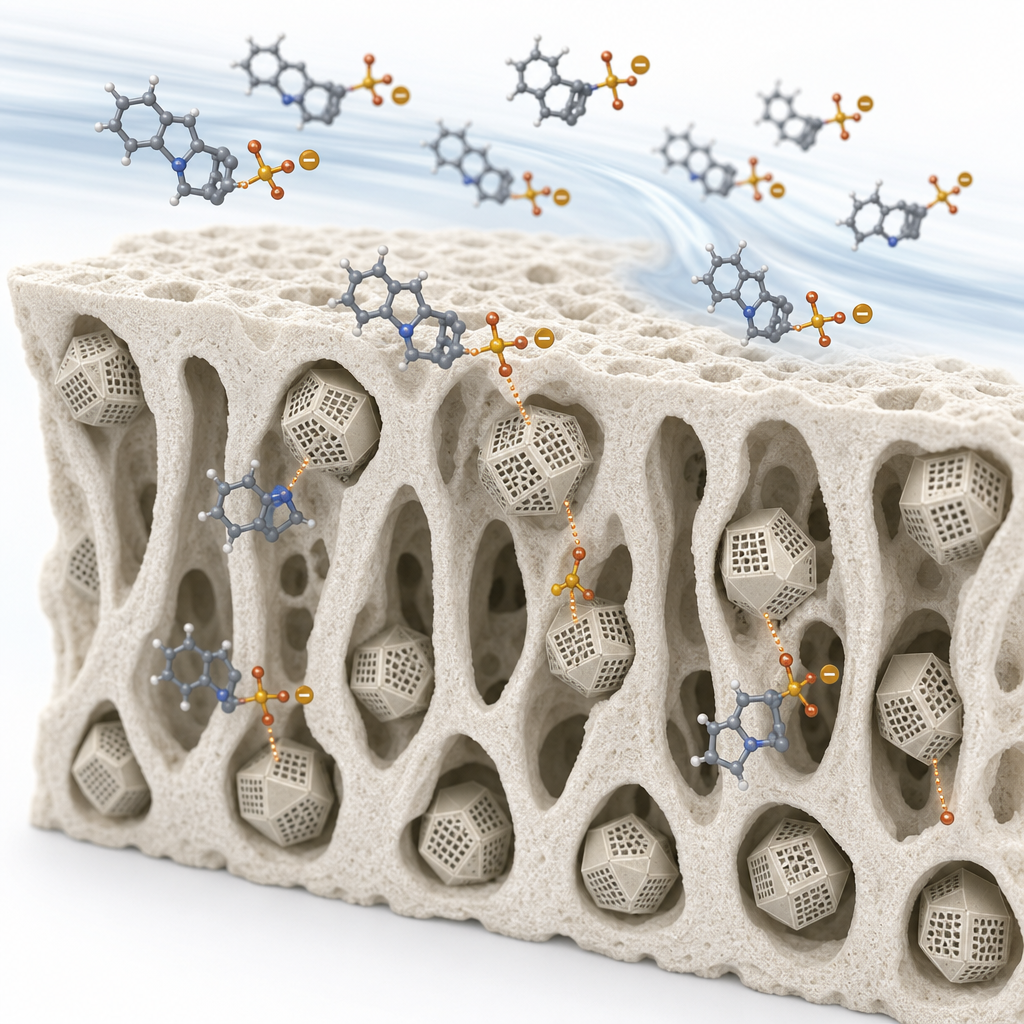
Adsorption was quantified by fluorescence (excitation 278 nm, emission 399 nm) after stirring known masses of dry membrane in indoxyl sulfate solution at 37 °C for 0.5, 1, and 3 h. The PES–P87 composite membranes reached an adsorption level of approximately 550 μg of indoxyl sulfate per gram of membrane, while pristine PES membranes showed negligible uptake, confirming that P-87 is responsible for the capture. The corresponding mass of P-87 powder, calculated from TGA, gave a comparable per-gram-zeolite adsorption capacity, indicating that embedding the zeolite in PES did not significantly block its active sites. To probe the mechanism, the authors varied the medium with NaCl, KCl, CaCl₂, and PBS buffers across pH 4–10. Adsorption decreased markedly in the presence of salts and at higher ionic strength, and desorption experiments showed that pre-adsorbed indoxyl sulfate could be released by changing pH and salt concentration. Combined with the measured zeta-potential of P-87, these results point to electrostatic attraction between the negatively charged indoxyl sulfate anion and oppositely charged surface sites on the zeolite as the dominant interaction. Hydrophobic and pore-filling contributions are likely secondary.
The practical implication is a route toward improved dialysis membranes that can capture protein-bound toxins in addition to filtering small water-soluble metabolites. Because the spin-coating process is simple and the zeolite loading is high (50 wt%), the approach is compatible with existing membrane manufacturing workflows. Beyond hemodialysis, P-87-loaded PES membranes could be relevant to wearable artificial kidney concepts, hemoperfusion cartridges, and laboratory-scale separations of charged organic molecules from biological fluids. Follow-up work indicated by the paper includes optimizing zeolite loading versus membrane permeability, evaluating blood compatibility, and extending the adsorbent screening to other protein-bound uremic toxins such as p-cresyl sulfate.
For researchers working on adsorptive membranes, biomedical separations, or zeolite-based water and blood purification, this study illustrates how a single commercial zeolite can be screened from a panel and translated into a working composite membrane. The P-87 zeolite used here is available as part of the ACS Material molecular sieves catalog, alongside a broad range of zeolites, MOFs, and COFs suitable for similar adsorption studies. The reported 550 μg g⁻¹ uptake is modest in absolute terms but reproducible, and the paper's electrostatic-mechanism analysis provides a useful starting point for designing higher-capacity, charge-tuned adsorbents in future work.How ACS Material products were used
- P-87 Zeolite (Molecular Sieves) — “P-87 was purchased from ACS Materials, LLC.”
Product Performance in this StudyP-87 zeolite was the key adsorbent screened from ten candidates and incorporated into polyethersulfone membranes at 50 wt%, enabling the composite to adsorb 550 μg of indoxyl sulfate per gram of membrane, primarily through electrostatic attraction.
Related product categories
Frequently asked questionsHow much indoxyl sulfate can P-87 zeolite–PES composite membranes adsorb?
The polyethersulfone membranes loaded with 50 wt% P-87 zeolite adsorbed approximately 550 μg of indoxyl sulfate per gram of membrane from a 3.5 mg dL⁻¹ solution stirred at 37 °C. Pristine PES membranes prepared by the same spin-coating and phase-inversion procedure showed negligible uptake, confirming that the zeolite component is responsible for indoxyl sulfate capture in the composite.
What is the mechanism by which P-87 zeolite adsorbs indoxyl sulfate?
The dominant mechanism is electrostatic attraction. Increasing ionic strength with NaCl, KCl, or CaCl₂ reduced adsorption, and pre-adsorbed indoxyl sulfate could be desorbed by changing pH and salt conditions. Combined with zeta-potential measurements on the P-87 powder, these results indicate that the negatively charged indoxyl sulfate anion binds to oppositely charged surface sites on the zeolite rather than through purely hydrophobic interactions.
Why are protein-bound uremic toxins like indoxyl sulfate difficult to remove by dialysis?
Indoxyl sulfate binds tightly to serum albumin, so conventional hemodialysis clears only about 30% of protein-bound toxins compared with roughly 60% of urea and creatinine. Their retention is linked to cardiovascular disease progression in chronic kidney disease patients, motivating composite membranes that combine filtration with adsorption to capture these toxins through chemically specific interactions rather than size exclusion alone.