-
Pellet HZSM-5 Zeolite for Bio-oil Upgrading - Oklahoma State University, 2019
Jun 02, 2026 | ACS MATERIAL LLCTshikesho, R. S. et al. (2019). Catalytic Co-Pyrolysis of Red Cedar with Methane to Produce Upgraded Bio-oil. *Bioresource Technology*. https://doi.org/10.1016/j.biortech.2019.03.138
Bioresource Technology · 2019
Oklahoma State researchers use ACS Material pellet ZSM-5 zeolite for catalytic co-pyrolysis of red cedar with methane, yielding 53.4% upgraded bio-oil.
About this research
Researchers at Oklahoma State University used pellet HZSM-5 zeolite purchased from ACS Material LLC as the deoxygenation and aromatization catalyst for the catalytic co-pyrolysis of eastern red cedar biomass with methane, achieving a top bio-oil yield of 53.4 wt% with an energy content of 10.2 MJ/kg at 650 °C. The work, published in Bioresource Technology (2019) by Tshikesho, Kumar, Huhnke, and Apblett, demonstrates that pairing acid zeolites with methane and a bimetallic Mo/Zn modification offers a lower-cost alternative to conventional hydrodeoxygenation for upgrading lignocellulosic pyrolysis vapors into transportation-grade fuels and chemical precursors.
Fast pyrolysis is one of the most direct routes to convert woody biomass into a liquid intermediate that can be refined into transportation fuels, but raw bio-oil is plagued by high oxygen content, high water content, corrosive acidity, high viscosity, and poor thermal stability. These problems stem from the dense population of oxygenated species (acids, aldehydes, ketones, phenols, guaiacols, furans, polyols) generated when cellulose, hemicellulose, and lignin thermally decompose. Conventional hydrodeoxygenation requires expensive high-pressure hydrogen and precious-metal catalysts. The authors explore whether methane, an abundant and underutilized feedstock in the U.S., can serve as a hydrogen donor in situ when activated by a suitable bifunctional catalyst. Eastern red cedar, an invasive species in Oklahoma rangelands, provides a problem-solving feedstock that doubles as a sustainability win.
The pellet HZSM-5 catalyst from ACS Material LLC (Medford, MA, USA) was the workhorse acid zeolite in the bench-scale fixed-bed pyrolysis reactor. As specified in the Methods section, the pellet zeolite has a SiO2/Al2O3 molar ratio of 38, a specific surface area of 250 m²/g, a diameter of 2 mm, and a length of 2 to 10 mm. Before use it was calcined in air at 500 °C for 6 h to convert the ammonium-form zeolite into the protonated H-form. The pelletized geometry was specifically chosen because powder could not be reliably retained on the metal-mesh bed of the 2.54 cm × 90 cm stainless-steel tube reactor, while pellets enabled steady gas flow through the catalyst layer at the 1:1 catalyst-to-biomass mass ratio used. A portion of the pellet HZSM-5 was further wet-impregnated with molybdenum and zinc to give MoZn/HZSM-5, providing dehydrogenation and methane-activation sites alongside the strong Brønsted acidity of the parent zeolite.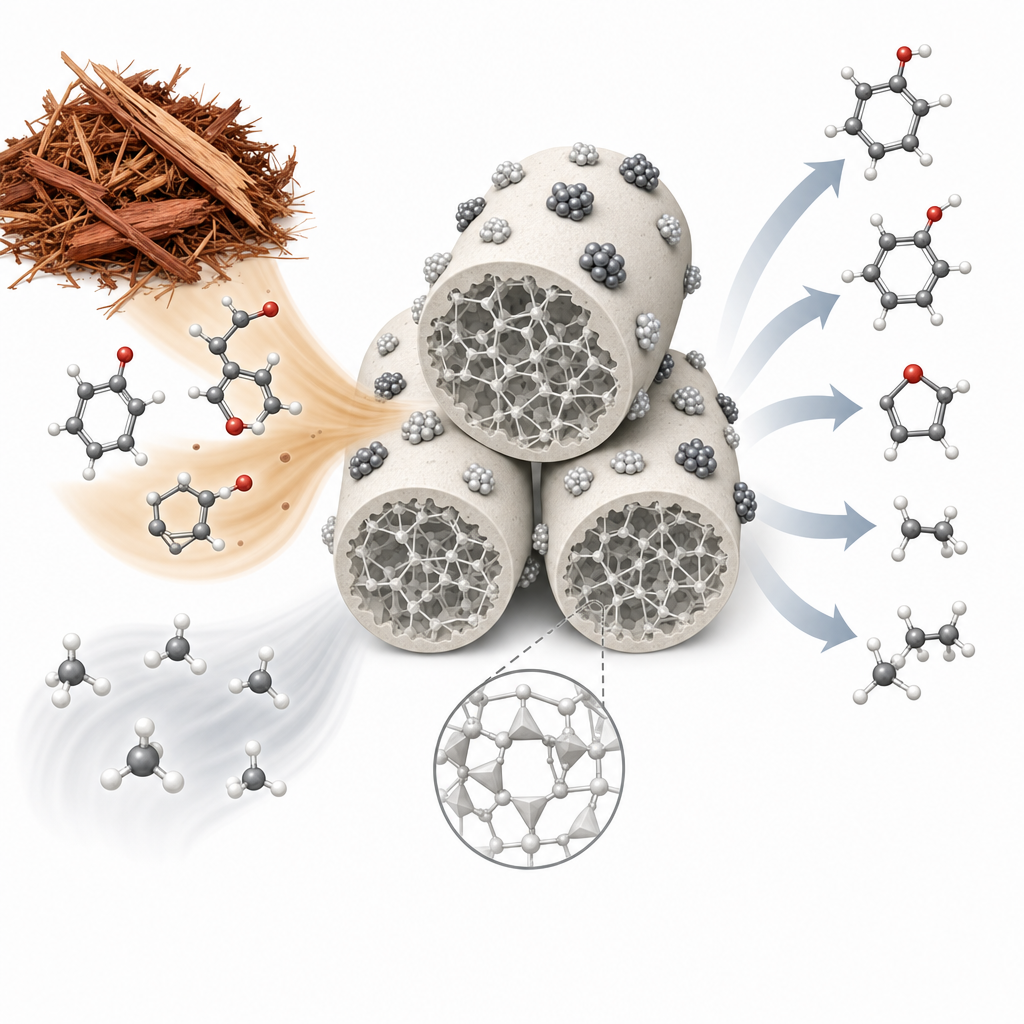 The pyrolysis runs spanned a 2 × 3 × 2 factorial of temperature (650 °C and 750 °C), catalyst (none, HZSM-5, MoZn/HZSM-5), and atmosphere (methane or inert). The highest bio-oil yield, 53.4 wt%, came from MoZn/HZSM-5 under methane at 650 °C, paired with the highest energy content of 10.2 MJ/kg and an energy yield of 29.9% of the feedstock's heating value. By contrast, the lowest bio-oil yield, 38.7 wt%, occurred over HZSM-5 alone under methane at 750 °C, where excessive cracking shifted product mass into non-condensable gases. GC/MS of the condensed liquids consistently identified acids, alcohols, aldehydes, BTEX, benzene derivatives, furans, ketones, PAHs, and phenols, with phenols dominating most product slates. Crucially, oxygenated compounds decreased markedly when MoZn/HZSM-5 was operated under methane at 750 °C, evidence that the bimetallic sites activate methane and route hydrogen into deoxygenation, decarbonylation, hydrogen transfer, and aromatization pathways. Companion Py-GC/MS micro-reactor runs at a 1:10 biomass-to-catalyst ratio confirmed the same compositional trends.
The immediate beneficiaries are biorefining and waste-to-fuels research programs that need cost-effective bio-oil upgrading without dedicated hydrogen plants. Methane co-feeding is attractive for sites with available natural gas, including refineries co-located with biomass supply chains. The approach is particularly relevant in the U.S. Southern Plains where eastern red cedar encroachment threatens grasslands, turning a problematic biomass into a feedstock for renewable BTEX aromatics and phenolic chemicals. The combination of a Mo/Zn-modified ZSM-5 with methane could also be adapted to agricultural residues, forestry waste, and torrefied biomass, and the authors note that further tuning of Mo and Zn loading and reactor residence time should improve selectivity toward gasoline-range aromatics.
For researchers working on catalytic biomass conversion, the pellet ZSM-5 catalyst from ACS Material's molecular sieve product line is available in formats suitable for both fixed-bed and microreactor studies. Its consistent SiO2/Al2O3 ratio and pellet dimensions make it a reproducible platform for benchmarking deoxygenation, methanol-to-hydrocarbons, and biomass pyrolysis chemistries, and for hosting transition-metal promoters of interest in upgrading complex oxygenate streams.How ACS Material products were used
- ZSM-5 Catalyst (pellet form) (Molecular Sieves) — “pellet ZSM-5 was purchased from ACS Material LLC (Medford, MA, USA). The pellet ZSM-5 zeolite has a SiO2/Al2O3 molar ratio of 38 and a specific surface area of 250 m2/g... The pellet ZSM-5 had a diameter of 2 mm and length of between 2 and 10 mm.”
Product Performance in this StudyThe pellet HZSM-5 from ACS Material served as the fixed-bed catalyst (and as the support for MoZn/HZSM-5) for catalytic co-pyrolysis. It enabled the deoxygenation, cracking, and aromatization reactions that delivered a peak bio-oil yield of 53.4 wt% with energy content of 10.2 MJ/kg at 650 °C under methane.
Related product categories
Frequently asked questionsWhy use pellet ZSM-5 instead of powder ZSM-5 in a fixed-bed pyrolysis reactor?
Pellet ZSM-5 is preferred in fixed-bed pyrolysis because the 2 mm-diameter pellets can be retained on a metal-mesh catalyst bed while still allowing steady gas flow at a 1:1 catalyst-to-biomass ratio. Powder ZSM-5 would either escape the bed or generate excessive pressure drop. In the Oklahoma State University study, pellet HZSM-5 from ACS Material with a SiO2/Al2O3 ratio of 38 and 250 m²/g surface area enabled reproducible bench-scale runs.
How does methane co-feeding improve bio-oil quality during catalytic pyrolysis?
Methane co-feeding, when combined with a bifunctional catalyst such as MoZn/HZSM-5, supplies in-situ hydrogen and carbon species that participate in deoxygenation, decarbonylation, hydrogen transfer, and aromatization. The net result is lower oxygenate content, higher energy density, and a larger fraction of aromatic hydrocarbons. The Oklahoma State team reported 53.4 wt% bio-oil yield at 650 °C and reduced oxygenates at 750 °C using MoZn/HZSM-5 under methane.
What makes HZSM-5 effective for converting biomass pyrolysis vapors into aromatics?
HZSM-5 combines small pore size with both weak and strong Brønsted acid sites. The narrow channels favor diffusion of smaller intermediates, steering chemistry toward light aromatic hydrocarbons, while the acid sites catalyze cracking, dehydration, and aromatization of oxygenated pyrolysis vapors. This molecular shape-selective behavior is why HZSM-5 outperforms many other zeolites for biomass-to-aromatics conversion and was central to the upgraded bio-oil yields reported in this work.