-
Phase Analysis of Commercial Graphene Nanoplatelets - West Virginia University, 2015
Jun 04, 2026 | ACS MATERIAL LLCSeehra, M. S. et al. (2015). Detection and quantification of 2H and 3R phases in commercial graphene-based materials. *Carbon*. https://doi.org/10.1016/j.carbon.2015.08.109
Carbon · 2015
West Virginia University researchers used XRD to quantify 2H and 3R graphite phases in ACS Material graphene nanoplatelets, finding a 70/30 ratio and ~87 layers.
About this research
Researchers at West Virginia University, in collaboration with the National Institute for Occupational Safety and Health (NIOSH), used X-ray diffraction (XRD) to characterize graphene nanoplatelets (thickness 2–10 nm) and graphene oxide samples obtained from ACS Material, alongside materials from other commercial suppliers, and demonstrated that the ACS Material nanoplatelets contain both the conventional 2H (ABAB Bernal) and the rhombohedral 3R (ABCA) graphite stacking phases in a 70/30 ratio. The work, published in Carbon (2015), establishes an XRD-based deconvolution method to quantify the relative concentrations of 2H and 3R phases in multilayer graphene-based materials – a quantification not previously reported – and provides a clearer picture of what commercial "graphene" products actually are.
The broader context concerns the rapid commercialization of graphene-based materials (GBMs) for electrical, optical, thermal, mechanical, and biomedical applications. Buyers often receive products labeled "graphene nanoplates," "graphene nanopowder," or "carboxyl graphene" with limited information about layer count, stacking order, or phase composition. These structural details matter: the 3R phase has been reported as a semiconductor with a tunable band gap (~6 meV in trilayer ABC stacks), whereas pure 2H multilayers remain semimetallic with no gap. The 3R phase is also less thermally stable, transforming to 2H above ~1000 °C, and recent literature links 3R stacking to surface superconductivity and proximity-induced ferromagnetism. Reliable phase identification therefore has direct consequences for device applications and for emerging toxicology studies of graphene-family nanomaterials.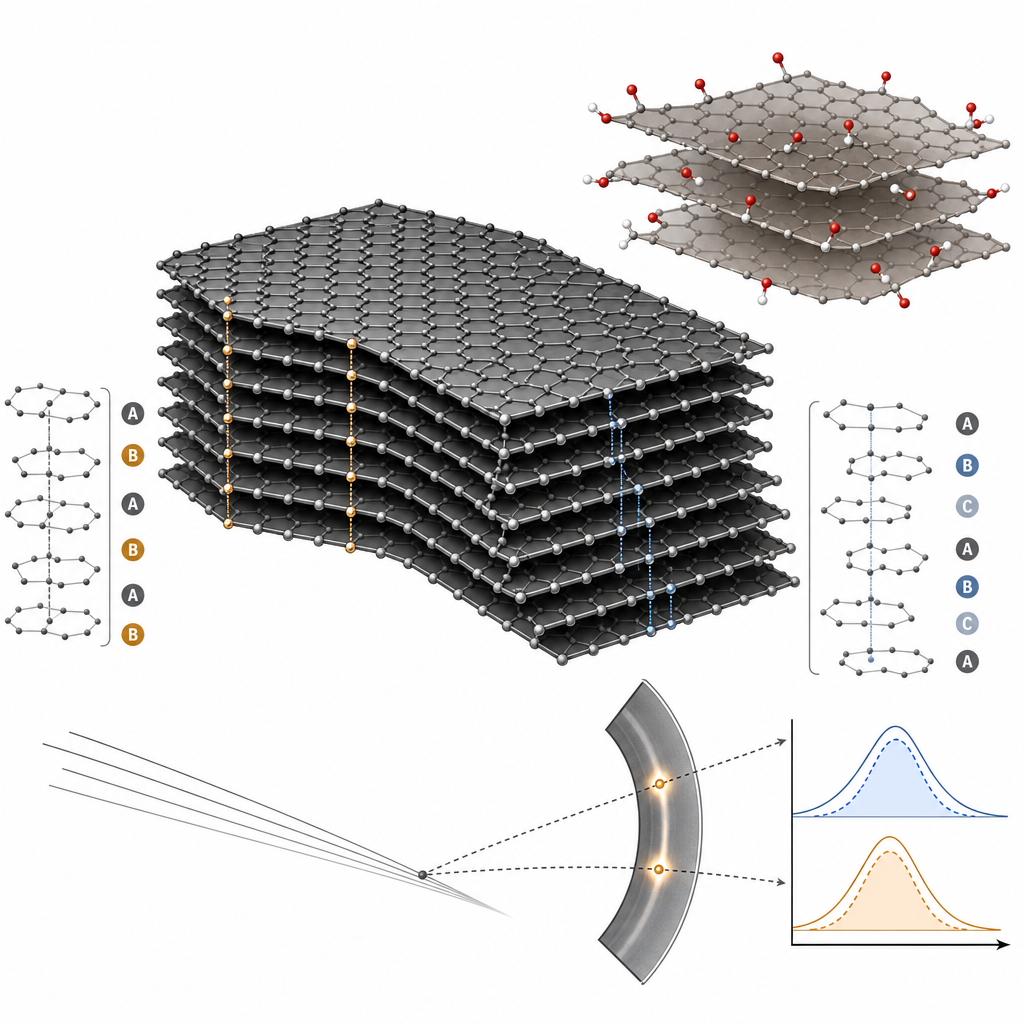
The ACS Material product appeared in the study as a sample under structural investigation. The graphene nanoplatelets (2–10 nm thickness, made by exfoliation of graphene oxide followed by reductive removal of oxygen, as disclosed by the supplier) were measured on a Rigaku D-Max diffractometer using Cu-Kα radiation (λ = 0.154185 nm). The authors indexed peaks against ICDD-PDF #041-1487 (2H) and #026-1079 (3R), and deconvoluted the (101) reflections near 2θ = 44.5° (2H) and 2θ = 43.5° (3R) using Gaussian line-shape fits in Magic Plot 2.5.1 and OriginPro 8 SR3. Apparent crystallite sizes Lc and La were derived from the Scherrer relation applied to the (002) and (101) line widths, and the number of layers Nc was calculated from Lc/d(002) with d(002) = 0.338 nm. A separate ACS Material graphene oxide sample provided the GO reference XRD pattern, showing a characteristic peak with d-spacing greater than 0.8 nm consistent with intercalated hydroxyl and epoxy functional groups. SEM (Hitachi S-4800) and TEM (JEOL JEM-1220) imaging of three representative samples corroborated the layered, sheet-like morphology.
For the ACS Material graphene nanoplatelets, the analysis returned a 2H/3R ratio of 70/30, an Lc of 29.3 nm corresponding to approximately 87 stacked graphene layers, and an in-plane lateral order La of 17 nm (2H) and 26 nm (3R), corresponding to roughly 69 and 103 unit cells along the a-axis, respectively. Across the seven multilayer samples examined, 2H/3R ratios spanned 70/30 to 58/42, with a population average near 60/40. Because the 2H structure repeats every two graphene layers and the 3R structure repeats every three, a 60/40 intensity ratio implies essentially equal numbers of carbon atoms in each stacking phase. Layer counts ranged from 65 to 109 and plate thicknesses from 22 nm to 37 nm – several times larger than the 2–10 nm thickness listed by suppliers. Eight other samples (including ACS Material's graphene oxide) belonged to a GO category with d-spacing greater than 0.8 nm, and three were structurally disordered like reduced GO. SEM and TEM confirmed plate-like morphologies with many stacked layers and curling at the edges.
These findings have practical implications for researchers using commercial GBMs in electronics, energy storage, composites, and biological studies. The presence of a substantial 3R fraction is important for groups pursuing band-gap engineering, ABC-trilayer device physics, or proximity-induced magnetic and superconducting phenomena. The authors also note that based on the IUPAC-like nomenclature proposed in Carbon, materials with dozens of stacked layers are more accurately classified as "graphite nanoplates" or "nanosheets" than as "graphene," a distinction that affects how surface area, rigidity, and biological interactions should be modeled. The toxicology angle, funded under NIOSH and the U.S. National Toxicology Program, is particularly relevant for occupational-exposure studies.
For researchers sourcing graphene-family materials, the study underlines the value of independently verifying phase composition and layer count of as-received powders. ACS Material's graphene nanoplatelets and graphene oxide product lines, available in a range of thicknesses and functionalizations, are commonly used in this kind of structural and applied work; the ACS Material graphene catalog spans nanoplatelets, single-layer graphene, GO, rGO, and functionalized variants suited to electrode, composite, and device research.How ACS Material products were used
- Graphene Nanoplatelets (2-10nm) (Graphene Series) — “The sample of the graphene nanoplates (2–10 nm) from ACS materials was made by exfoliation of GO followed by reduction to remove oxygen.”
- Graphene Oxide (ACS Material) (Graphene Series) — “X-ray diffraction patterns of sample of graphene oxide (GO) obtained from ACS Materials LLC”
Product Performance in this StudyThe ACS Material graphene nanoplatelets sample exhibited XRD features of multilayered graphite containing both 2H (ABA) and 3R (ABCA) phases at a 70/30 ratio, with a c-axis crystallite size of 29.3 nm corresponding to roughly 87 stacked graphene layers.
Related product categories
Frequently asked questionsHow can XRD distinguish 2H and 3R phases in commercial graphene nanoplatelets?
The (002) peak near 2θ ≈ 26° cannot resolve 2H (002) from 3R (003), but the (101) peaks of the two phases appear at distinct angles, near 2θ = 44.5° for 2H and 2θ = 43.5° for 3R. Deconvoluting these peaks with Gaussian line shapes and taking the ratio of integrated areas yields the relative phase fractions; for the ACS Material graphene nanoplatelets a 70/30 2H/3R ratio was obtained.
Why does the 3R stacking phase matter for graphene applications?
The 3R (ABCA, rhombohedral) phase behaves as a semiconductor with a tunable band gap, while 2H (ABAB) multilayer graphene remains semimetallic with no gap. A tunable gap is essential for transistors, photodetectors, and optoelectronic devices. The 3R phase has also been linked to surface superconductivity and proximity-induced ferromagnetism, making its quantification important for device-grade graphene material specifications.
How many graphene layers are typical in commercial graphene nanoplatelets?
XRD-derived Scherrer analysis showed that seven commercial multilayer samples, including ACS Material graphene nanoplatelets, contained between 65 and 109 stacked graphene layers, corresponding to plate thicknesses of 22 to 37 nm. These values are several times the 2–10 nm thicknesses listed in supplier datasheets, so independent characterization is recommended for applications sensitive to layer count and rigidity.