-
Porous Carbon for ALD V2O5 Pseudocapacitors - NC State, 2017
Jun 04, 2026 | ACS MATERIAL LLCDaubert, J. S. et al. (2017). Intrinsic limitations of atomic layer deposition for pseudocapacitive metal oxides in porous electrochemical capacitor electrodes. *Journal of Materials Chemistry A*. https://doi.org/10.1039/c7ta02719b
Department of Chemical and Biomolecular Engineering · Journal of Materials Chemistry A · 2017
North Carolina State University used ACS Material Porous Carbon to define ALD V2O5 coating limits in micro-, meso- and macroporous electrochemical capacitor electrodes.
About this research
Researchers led by Gregory N. Parsons at North Carolina State University used ACS Material Porous Carbon as the microporous activated-carbon substrate ("micro-AC") to define the intrinsic limitations of atomic layer deposition (ALD) for depositing pseudocapacitive V2O5 inside porous electrochemical capacitor electrodes, identifying a critical pore-sealing diameter of 13 Å. By comparing four carbon powders with distinct micro-, meso-, and macroporous structures, the team correlated experimental V2O5 mass uptake with an ALD coating model. The study clarifies why fine micropores cannot be coated and how that limit caps the achievable gravimetric capacity of carbon-based pseudocapacitor electrodes.
Electrochemical capacitors are attractive for storing energy from intermittent clean sources because they offer high power density and long cycle life, but their energy density lags behind batteries. A common strategy to boost charge storage is to add pseudocapacitive metal oxides, such as V2O5, that undergo fast, reversible Faradaic reactions while retaining capacitor-like behavior. ALD is uniquely suited to coat high-surface-area porous carbon with conformal, thickness-controlled oxide films without line-of-sight requirements. However, the nanoscale and disordered pore network of activated carbon raises a fundamental question that this work addresses: how small a pore can ALD precursors actually penetrate? Understanding this limit is essential for designing electrodes that maximize accessible pseudocapacitive material without sealing off the very pores that provide surface area, a long-standing challenge in energy-storage materials engineering.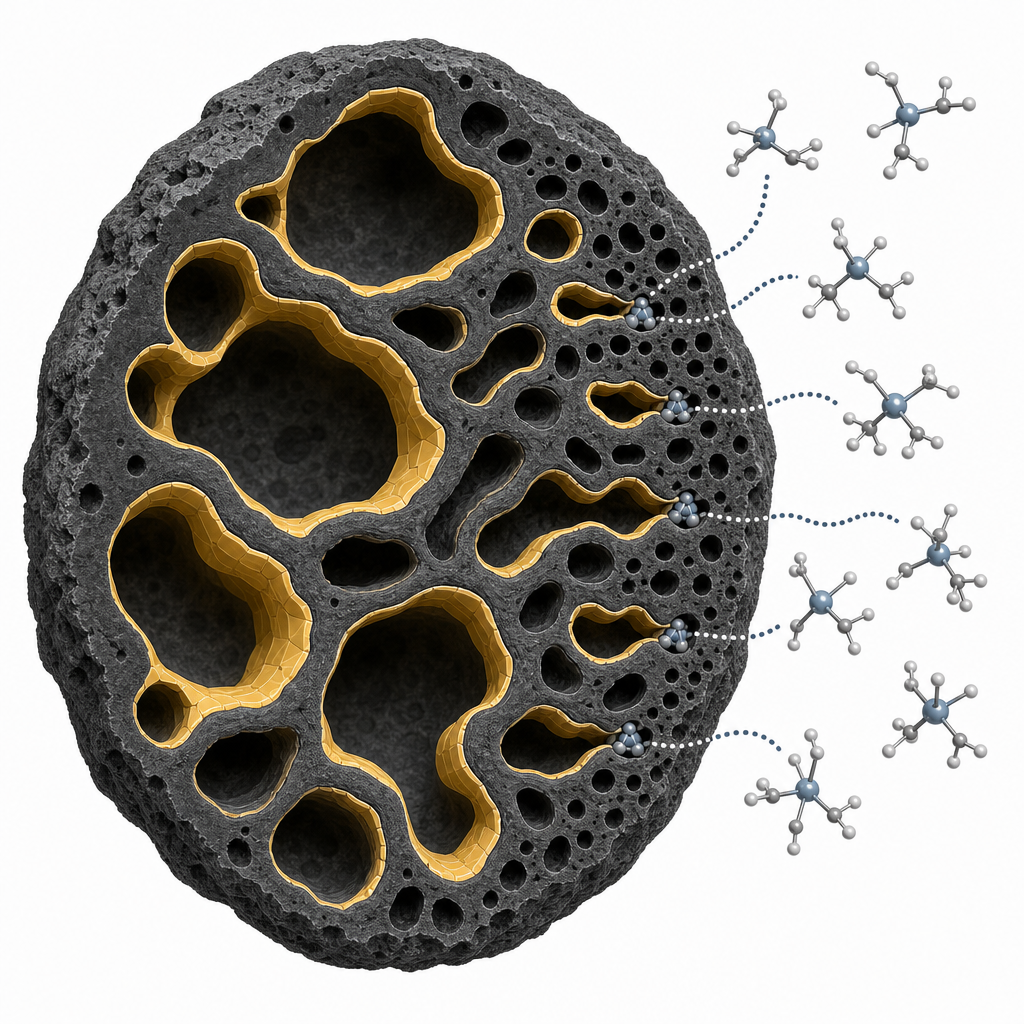
The ACS Material Porous Carbon functioned as the micro-AC electrode material, one of four carbon powders whose pore structures were characterized by nitrogen adsorption (Quantachrome Autosorb-1C) and BJH desorption analysis. Carbon powders were mixed with 5 wt.% acetylene black and 10 wt.% PVDF binder in NMP, cast onto stainless steel current collectors with a doctor blade (~200 µm thick), and dried under vacuum. The electrodes were then coated with V2O5 in a custom viscous flow-tube ALD reactor using vanadium triisopropoxide (VTIP) and water at 150 °C, with a cycle timing of 32(60)/100/0.2(60)/100 s and ultrahigh-purity nitrogen carrier gas. Film thickness was tracked on silicon monitor wafers by spectroscopic ellipsometry. Electrodes were annealed in air between 200 and 300 °C, and the V2O5 was characterized by XPS, XRD, and Raman spectroscopy, confirming a 5+ vanadium oxidation state and an amorphous-to-orthorhombic transition after annealing. The microporous ACS Material carbon provided the critical test case for pore sealing because its pores cluster near the molecular dimensions of the VTIP precursor.
The key quantitative findings centered on the 13 Å critical pore diameter, determined by least-squares fitting of pore structure, deposited V2O5 thickness, and experimental volume gain across all four carbons. This value is close to the ~9.6 Å estimated molecular diameter of the VTIP precursor. Pore sealing reduced the accessible pore volume of the macro-AC from 0.94 to 0.42 cm3/g, more than halving it. Electrochemically, thin V2O5 layers boosted capacity substantially: macro-AC reached 406 C/g at 2 mV/s with a 150 Å coating, a 144% increase over the bare carbon, while macro-CB carbon black reached 546 C/g with a 170 Å coating, a more than 40-fold increase from its low starting capacity. The microporous and mesoporous carbons performed worse, achieving only 30-35% of the maximum capacity predicted for 13 Å sealing, whereas macro-AC and macro-CB reached 62% and 83-84%, respectively. Thicker V2O5 introduced Li+ diffusion limitations, shifting behavior from rectangular pseudocapacitive voltammograms toward battery-like redox peaks (α→ε→δ→γ-V2O5 phase transitions). Capacity retention from 1 to 200 mV/s dropped to ~10% for thickly coated macro electrodes, versus 60-70% for uncoated carbon, underscoring the trade-off between added capacity and rate performance.
This research guides the rational design of ALD-modified pseudocapacitor electrodes for energy storage, helping engineers select carbon supports with the right pore-size distribution to balance gravimetric capacity, areal capacity, and high-rate performance. The findings extend beyond V2O5 to other ALD pseudocapacitive oxides such as RuO2, Fe2O3, NiO, TiO2, and Co3O4, and more broadly inform any application requiring conformal coating of microporous solids, including catalysis supports, membranes, and battery electrodes. The work suggests that macroporous carbons may be preferable when uniform, accessible oxide coatings are desired, and that precursor molecular size sets a hard floor on coatable pore dimensions.
For researchers tackling similar problems, the porous activated carbon used here is representative of the Porous Carbon offered within ACS Material's Carbon Series, available to groups studying ALD coating limits, pseudocapacitor electrodes, and microporous adsorbents. The study demonstrates the value of well-characterized porous carbon as a model substrate for probing precursor diffusion and pore-sealing behavior. As the authors show, matching pore structure to precursor dimensions is decisive for energy-storage performance, making reproducible, characterized carbon supplies an important starting point for reliable experimental comparisons.How ACS Material products were used
- Porous Carbon (micro-AC activated carbon) (Carbon Series) — “the "micro-AC" (AC refers to activated carbon) is Porous Carbon that was purchased from ACS Material.”
Product Performance in this Study
The ACS Material Porous Carbon served as the microporous activated carbon substrate (micro-AC) for ALD V2O5 coating. Its predominantly sub-13 Å micropores were shown to seal during ALD, limiting accessible pore volume and demonstrating the intrinsic deposition limits investigated in the study.
Related product categories
Frequently asked questions
What is the critical pore diameter for ALD V2O5 coating in porous carbon?
The study determined a critical pore-sealing diameter of 13 Å across all four carbon powders, fitted from pore structure, deposited V2O5 thickness, and experimental volume gain. Pores below this diameter become sealed and cannot be coated. The value is close to the estimated 9.6 Å molecular diameter of the vanadium triisopropoxide (VTIP) ALD precursor, indicating precursor size sets the coating limit.
How much does ALD V2O5 improve capacitance in macroporous carbon electrodes?
Macroporous activated carbon (macro-AC) reached 406 C/g at 2 mV/s with a 150 Å V2O5 coating, a 144% increase over the bare carbon. Macroporous carbon black (macro-CB), which starts with very low surface area, increased more than 40-fold to 546 C/g at 2 mV/s with a 170 Å coating. Microporous and mesoporous carbons showed much smaller gains.
Why does thick ALD V2O5 reduce pseudocapacitor rate performance?
Thick V2O5 layers introduce Li+ diffusion limitations, shifting charge storage from capacitive (rectangular voltammograms) toward battery-like behavior with sharp redox peaks. Thickly coated macro electrodes retained only about 10% of their capacity when scan rate increased from 1 to 200 mV/s, versus 60-70% for uncoated carbon, lowering power density. Thin coatings preserve better capacitive performance.