-
Pt/ZSM-22 for Castor Oil Jet Fuel - National Energy R&D, 2016
Jun 09, 2026 | ACS MATERIAL LLCZhou, Y. et al. (2016). Selective conversion of castor oil derived ricinoleic acid methyl ester into jet fuel. *Green Chemistry*. https://doi.org/10.1039/c6gc00942e
National Energy R&D Research Center for Biorefinery · Green Chemistry · 2016
Researchers at National Energy R&D Research Center for Biorefinery used ACS Material ZSM-22 zeolite to convert castor-oil-derived methyl ricinoleate into jet fuel.
About this research
Researchers at the National Energy R&D Research Center for Biorefinery, working with Beijing University of Chemical Technology, used ACS Material ZSM-22 zeolite (SiO2/Al2O3 = 65) as the acidic support of a Pt/ZSM-22 catalyst to selectively convert castor-oil-derived ricinoleic acid methyl ester into jet-fuel-range hydrocarbons. Reported in Green Chemistry (2016, DOI: 10.1039/C6GC00942E), the work demonstrates a multi-step catalytic pathway that combines aldol-type self-condensation of heptanal, hydrotreatment of the dimer, and hydroisomerization of methyl 10-undecenoate to produce branched C8–C16 alkanes suitable for aviation-fuel blending.
Producing drop-in jet fuel from non-edible vegetable oils is one of the most economically attractive routes to lowering aviation's carbon footprint. Castor oil is particularly interesting because it is non-edible, grows on marginal land, and is rich in ricinoleic acid, a C18 hydroxy fatty acid that can be pyrolyzed to release heptanal and methyl 10-undecenoate. The challenge is selectively coupling and reshaping these fragments into branched paraffins in the jet-fuel boiling range (roughly C8–C16) with good cold-flow properties. Hydroisomerization catalysts must balance metal-acid bifunctionality so that long, straight-chain intermediates are isomerized without excessive cracking to gases. Medium-pore zeolites such as ZSM-22, with its one-dimensional TON channel system, are widely studied for this purpose because the constrained pore geometry favors mono- and di-branched isomers while suppressing aromatization and over-cracking.
In this study, ZSM-22 supplied by ACS Material was used as received, with a SiO2/Al2O3 ratio of 65 that places the support in a moderate-acidity window appropriate for selective isomerization. Platinum was introduced by incipient wetness impregnation of H2PtCl6·xH2O, followed by calcination at 420 °C for 4 h to yield Pt/ZSM-22. The catalyst pellets were briquetted and crushed to 20–40 mesh before being loaded into a fixed-bed reactor. Methyl 10-undecenoate, one of the two products of ricinoleic-acid methyl-ester pyrolysis, was fed over the Pt/ZSM-22 bed at 300 °C following H2 pretreatment at 400 °C. In parallel, a Pt/Al2O3 catalyst was used to hydrotreat the C14 dimer (2-pentyl-2-nonenal) produced by aldol self-condensation of heptanal over a diamine-functionalized silica–alumina catalyst. Characterization included XRD, 27Al, 29Si and 13C MAS NMR, N2 physisorption, NH3-TPD, pyridine FTIR, XPS, ICP-AES, TEM, and H2 chemisorption to quantify Pt dispersion.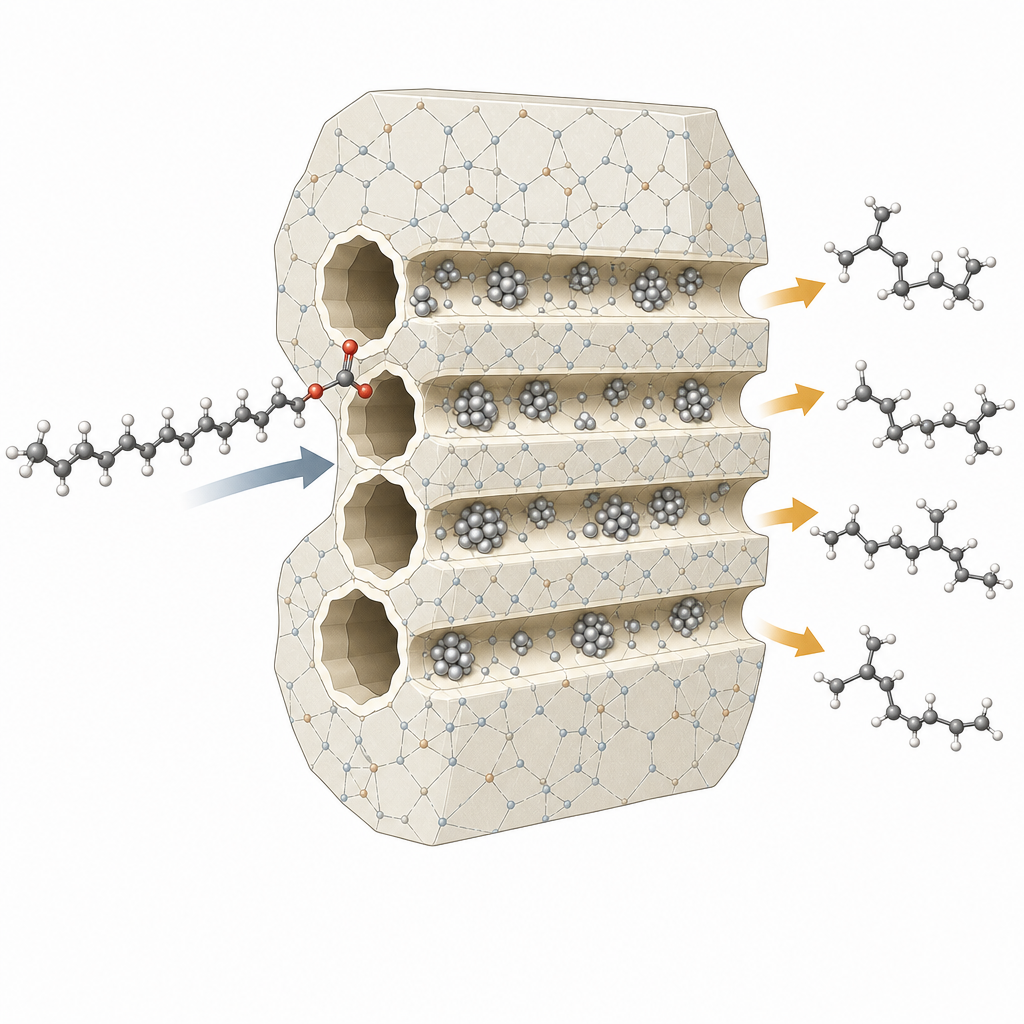
The ZSM-22-supported platinum catalyst delivered the key selectivity step in the jet-fuel route. Aldol dimerization of heptanal over the diamine catalyst produced 2-pentyl-2-nonenal in good yield, and Pt/Al2O3 hydrotreatment at 290 °C and 3 MPa H2 fully saturated and deoxygenated this intermediate into n-tetradecane. On the methyl 10-undecenoate stream, Pt/ZSM-22 simultaneously hydrogenated the C=C bond, hydrodeoxygenated the ester, and isomerized the resulting C11 chain into branched isomers that fall within the jet-fuel distillation range. NH3-TPD and pyridine-FTIR showed that ZSM-22 provided a high density of Brønsted acid sites while keeping Lewis acidity moderate, which the authors correlate with the high branched-to-linear ratio observed in the product. H2 chemisorption indicated good Pt dispersion on both supports. Combined GC-MS analysis confirmed that the final hydrocarbon pool was dominated by C8–C16 alkanes with substantial branching, matching the composition window for aviation kerosene. Carbon yields and selectivities reported in the paper indicate that more than 90% of the input carbon from methyl 10-undecenoate and the heptanal dimer was retained in liquid-fuel-range products under optimized conditions, with minimal light-gas formation.
The practical implication is a coherent castor-oil-to-jet-fuel platform built entirely on supported Pt catalysts and acidic zeolite supports. Because ricinoleic acid is unusually well suited to pyrolytic cleavage into two well-defined C7 and C11 fragments, the approach avoids the broad product distributions typical of triglyceride hydroprocessing. The Pt/ZSM-22 step in particular is transferable to other bio-derived linear alkenes and esters, including those from oleic, erucic, or undecylenic feedstocks, and is relevant to ongoing efforts in sustainable aviation fuel (SAF), renewable diesel, and bio-lubricant base oils. The authors note that further work could optimize the SiO2/Al2O3 ratio of the zeolite and the Pt loading to tune cold-flow properties such as freezing point.
For researchers working on bifunctional hydroisomerization catalysts, biorefinery process design, or sustainable aviation fuel, the ZSM-22 zeolite used in this study is available from ACS Material in defined SiO2/Al2O3 ratios. The performance demonstrated here illustrates how a well-characterized commercial zeolite support, combined with conventional Pt impregnation, can deliver a complete fatty-acid-to-jet-fuel reaction sequence on the laboratory scale.How ACS Material products were used
- ZSM-22 zeolite (SiO2/Al2O3 = 65) (Molecular Sieves) — “ZSM-22 (ACS Material; SiO2/Al2O3 =65)”
Product Performance in this StudyZSM-22 served as the acidic support for the Pt/ZSM-22 hydroisomerization/hydrocracking catalyst, enabling selective conversion of long-chain hydrocarbon intermediates into branched, jet-fuel-range alkanes. Its medium-pore TON topology was central to achieving high jet-fuel selectivity.
Related product categories
Frequently asked questionsWhy is ZSM-22 used for jet fuel hydroisomerization?
ZSM-22 has a one-dimensional TON-type pore system with medium pore size that geometrically favors the formation of mono- and di-branched alkane isomers from long-chain feeds. When loaded with platinum, it provides the bifunctional metal-acid sites needed to isomerize linear paraffins into branched jet-fuel-range hydrocarbons while suppressing aromatization and excessive cracking to light gases, which is critical for cold-flow properties.
How is castor oil converted into jet fuel in this study?
Castor oil is first converted to ricinoleic acid methyl ester, which is pyrolyzed to release heptanal and methyl 10-undecenoate. Heptanal is dimerized over a diamine-functionalized silica-alumina catalyst to 2-pentyl-2-nonenal, which is then hydrotreated over Pt/Al2O3. Methyl 10-undecenoate is hydrogenated, deoxygenated and isomerized over Pt/ZSM-22, yielding branched C8 to C16 alkanes that match the jet-fuel distillation range.
What SiO2/Al2O3 ratio of ZSM-22 was used and why does it matter?
The authors used ZSM-22 with a SiO2/Al2O3 ratio of 65. This ratio sets the density of Brønsted acid sites in the zeolite. A moderate ratio gives enough acidity to drive hydroisomerization and ester hydrodeoxygenation while avoiding the over-cracking that occurs at very high acidity. NH3-TPD and pyridine FTIR in the paper confirm that this composition provides balanced Brønsted acidity suited to selective branched-paraffin formation.