
The cuvette is the one optical part of a UV-Vis measurement that you choose, fill and clean yourself. The wrong material absorbs light before the sample does, the wrong path length pushes the reading out of its reliable range, and a careless blank carries its error into every result. This guide covers quartz vs glass cuvette choice (and where plastic fits), how to choose a path length, how to blank a spectrophotometer with the same or matched cells, and how to keep cells clean. It ends with the cells and holders supplied with ALab™ spectrophotometers.
Quick answer: Use quartz or fused-silica cuvettes for UV work. Glass absorbs strongly below about 320 nm, and some sources put its usable limit at 334–350 nm, so it is a visible-range cell [1][2]. Fused quartz is reasonably transparent down to about 210 nm and high-purity fused synthetic silica to about 190 nm [1]. "Plastic" is not one material: published lower limits for acrylic (PMMA) and polystyrene range from about 300 to 340 nm, so check the data for your cells [1][2][5]. The standard path length is 10 mm [1][4]. For a conventional single-beam method, measure the blank and sample in the same cell; for a two-cuvette double-beam method, first balance with solvent in both cells and keep each cell in the same orientation [1]. Some double-beam layouts handle the reference differently, so follow the instrument manual [2].
1. Why the Cell Is Part of the Measurement
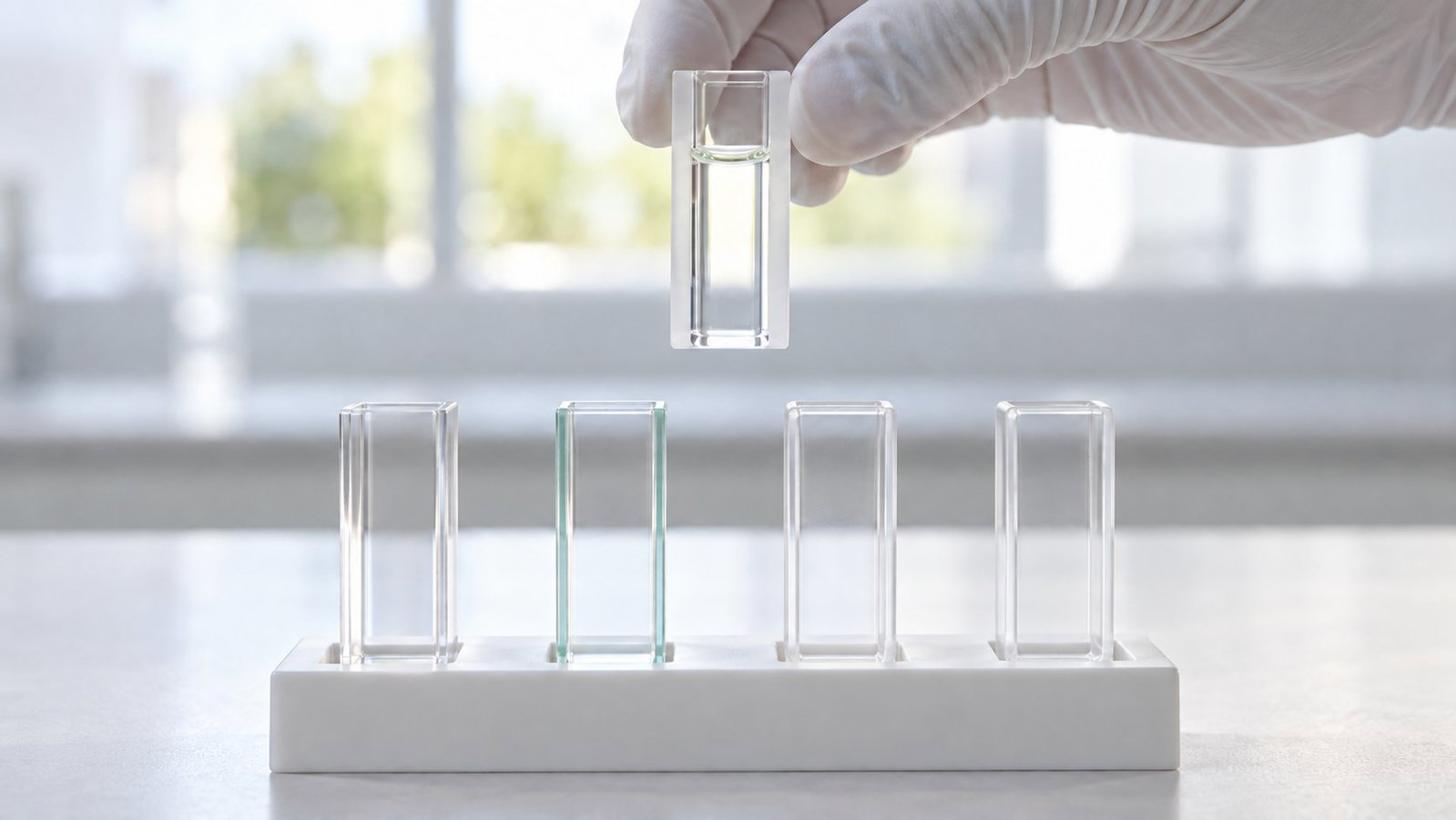
Once a cuvette sits in the beam, it becomes an optical component. Ideally it would be completely transparent at every wavelength, because anything the cell absorbs comes out of the range left for the sample. Owen's primer gives a simple example: if the upper limit of the instrument's linear range is 2.5 AU and the cell itself absorbs 1 AU, only 1.5 AU remain for the sample [1]. Owen also notes that all cell materials show at least about a 10 % loss in transmission at all wavelengths [1].
This is why the blank matters. In absorbance work, the reference intensity P₀ is redefined as the light that passes through the blank. Doing so corrects for light lost to scattering, reflection, absorption by the container and absorption by the sample matrix [3]. The blank does not give back the range the cell takes away, however: in Owen's example, the cell's 1 AU comes straight out of the usable range [1]. The cell has to be transparent where you measure.
2. Quartz vs Glass Cuvette (and Where Plastic Fits)
Glass. Glass cells cost a little more than plastic, are durable and, with proper care, last for years [1]. Owen states that glass absorbs strongly below 320 nm and is not suitable for measurements in that region [1]. Agilent's current primer tabulates optical glass as suitable from 334 to 2500 nm and says optical glass can be used when measurements below 350 nm are not required [2]. The sources differ by a few tens of nanometres, so treat glass as a visible-range material and do not rely on it in the near UV without data for your own cells.
Quartz and fused silica. Owen distinguishes two grades: fused quartz cells are reasonably transparent down to about 210 nm, and the best cells, made of high-purity fused synthetic silica, down to about 190 nm [1]. An open analytical chemistry textbook states that a quartz or fused-silica cell is required below 300 nm, where other materials absorb significantly [4]. Agilent describes quartz as the material for the widest wavelength range [2]. "Quartz" on a label does not tell you which grade you have; the lower limit belongs to the specific cell and its maker's data.
Plastic. Owen notes that the cheapest cells are usually acrylic, absorb strongly below 300 nm, are not resistant to all solvents, and can vary from cell to cell in absorbance and path length [1]. Agilent names the two common disposable polymers: polystyrene, which it limits to 340–800 nm, and PMMA, which it says can be used down to 300 nm; neither is suitable at elevated temperatures [2]. A university teaching laboratory lists both polystyrene and PMMA cells in its stock as 300–900 nm, and separately lists UV-transmitting plastic cuvettes with a 230–1000 nm range [5]. Plastic types therefore differ, and so do published figures for the same polymer. There is no single "plastic cut-off".
Table 1. Approximate lower wavelength limits of cuvette materials, from the cited sources
| Material | Lower limit | Source |
|---|---|---|
| Glass | Absorbs strongly below 320 nm | Owen [1] |
| Optical glass | 334–2500 nm suitable; not needed below 350 nm | Agilent [2] |
| Acrylic (PMMA) | Absorbs strongly below 300 nm / usable down to 300 nm | Owen [1]; Agilent [2] |
| PMMA | 300–900 nm (teaching-lab stock) | York [5] |
| Polystyrene | 340–800 nm | Agilent [2] |
| Polystyrene | 300–900 nm (teaching-lab stock) | York [5] |
| UV-transmitting plastic | 230–1000 nm (teaching-lab stock) | York [5] |
| Fused quartz | Reasonably transparent to about 210 nm | Owen [1] |
| High-purity fused synthetic silica | Reasonably transparent to about 190 nm | Owen [1] |
| Quartz or fused silica | Required below 300 nm | Harvey [4] |
Approximate values from each source; they are not measured data, and they vary with manufacturer and grade. Check the transmission data for your own cells.
Chemical resistance follows the same pattern. The teaching-lab data rate both polystyrene and PMMA as poor with acetone, acetonitrile, ethanol, methanol and chloroform, while quartz can be used with almost all solvents [5]. Agilent warns that polystyrene cells can be damaged by some samples or solvents, scratch easily and are designed for single use [2]. For the solvents listed by York, quartz is the most broadly compatible of the materials in its table [5], and plastic compatibility should be checked before use [2][5]; for strongly basic solutions, see the cleaning section below.
3. The Most Common Mistake: Glass in the UV
Much routine UV work sits below glass's limit. Nucleic acids have their absorbance maximum at 260 nm, Agilent's tables place tryptophan and its protein examples at 278–279 nm, and every simple chromophore it lists has its absorbance maximum below 300 nm [2]. At these wavelengths a glass cell itself absorbs strongly [1], and, as Section 1 showed, whatever the cell absorbs is lost from the range left for the sample [1]. The fix is simple: use a quartz or fused-silica cell for anything below about 300–320 nm [1][4].
A UV-capable instrument does not change this. The SP-UV3101 has a specified wavelength range of 190–1100 nm, but a measurement can only use the part of that range where the cell, the solvent and the sample are all transparent enough. The instrument range and the cell's range are separate limits; the narrower one wins.
The ALab™ instruments illustrate the split. The SP-UV2102 and SP-UV3101 (and the SP-UV3102, SP-XUV5101 and SP-XUV5102) come with four 10 mm glass cuvettes and two 10 mm quartz cuvettes as standard accessories, along with a power cord, user's manual and PC software. Treat the supplied glass cells as visible-region cells; for UV work, use a quartz or fused-silica cell whose specified transmission range covers your wavelength. The material grade, transmission range and matching tolerance of the supplied quartz cells are not specified, so do not assume that the included quartz cells cover the instrument's full UV range. Package contents reflect the current configuration, and the itemized bill of materials is confirmed on the quotation.
For A260/A280 work specifically, see our guide to DNA and protein quantification. A260/A280 DNA and protein quantification
4. The Solvent Has a Cut-Off Too
Changing to quartz does not help if the solvent absorbs first. Except for water, the common solvents in Owen's table all have a UV cut-off below which they absorb too strongly for measurement [1]. Owen defines the cut-off as the wavelength at which a 10 mm path of the solvent transmits less than 25 % [1].
Table 2. Solvent cut-off wavelengths (transmittance < 25 % at 10 mm path), from Owen [1]
| Solvent | Cut-off wavelength (nm) |
|---|---|
| Distilled water | < 195 |
| Hexane | 199 |
| Ethanol (absolute) | 207 |
| Methanol | 210 |
| Cyclohexane | 211 |
| Chloroform | 246 |
| Dimethylsulfoxide | 270 |
| Acetone | 331 |
Source: Owen [1], Table 4. Check your solvent's own specification.
Two practical points follow. Acetone cuts off at 331 nm, so in acetone a quartz cell gains nothing below about 330 nm [1]. And volatile solvents such as acetone or methylene chloride should be measured in a stoppered or capped cell, because evaporation can change the concentration quickly [1][2]. Buffers and other matrix components add their own absorbance; the blank should contain all of them, as described in Section 6.
5. Cuvette Path Length
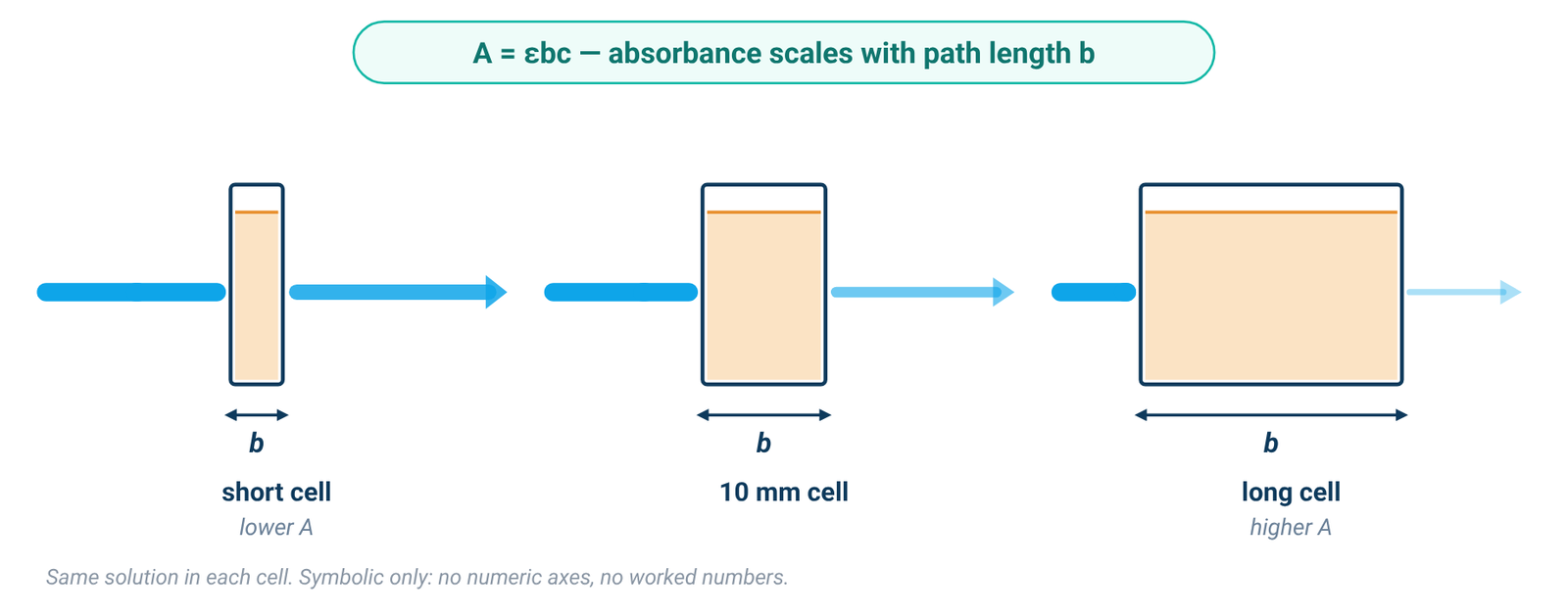
Beer–Lambert's law, A = εbc, makes absorbance proportional to the path length b, usually expressed in centimetres [1][2]. (The maths is covered in our Beer–Lambert article. Beer–Lambert law) Path length is therefore a method choice, not a fixed property of the instrument.
The standard. The open-topped rectangular cell is the most widely used; it is made in path lengths from 1 to 100 mm, but 10 mm is by far the most popular, and almost all rectangular cells have an external width of 12.5 mm [1]. The textbook gives the same picture: 1 cm is most common, with cells from 0.1 cm up to 10 cm available [4].
Shorter or longer. Agilent's primer suggests a short path (5 mm or less), or dilution, for samples above about 3 absorbance units, and a long path (up to 100 mm) for dilute samples below about 0.2 absorbance units [2]. Longer cells also suit very dilute solutions and gases [4]. A short cell can also help with a solvent that absorbs strongly [2].
Tolerances. Because absorbance depends on path length, its precision matters for absolute measurements. Owen gives ±0.01 mm as the path-length tolerance for good-quality cells from 0.5 to 100 mm, and recommends using the same cell for standards and samples for the best quantitative accuracy [1]. A test tube used as a cell adds error from its variable path length and optical properties [4].
Small volumes. Apertured cells and microcells reduce the sample volume (Owen cites about 60 µL for a typical microcell and down to 5 µL for ultramicrocells) but block part of the beam, reduce throughput and can lower sensitivity [1]. The parts of the cell that hold no sample must be masked, otherwise light passes through the walls [1][2]. Agilent adds that the window must line up with the instrument's beam height (the "z-height") [2]. A small-volume cell is only useful if its geometry suits your instrument's sample compartment.
What comes with ALab™ models. The single-beam models (SP-UV1000, SP-UV1100 and SP-UV2102) come with a manual four-position 1 cm holder as standard, and the double-beam models (SP-UV3101, SP-UV3102, SP-XUV5101 and SP-XUV5102) with a single-position 1 cm holder. These are holder descriptions, not path-length specifications. Holders for longer cells are also available as accessories: four-position holders for 10–50 mm and 100 mm cells for the SP-1000/1100 series, and a four-position holder for 1–5 cm cells for the SP-UV2102. A longer-path single-position holder is also listed for the SP-UV3101, but its description (a 5 cm holder for 1–10 cm cells) is internally inconsistent, so confirm the supported path lengths at quotation. A listed holder does not mean that every cell material, wall thickness or external size fits it; confirm the combination at quotation.
6. How to Blank a Spectrophotometer
A blank sets the 100 %T (zero absorbance) reference. In the classic description, the instrument is first set to 0 %T with the light blocked by a shutter, then to 100 %T with an appropriate blank in the beam; the blank is then replaced by the sample [4]. Owen notes that modern instruments store the reference reading automatically [1].
What goes in the blank. For solutions, the blank is a cuvette of the pure solvent used to prepare the sample, which removes the solvent's absorbance from the result [1][2]. More generally, the blank corrects for the container and the sample matrix as well as scatter and reflection [3], so it should contain everything in the sample except the analyte: the same buffer, at the same composition.
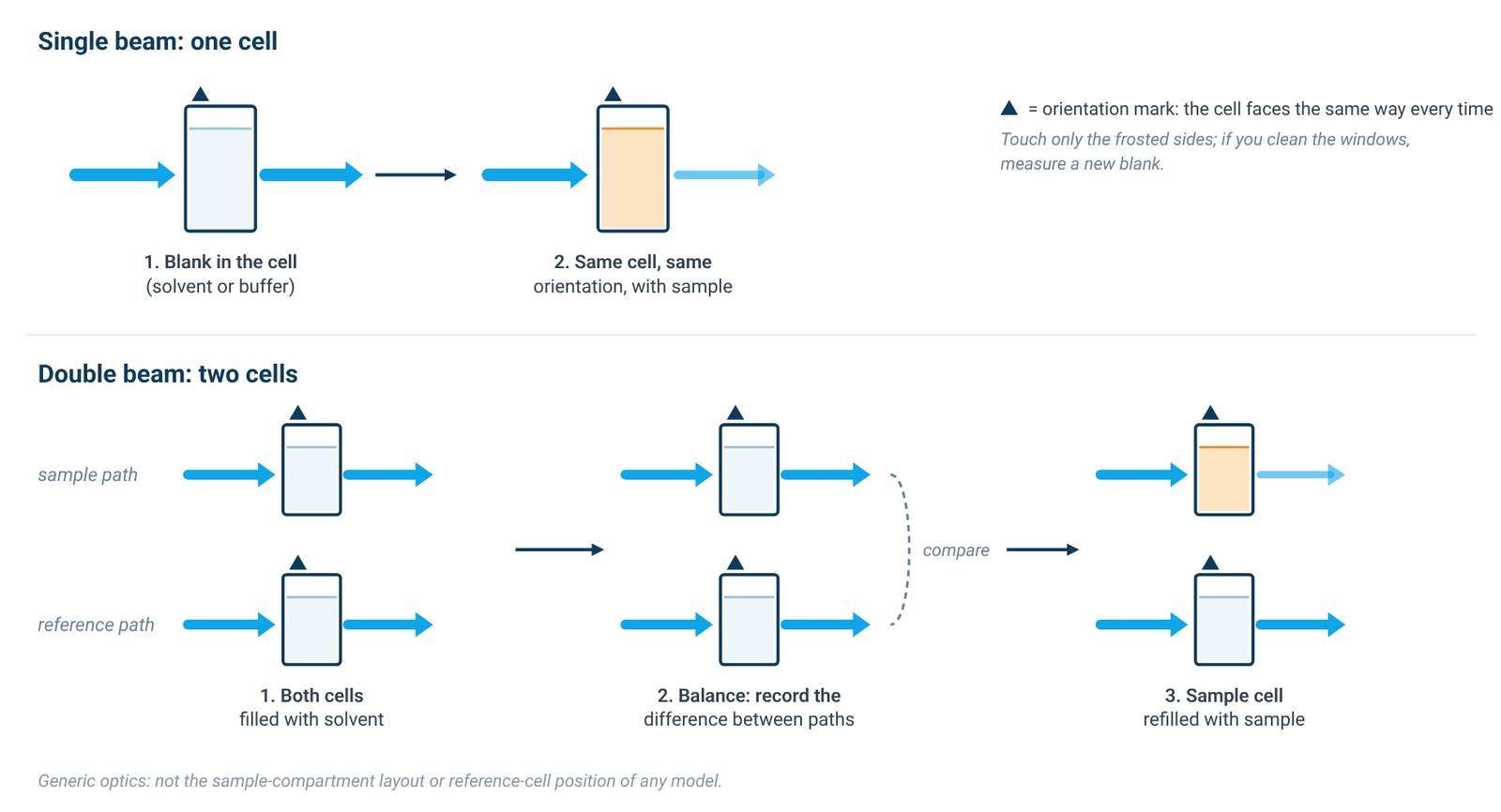
Single beam: same cell. With a single-beam instrument, measure the blank in a cuvette, then measure the sample in the same cuvette [1]. Because blank and sample are read at different times, Agilent recommends repeating the blank frequently and regularly during a session [2].
Double beam: a matched pair. With a double-beam (or split-beam) instrument, Owen describes two cuvettes, both first filled with pure solvent, for a so-called balance measurement of the difference between the two optical paths. The sample cuvette is then refilled with the sample, and the balance spectrum is subtracted from the result [1]. Because two cells are in use, cells are often sold as matched pairs, which the textbook notes is important for double-beam work [4]. Agilent explains that a matched pair gives a similar reading when empty or filled with water, within a tolerance the maker specifies (for example, within 1.5 % of each other at 200 nm), and that match codes are most meaningful for new cells, since wear and contamination change transmission over time [2]. Agilent also notes that better manufacturing has virtually eliminated the need for transmission matching in regular high-grade quartz cells [2]. Some newer designs use a reference detector and measure the blank in the sample position instead [2]; follow your instrument's manual.
Orientation and cleanliness. A cell should always face the same direction in the holder so that its optical effects are identical for blank and sample [1]. Once the blank is measured, avoid wiping or cleaning the windows; if you have to clean them, measure a new blank [2].
For how single- and double-beam designs differ, see our comparison article. Single-beam vs double-beam spectrophotometers
7. Cuvette Cleaning and Handling
- Touch only the frosted sides. Oil from fingerprints absorbs significantly, especially in the UV [1][2].
- Wipe gently. Owen recommends photographic tissue for mild contamination [1]; Agilent recommends a clean, soft cloth free of detergents or lubricants and warns that some lens tissues contain both [2]. Either way, avoid scratching the windows [1][2].
- Clean seriously contaminated cells with a mild detergent or the cell maker's cleaning fluid; Owen notes hydrochloric or nitric acid for severe cases [1].
- Avoid ultrasonic baths for glass or quartz cells, hydrofluoric acid at any concentration, and strong bases (pH 9.0 and above), which degrade the window surfaces [2].
- Empty and rinse promptly. Proteins and strong dyes can stick to the inner walls; rinse with your solvent between samples and clean cells thoroughly at the end of the day [2].
- Store cells dry in a suitable container, or wet in a mildly acidic solution (1 % nitric or hydrochloric acid), one cuvette per beaker, rinsing well before reuse [2].
- Watch for bubbles and condensation. Air bubbles (for example from stirring too fast) and condensation on cold cells both cause erroneous readings [2].
- Cap volatile samples to limit evaporation [1][2].
8. Choosing the Right Cell
Table 3. Choosing a cuvette by measurement condition
| If your measurement… | Choose… | Source |
|---|---|---|
| Goes below about 300–320 nm | Quartz or fused silica; check the cell's lower limit | [1][4] |
| Stays in the visible, in water | Glass, or a plastic whose specified range covers your wavelengths | [1][2][5] |
| Uses organic solvents | Quartz (or glass for visible-only work); check plastic compatibility before use | [1][2][5] |
| Is a quantitative calibration | The same cell for standards and samples, or a matched pair; same orientation | [1][4] |
| Has a strong absorber (above about 3 A) | Dilute, or use a shorter path | [2] |
| Is a dilute sample (below about 0.2 A) | A longer path cell (with a holder that accepts it) | [2][4] |
| Has a small sample volume | A masked apertured or micro cell at the right beam height | [1][2] |
| Uses a volatile solvent | A stoppered or capped cell | [1][2] |
9. ALab™ Instruments and the Cells They List
The table below gives, for the UV-capable models, the beam design, wavelength range, standard holder and the supplied cuvettes.
Table 4. Beam, wavelength range, standard holder and listed cuvettes
| Model | Beam | Wavelength range | Light source | Standard holder | Supplied cuvettes |
|---|---|---|---|---|---|
| SP-UV1000 | Single Beam | 200–1000nm | Tungsten + deuterium lamps | Manual 4-position 1cm holder (standard for single beam) | — (glass/quartz cuvettes listed as accessories) |
| SP-UV1100 | Single Beam | 190–1100nm | Tungsten + deuterium lamps | Manual 4-position 1cm holder (standard for single beam) | — (glass/quartz cuvettes listed as accessories) |
| SP-UV2102 | Single Beam | 190–1100 nm | Tungsten + deuterium lamps | Manual 4-position 1cm holder (standard for single beam) | 10mm glass cuvette × 4; 10mm quartz cuvette × 2 |
| SP-UV3101 | Double Beam | 190–1100 nm | Tungsten + deuterium lamps | Single hole 1cm holder (standard for double beam) | 10mm glass cuvette × 4; 10mm quartz cuvette × 2 |
| SP-UV3102 | Double Beam | 190–1100 nm | Tungsten + deuterium lamps | Single hole 1cm holder (standard for double beam) | 10mm glass cuvette × 4; 10mm quartz cuvette × 2 |
| SP-XUV5101 | Double Beam | 190–1100 nm | Xenon lamp | Single hole 1cm holder (standard for double beam) | 10mm glass cuvette × 4; 10mm quartz cuvette × 2 |
| SP-XUV5102 | Double Beam | 190–1100 nm | Xenon lamp | Single hole 1cm holder (standard for double beam) | 10mm glass cuvette × 4; 10mm quartz cuvette × 2 |
Source: ACS Material product specifications (October 2026). SP-UV1000 and SP-UV1100 values are for the SP-1000/1100 series. A dash means the specification is not listed. Material grade, transmission range, matching tolerance and path length of the cuvettes are not specified; the 1 cm and 10 mm figures are product descriptions. Package contents reflect the current configuration and are confirmed on the quotation.
Glass and quartz cuvettes are listed as accessories for the SP-1000/1100 series, but package contents are not specified, so it is unclear which cells, if any, are included with the SP-UV1000 or SP-UV1100. On all models, a UV wavelength range is only usable with a UV-transparent cell and solvent (Sections 2–4). For the SP-UV1000 (200–1000nm) and SP-UV1100 (190–1100nm), plan on quartz cells for UV work. The SP-UV2102 is a single-beam touch-screen model and the SP-UV3101 a double-beam touch-screen model; both use tungsten and deuterium lamps, and both cover 190–1100 nm. The SP-XUV5101 and SP-XUV5102 use a xenon lamp. No blanking procedure or reference-cell arrangement is described for these models, so follow the method in Section 6 and the instrument manual.
Explore the models: SP-1000/1100 series (SP-UV1000, SP-UV1100) · SP-UV3101 · SP-UV2102. For a wider comparison of the range, see our buying guide. How to choose a UV-Vis spectrophotometer
10. Cuvette Checklist
- Your shortest wavelength decides the material: quartz or fused silica below about 300–320 nm [1][4].
- Check the solvent's cut-off as well as the cell's [1].
- Treat any plastic cut-off as polymer- and supplier-specific [1][2][5].
- Pick a path length that puts the absorbance in a reliable range [2].
- Blank with the same solvent or buffer, in the same cell or a matched pair, in the same orientation [1][4]; re-blank after cleaning a window and regularly during long single-beam sessions [2].
- Keep windows clean, dry and free of fingerprints [1][2].
11. Frequently Asked Questions
Can I use glass cuvettes at 260 or 280 nm?
No. Glass absorbs strongly below about 320 nm, and some sources put the limit at 334–350 nm [1][2]. Use quartz or fused silica below 300 nm [4].
Is quartz the same as fused silica?
They are related but not identical grades. Owen gives fused quartz as reasonably transparent to about 210 nm and high-purity fused synthetic silica to about 190 nm [1]. Check the maker's data for your cells.
Do plastic cuvettes work in the UV?
Standard polystyrene and acrylic (PMMA) cells are limited to roughly 300–340 nm and above, depending on the polymer and the source [1][2][5]. One university teaching-lab source lists a UV-transmitting plastic cuvette range down to 230 nm [5]; that is not a general cut-off for plastics. Check the specified range of the specific cell.
Do I need matched cuvettes for a double-beam instrument?
When a blank and a sample cell are used side by side, a matched pair matters [4]. A solvent-versus-solvent balance measurement records the remaining difference between the two paths so it can be subtracted [1].
What path length should I use?
Start with 10 mm, the standard [1][4]. Use a shorter path for very strong absorbers and a longer one for dilute samples [2].
12. Keep Exploring the UV-Vis Hub
- UV-Vis spectrophotometry guide: how the instrument works and what limits an absorbance reading.
- Beer–Lambert law: the formula behind absorbance, path length and concentration.
- Spectral bandwidth, stray light and photometric accuracy: reading the spec sheet.
- How to choose a UV-Vis spectrophotometer: wavelength range, beam design and light source across all models.
- Single-beam vs double-beam spectrophotometers: drift, stability and when a reference beam matters.
- A260/A280 DNA and protein quantification: UV cells and blanks for nucleic acids and proteins.
- Graphene concentration by UV-Vis: cells and blanks for nanomaterial dispersions.