-
rGO/Ferritin FET Phosphate Sensor - UW-Milwaukee, 2017
Jun 25, 2026 | ACS MATERIAL LLCMao, S. et al. (2017). Ultrasensitive detection of orthophosphate ions with reduced graphene oxide/Ferritin field-Effect transistor sensors. *Environmental Science: Nano*. https://doi.org/10.1039/c6en00661b
Department of Mechanical Engineering · Environmental Science: Nano · 2017
University of Wisconsin-Milwaukee researchers built an rGO/ferritin FET sensor using ACS Material graphene oxide, achieving 26 nM orthophosphate detection.
About this research
Researchers at the Department of Mechanical Engineering, University of Wisconsin-Milwaukee, developed a reduced graphene oxide (rGO)/ferritin field-effect transistor (FET) sensor for ultrasensitive detection of orthophosphate ions (HPO4^2-) in water, using ACS Material's Single Layer Graphene Oxide Dispersion as the precursor to the rGO sensing channel. The device achieved a limit of detection of 26 nM, corresponding to a phosphorus concentration of 0.806 µg/L, which is more than an order of magnitude below the U.S. EPA recommended total phosphorus level of 25 µg/L for water reservoirs. The sensor responded on the order of seconds and showed strong selectivity against common interfering anions, making it a credible candidate for real-time online phosphorus monitoring.
Phosphorus is a key driver of eutrophication, and reliable detection below 0.01 mg/L is needed to monitor surface water before harmful algal blooms develop. Conventional colorimetric methods (vanadomolybdophosphoric acid, stannous chloride, ascorbic acid) lose accuracy in that low concentration range and require multiple reagents and offline measurements. Electrochemical and ion-selective electrode methods have improved sensitivity but still struggle with detection limits in the µg/L range, electrode fouling, and short membrane lifetimes. Graphene-based FET sensors have emerged as a promising alternative because the 2D channel's conductance is highly sensitive to surface charges and gating from adsorbed analytes, enabling real-time, label-light electronic readout suitable for field-deployable, low-cost water quality instruments.
The ACS Material Single Layer Graphene Oxide Dispersion (10 mg/mL, monolayer GO in deionized water; ordered as SKU GNO1W001) was central to device fabrication. A diluted aliquot of the GO suspension was drop-cast across gold interdigitated electrodes (2 µm finger width and gap, 50 nm thick) patterned on a Si/SiO2 wafer (200 nm thermal oxide). The film was then annealed in flowing argon at 400 °C for 1 hour to thermally reduce the GO into rGO, leaving a continuous nanosheet network bridging the source-drain electrodes. Ferritin (Sigma-Aldrich, equine spleen) was attached to the rGO surface by 2-hour incubation in a 10 mg/mL ferritin solution, exploiting van der Waals adhesion of the ~12 nm protein nanocages. A pyrene-NHS linker (1-pyrenebutyric acid N-hydroxysuccinimide ester) was tested but found to actually reduce sensitivity, so the final platform used direct ferritin attachment to the rGO sheets derived from the ACS Material graphene oxide.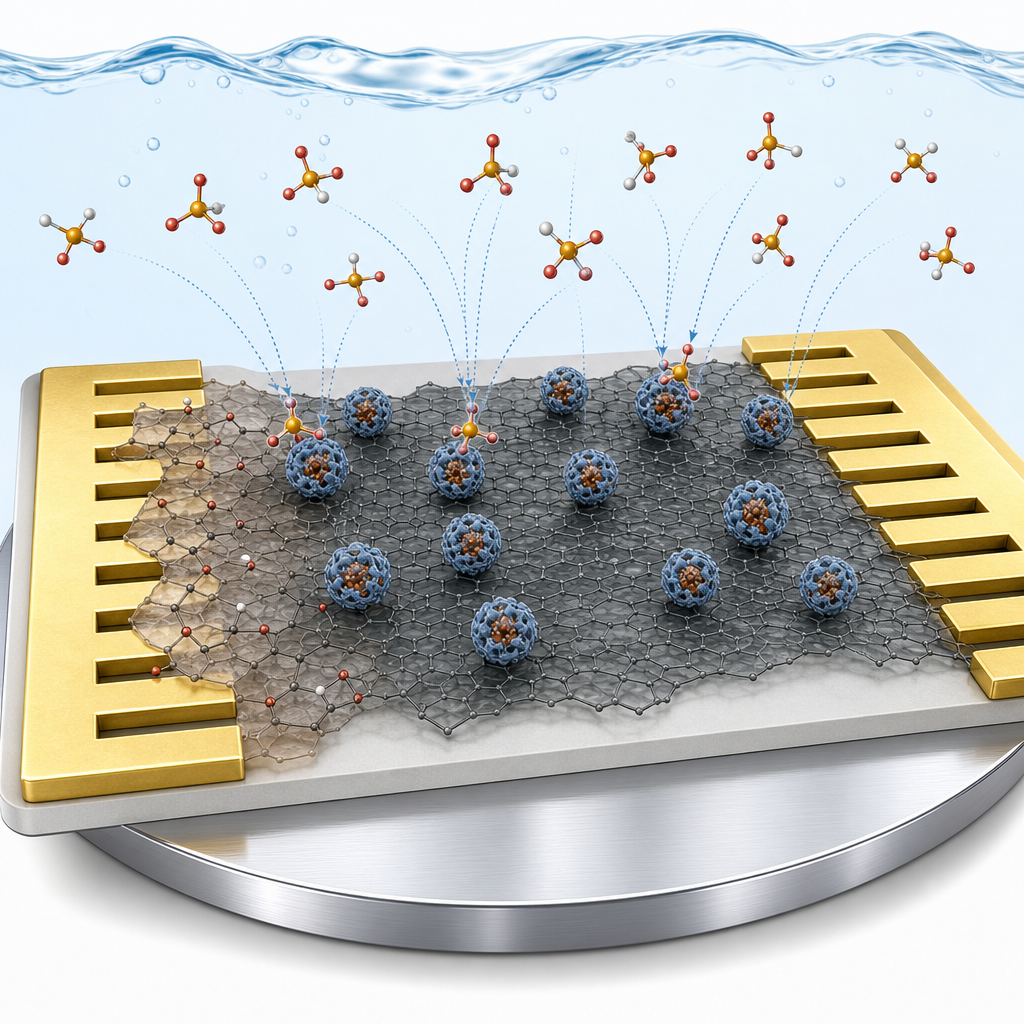
SEM imaging confirmed uniform rGO coverage between electrodes with ferritin nanoparticles (~10 nm) well dispersed on the sheets. I-V curves were nearly linear, indicating a small Schottky barrier between rGO and gold, and transistor measurements revealed p-type semiconducting behavior with an on/off ratio near 1.64. In dynamic sensing, addition of HPO4^2- produced rapid current increases attributed to a gating effect: ferritin's hydrated iron oxide core (FeO-OH) reacts with HPO4^2- to form FeO-O-PO3^2- + H2O, leaving ferritin negatively charged and acting as a local negative gate on the p-type rGO, increasing hole concentration. Schottky-barrier lowering at the Au contact contributed additional current gain. The sensor sensitivity scaled logarithmically with concentration (y = 3.1213 log(x) + 5.1347), giving a calculated LOD of 0.026 µM (26 nM). Selectivity tests showed that the response to 2 µM HPO4^2- (1.90%) was roughly 5-20x larger than responses to 5 µM Cl- (0.10%), 3.3 µM SO4^2- (0.30%), and 2.5 µM CO3^2- (0.35%), thanks to combined Coulombic and Lewis acid-base binding between phosphate and the iron core. Recycling in 2% NaOH/2% NaCl recovered 71% and 57% of sensitivity after four and five uses.
This platform enables online, real-time phosphorus monitoring in surface water, supporting eutrophication control, agricultural runoff management, and drinking-water quality assurance. The same architecture - a 2D semiconducting channel plus a specific adsorption probe - can be extended to other nutrients and ions in environmental and clinical contexts, including phosphate measurement in body fluids relevant to hyperparathyroidism, vitamin D deficiency, and Fanconi syndrome. The authors note that controlling rGO sheet density and probe density, along with developing a calibration protocol, will be important next steps for reproducible deployment.
For researchers building graphene oxide-based sensors, the work demonstrates that ACS Material's monolayer graphene oxide dispersion can serve as a reliable precursor for rGO FET channels that detect sub-µg/L analyte concentrations. The same Single Layer Graphene Oxide Dispersion product line is available to laboratories developing biosensors, water-quality monitors, and flexible electronic devices that depend on uniform, solution-processable 2D carbon films.How ACS Material products were used
- Single Layer Graphene Oxide Dispersion (Graphene Series) — “Monolayer GO solution (10 mg mL−1) dispersed in deionized water (DI water) was ordered from ACS Materials (Single Layer Graphene Oxide Dispersion, SKU# GNO1W001).”
Product Performance in this StudyThe ACS Material monolayer graphene oxide dispersion was thermally reduced to form the rGO sensing channel of the FET sensor. The resulting rGO sheets bridged the gold electrodes uniformly and provided the p-type semiconducting channel essential for detecting orthophosphate ions at a limit of detection of 26 nM.
Related product categories
Frequently asked questionsHow does graphene oxide enable ultrasensitive phosphate detection in FET sensors?
Graphene oxide is thermally reduced to rGO to form a conductive 2D channel between source and drain electrodes. When a recognition probe such as ferritin is attached, binding of HPO4^2- ions creates a local negative gating potential on the p-type rGO and lowers the Schottky barrier at the contacts, producing a measurable current change. Because rGO is only one atom thick, even nanomolar levels of analyte produce a detectable signal.
Why is ferritin used as the probe for orthophosphate ion detection?
Ferritin's iron-oxyhydroxide core reacts specifically with HPO4^2- through both Coulombic and Lewis acid-base interactions, forming FeO-O-PO3^2- groups. This gives selectivity over common interferents such as Cl-, SO4^2- and CO3^2-. Ferritin is also a small (~12 nm) nanoparticle, so the charge from bound phosphate remains close enough to the rGO surface to gate the channel without being fully screened by the ionic solution.
What limit of detection did the rGO/ferritin sensor achieve for phosphate in water?
The sensor reached a limit of detection of 26 nM HPO4^2-, equivalent to a phosphorus concentration of 0.806 µg/L. This is more than an order of magnitude below the U.S. EPA recommended total phosphorus level of 25 µg/L for reservoirs and far lower than conventional colorimetric methods, which lose accuracy below 0.01 mg/L. Sensor response was on the order of seconds, supporting real-time monitoring.