-
SAPO-34 for CO2-to-Olefins Tandem Catalysis - WVU, 2026
Jun 15, 2026 | ACS MATERIAL LLCPoreddy, M. R. et al. (2026). Microwave-Induced Single-Stage CO2 Hydrogenation to Light Olefins over a ZnO-ZrO2/SAPO-34 Tandem Catalyst. *ACS Sustainable Chemistry & Engineering*. https://doi.org/10.1021/acssuschemeng.5c12902
Department of Chemical & Biomedical Engineering · ACS Sustainable Chemistry & Engineering · 2026
West Virginia University used ACS Material SAPO-34 in a ZnO-ZrO2/SAPO-34 tandem catalyst, achieving 26.3% CO2 conversion and 58.6% olefin selectivity under microwave heating.
About this research
Researchers at West Virginia University demonstrated that a ZnO-ZrO2/SAPO-34 tandem catalyst built around ACS Material SAPO-34 can convert CO2 directly into light olefins under microwave irradiation, reaching 26.3% CO2 conversion with 58.6% C2=-C4= olefin selectivity. The study, published in ACS Sustainable Chemistry & Engineering (2026), placed the metal oxide and zeolite components together with silicon carbide in a single-zone mixed catalyst bed. ZnO-ZrO2 domains activate CO2 and form methanol intermediates, while the SAPO-34 supplies the acid sites needed for C-C coupling and methanol-to-olefins conversion. The microwave field, coupled through SiC and polar reaction intermediates, lowered the apparent activation energy and allowed high olefin yields at moderate bulk temperatures.
Converting CO2 into ethylene and propylene addresses two intertwined challenges: reducing anthropogenic carbon emissions and creating a circular carbon economy from an abundant, low-cost feedstock. Light olefins are foundational building blocks for polymers, solvents, synthetic rubbers, and broader petrochemical derivatives, so a direct CO2-to-olefin route carries strong industrial relevance. Conventional Fischer-Tropsch-to-olefins and methanol-to-olefins routes are multistep and energy-intensive, and CO2 is thermodynamically and chemically very stable. Bifunctional and tandem catalysts that simultaneously perform CO2 activation and C-C coupling are an active research front, but they typically rely on conventional thermal heating with large temperature gradients and inefficient energy use. This paper explores microwave heating as a fundamentally different energy-delivery mode that couples directly with dipolar intermediates and semiconducting oxides, potentially altering both kinetics and thermodynamics of the surface reactions.
The ACS Material SAPO-34 served as the zeolitic acid component of the tandem system. As stated in the Experimental Section, "SAPO-34, which was acquired from ACS Material, was converted to its H-form by calcination and then physically mixed with ZnO-ZrO2 in a 1:1 mass ratio." The ZnO-ZrO2 binary oxide was synthesized separately by coprecipitation of zinc nitrate and zirconyl nitrate, then calcined at 500 °C to form a solid solution. After H-form conversion and 1:1 physical mixing with the oxide, the composite was pelletized, crushed, and sieved to 20-30 mesh. SiC, added as a diluent, enhanced microwave absorption and ensured uniform field distribution across the bed. The mixture was loaded into a quartz tube held with quartz wool and placed in the maximum microwave zone of a SAIREM solid-state generator with magnetically enhanced cavity, four-stub automatic tuner, and PID-controlled infrared pyrometer temperature feedback. SAPO-34's well-known selectivity for lower olefins (C2=-C3=) made it the appropriate framework to drive the methanol-to-olefins step after CO2 activation on the oxide.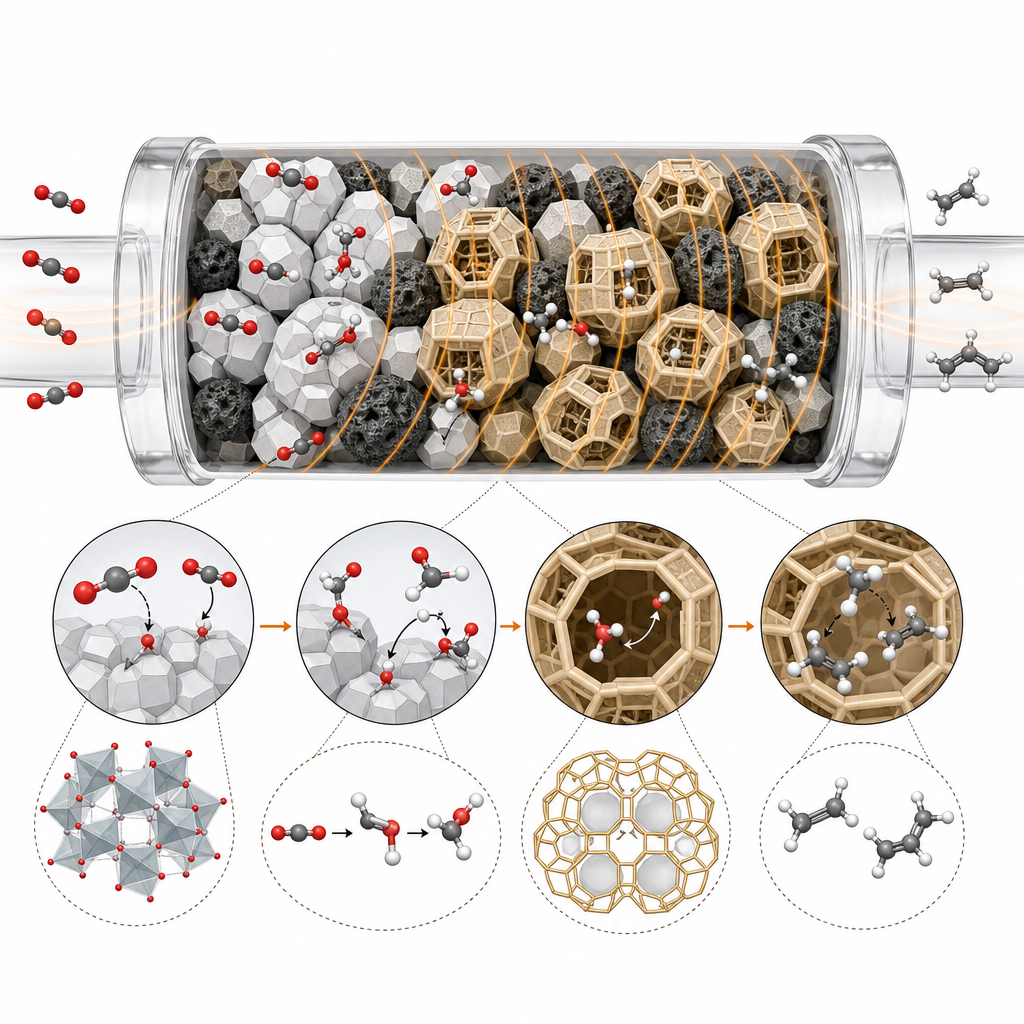
The catalyst was evaluated across temperatures from 320 to 380 °C and pressures from 1 to 2 MPa at a GHSV of 3600 h-1. Under microwave heating, CO2 conversion increased nearly linearly with temperature, while olefin selectivity peaked near 350 °C; above that point CO and methane formation via the Sabatier and reverse water-gas-shift pathways became dominant. The best performance, 26.3% CO2 conversion and 58.6% C2=-C4= olefin selectivity, was obtained at 350 °C and 2 MPa. XRD confirmed that Zn2+ incorporated into the ZrO2 lattice to form a single tetragonal Zn-Zr solid solution rather than segregated ZnO crystallites, indicating well-dispersed Zn-O-Zr interfacial sites. CO2-TPD showed that the ZnO-ZrO2 composite developed an intense high-temperature desorption peak at 500-600 °C, evidence of strong basic sites and additional oxygen vacancies that enhance CO2 chemisorption and activation. Critically, microwave heating delivered high olefin yields at 350 °C, the temperature at which thermal systems instead favored methanol decomposition and CO/CH4 formation. Thermal systems required higher temperatures (≥400 °C) and pressures (≥2 MPa) to reach comparable output, underscoring the energy-efficiency advantage of selective dielectric heating of polar formate and methoxy intermediates.
This work points toward more energy-efficient routes for CO2 capture and utilization, supporting sustainable production of ethylene and propylene as drop-in feedstocks for polymer and petrochemical industries. The microwave-assisted tandem approach could reduce the operating temperatures and pressures needed for CO2 hydrogenation, with implications for distributed or modular chemical manufacturing tied to carbon-capture streams. The authors note that future technoeconomic analysis is needed to assess the feasibility and performance of the microwave-driven system under scaled operating conditions. Further catalyst optimization, framework acidity tuning, and reactor engineering for uniform field distribution are natural follow-up directions in CO2-to-chemicals research.
For researchers pursuing similar tandem catalysis, the SAPO-34 used here is available through ACS Material's molecular sieves catalog. The paper demonstrates that a commercially sourced SAPO-34, converted to its H-form, integrates cleanly with a coprecipitated ZnO-ZrO2 oxide to form an effective bifunctional bed for CO2 hydrogenation. The reported conversion and selectivity figures provide a useful benchmark for groups working on methanol-to-olefins chemistry, microwave-assisted catalysis, and circular-carbon process development.How ACS Material products were used
- SAPO-34 (Molecular Sieves) — “SAPO-34, which was acquired from ACS Material, was converted to its H-form by calcination and then physically mixed with ZnO-ZrO2 in a 1:1 mass ratio.”
Product Performance in this StudyThe ACS Material SAPO-34, used in its H-form, provided the acid sites for C-C coupling in the methanol-to-olefins step, enabling a light-olefin selectivity of 58.6% in the tandem catalyst.
Related product categories
Frequently asked questionsWhat is SAPO-34 used for in CO2-to-olefin catalysis?
SAPO-34 is a silicoaluminophosphate molecular sieve that provides the acid sites needed for C-C coupling in the methanol-to-olefins step. In this tandem system, ZnO-ZrO2 first activates CO2 and forms methanol intermediates, and SAPO-34 then converts those intermediates into light olefins. Its small-pore framework gives high selectivity toward C2=-C3= olefins, making it well suited for direct CO2 hydrogenation to ethylene and propylene.
How does microwave heating improve CO2 hydrogenation to light olefins?
Microwave heating couples directly with polar formate and methoxy intermediates and with semiconducting oxides, producing selective volumetric heating at reaction sites. This lowers the apparent activation energy for CO2 conversion, allowing high olefin yields at 350 °C, where thermal systems instead favor methanol decomposition and CO/CH4 formation. SiC added to the bed enhances microwave absorption and ensures uniform field distribution, improving energy efficiency.
Why is reaction pressure important for CO2 conversion in this tandem catalyst?
Increasing pressure from 1 to 2 MPa raised CO2 conversion and C2=-C4= olefin selectivity while reducing CO formation. Higher pressure increases gas-phase density and adsorption probability on the Zn-Zr interfacial sites, favoring both CO2 activation and subsequent hydrogenation toward methanol and olefins. The best result, 26.3% conversion and 58.6% olefin selectivity, was achieved at 2 MPa and 350 °C.