-
SAPO-34 for NH3-SCR Catalyst Study - Chalmers, 2018
Jul 09, 2026 | ACS MATERIAL LLCWoo, J. et al. (2018). Effect of various structure directing agents (SDAs) on low-temperature deactivation of Cu/SAPO-34 during NH 3 -SCR reaction. *Catalysis Science & Technology*. https://doi.org/10.1039/c8cy00147b
Chemical Engineering · Catalysis Science & Technology · 2018
Chalmers researchers compare SAPO-34 supports, including a commercial SAPO-34 from ACS Material, to elucidate low-temperature deactivation of Cu/SAPO-34 in NH3-SCR.
About this research
Researchers at Chemical Engineering, Chalmers University of Technology, in collaboration with Fiat Chrysler Automobile US, used a commercial SAPO-34 supplied by ACS Material as the comparison benchmark in a systematic study of how structure directing agents (SDAs) govern the low-temperature deactivation of Cu/SAPO-34 NH3-SCR catalysts. The work, published in Catalysis Science & Technology (2018), compared SAPO-34 supports synthesized with morpholine (MO), triethylamine (TEA), and tetraethylammonium hydroxide (TEAOH) against the commercial SAPO-34(ACS) sample, and showed that the choice of SDA dramatically changes Cu speciation, hydrothermal robustness, and ability to recover SCR activity after wet, low-temperature exposure.
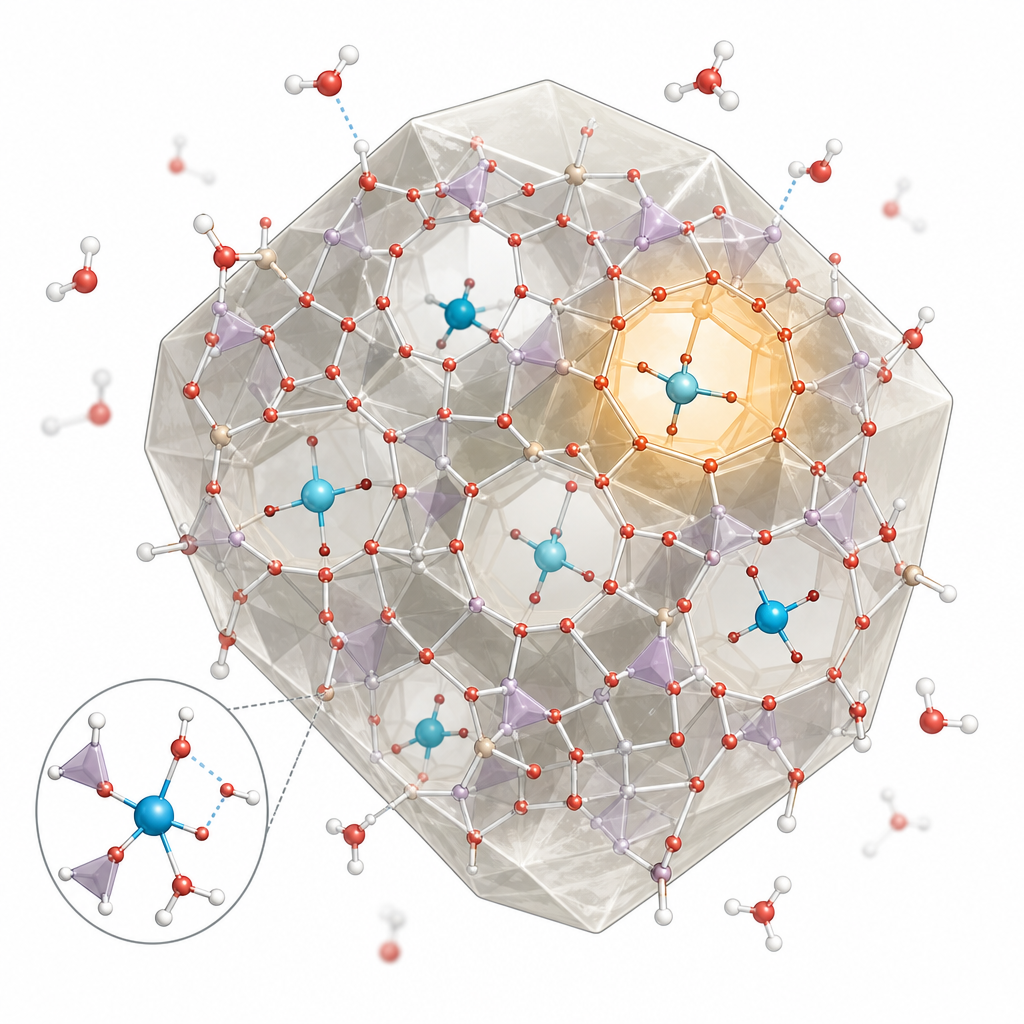
This question matters because Cu-exchanged small-pore chabazite (CHA) zeolites and zeotypes are the dominant catalysts for NOx abatement in modern diesel and lean-burn aftertreatment. Cu/SAPO-34 offers excellent high-temperature hydrothermal durability and N2 selectivity, but earlier work showed that SAPO-34 supports are sensitive to humidity at ambient or low temperatures, with Si-O-Al bonds opening to form Si-OH and Al-OH groups in the presence of water. Leistner and Olsson previously observed NOx conversion collapsing from 87% to 6% after just 9 h of low-temperature water exposure for a morpholine-templated Cu/SAPO-34. Understanding why some SAPO-34 frameworks survive humid low-temperature operation while others do not is essential for designing SCR-on-filter systems where DPF regeneration cycles repeatedly expose the catalyst to water vapor.
The commercial SAPO-34 from ACS Material was incorporated as a fourth support alongside the three in-house hydrothermally synthesized SAPO-34 samples, all loaded with Cu by incipient wetness impregnation (IWI) using Cu(NO3)2·2.5H2O in ethanol followed by calcination at 600 °C for 5 h. The four resulting Cu/SAPO-34 catalysts were washcoated onto 400 cpsi cordierite monoliths (~500 mg total washcoat, 95% catalyst plus 5% binder) and tested in a quartz plug-flow reactor at a GHSV of 24,264 h-1 with 400 ppm NO, 400 ppm NH3, 8% O2 and 5% H2O. Including the ACS Material SAPO-34 allowed the authors to anchor the SDA-dependent findings against an off-the-shelf chabazite that researchers and emission-control engineers can readily obtain, rather than relying solely on lab-prepared materials. The commercial sample was also characterized by XRD, BET, ICP-SFMS, SEM, 27Al/29Si/31P MAS NMR, NH3-TPD, ex situ and in situ DRIFTS, CO- and NO-DRIFTS, and H2-TPR using the same protocol applied to the lab samples.
The characterization confirmed all four supports retained the CHA structure with no detectable CuO crystallites. Lab-made SAPO-34(MO, TEA, TEAOH) showed BET surface areas above 600 m2/g, higher than the SAPO-34(ACS) reference, with SAPO-34(TEAOH) exhibiting the largest pore volume and pore diameter. After a low-temperature water deactivation protocol, Cu/SAPO-34(TEA) and Cu/SAPO-34(TEAOH) almost fully recovered their NH3-SCR activity, while Cu/SAPO-34(MO) and Cu/SAPO-34(ACS) only partially regenerated under a series of eight conditioning experiments spanning 150–250 °C with varied pre-treatments (8% O2, with or without 5% H2O, at 70, 600, or 700 °C). CO-DRIFTS, NO-DRIFTS, and H2-TPR collectively pointed to two distinct Cu coordination sites in every sample, with their relative populations strongly dependent on SDA choice. Solid-state 27Al, 29Si, and 31P MAS NMR clarified how SDAs alter the local Al, P, and Si environments, linking framework connectivity to the resilience of Cu speciation against humid low-temperature attack.
The implications extend across automotive emission control, stationary diesel SCR, and any application where CHA-type Cu zeotype catalysts encounter cyclic water exposure. The work suggests that switching SDA from morpholine to triethylamine or TEAOH can deliver substantially better low-temperature humidity tolerance without sacrificing high-temperature hydrothermal stability, an outcome of direct interest to catalyst formulators developing next-generation SCR-on-filter systems. Beyond NH3-SCR, the SDA-driven control of Cu siting may inform Cu/SAPO-34 use in methanol-to-olefins, methane oxidation, and related zeotype-supported catalysis where Cu coordination governs selectivity and stability.
Researchers working on chabazite zeolites, Cu-exchanged molecular sieves, and SCR catalysis can obtain the same commercial SAPO-34 used as the ACS reference in this paper from ACS Material's molecular sieves catalog, supporting reproducible benchmarking against the Chalmers dataset. The paper demonstrates how a well-defined commercial standard alongside lab-synthesized analogs can sharpen mechanistic conclusions about deactivation chemistry.How ACS Material products were used
- SAPO-34 (Molecular Sieves) — “For comparison purposes, a commercially available catalyst, SAPO-34(ACS material, USA), was additionally chosen in this study.”
Product Performance in this Study
The commercial SAPO-34 from ACS Material served as a benchmark reference against three lab-synthesized SAPO-34 supports made with different structure directing agents. Cu/SAPO-34(ACS) showed only partial recovery of NH3-SCR activity after low-temperature water deactivation, behaving similarly to the morpholine-templated material and providing a useful commercial baseline for evaluating SDA-dependent deactivation.
Related product categories
Frequently asked questions
Why does the choice of structure directing agent matter for Cu/SAPO-34 SCR catalysts?
The structure directing agent used during hydrothermal synthesis of SAPO-34 controls framework Al, P, and Si coordination, which in turn governs Cu siting after ion exchange. This Chalmers study found that Cu/SAPO-34 made with triethylamine or TEAOH almost fully recovered NH3-SCR activity after humid low-temperature exposure, while morpholine-templated and a commercial SAPO-34 reference recovered only partially, demonstrating that SDA selection directly impacts hydrothermal durability.
How is SAPO-34 used as an NH3-SCR catalyst support?
SAPO-34 has the small-pore chabazite (CHA) structure that favors high N2 selectivity and resistance to hydrocarbon poisoning in NH3-SCR. Copper is introduced by ion exchange or incipient wetness impregnation to form Cu/SAPO-34, which the Chalmers study washcoated onto 400 cpsi cordierite monoliths and tested at 150–500 °C with 400 ppm NO, 400 ppm NH3, 8% O2, and 5% H2O for diesel NOx abatement.
What causes low-temperature deactivation of Cu/SAPO-34?
Low-temperature water exposure can open framework Si-O-Al bonds in SAPO-34, forming Si-OH and Al-OH groups and disturbing the local environment of exchanged Cu. The paper shows two distinct Cu sites coexist in Cu/SAPO-34, identified by CO-DRIFTS, NO-DRIFTS, and H2-TPR. The relative population of these Cu sites, and thus the susceptibility to irreversible deactivation, depends strongly on the structure directing agent used in synthesis.