-
SAPO-34 Ionic Liquid Mixed Matrix Membranes for CO2/CH4 - Universiti Teknologi PETRONAS, 2018
Jun 16, 2026 | ACS MATERIAL LLCMohshim, D. F., Mukhtar, H., & Man, Z. (2018). A study on carbon dioxide removal by blending the ionic liquid in membrane synthesis. *Separation and Purification Technology*. https://doi.org/10.1016/j.seppur.2017.06.034
Separation and Purification Technology · 2018
Researchers blended ACS Material SAPO-34 with PES and emim[Tf2N] ionic liquid to fabricate mixed matrix membranes with improved CO2/CH4 selectivity for natural gas sweetening.
About this research
Researchers at Universiti Teknologi PETRONAS used commercial SAPO-34 molecular sieve powder purchased from ACS Material to develop a new class of mixed matrix membranes that combine polyethersulfone (PES), SAPO-34, and the ionic liquid 1-ethyl-3-methylimidazolium bis(trifluoromethanesulfonyl)amide (emim[Tf2N]) for carbon dioxide removal from natural gas. Published in Separation and Purification Technology (2018), the study demonstrates that incorporating an ionic liquid into both polymeric and mixed matrix membrane formulations significantly improves the ideal CO2/CH4 selectivity, showing that the strong CO2 affinity of ionic liquids can be transferred into a robust solid membrane format suitable for high-pressure natural gas processing.
The motivation for this work is the persistent challenge of upgrading natural gas streams that contain very high CO2 fractions. In Malaysian gas fields such as K5 in Sarawak, as well as the Natuna field in Indonesia and Gorgon in Australia, CO2 concentrations can reach 70-80%, which suppresses heating value, accelerates pipeline corrosion in the presence of water, and renders many reservoirs uneconomical to develop. Conventional amine absorption is energy-intensive, and existing polymeric membranes face the well-known permeability-selectivity trade-off. Mixed matrix membranes that combine a polymer with an inorganic molecular sieve are an established strategy, but interfacial defects between filler and polymer limit performance. Adding a room-temperature ionic liquid with high CO2 solubility is an emerging approach to fill that interphase gap and to introduce a CO2-philic chemical environment into the membrane.
The ACS Material SAPO-34 was central to the membrane design. The paper notes that "Commercial SAPO-34 has been purchased from ACS Material in powder form having the kinetic diameter of 0.38 nm." Because the SAPO-34 pore aperture is close to the kinetic diameter of CH4 (0.38 nm) but larger than that of CO2 (0.33 nm), the filler provides size-selective transport favoring CO2. The SAPO-34 powder was dried and dispersed in N-methylpyrrolidone (NMP), then combined with PES Ultrason E 6020 P (BASF) at 20 wt% polymer loading. For ionic liquid-containing formulations, emim[Tf2N] (Sigma-Aldrich, 99.99% purity) was first dissolved in NMP, followed by addition of PES and SAPO-34. Six membrane variants were cast: neat PES, PES with 10 and 20 wt% emim[Tf2N] (ILPMs), a neat PES/SAPO-34 mixed matrix membrane (PES_S20), and the ternary IL3M membranes containing both 20 wt% SAPO-34 and 10 or 20 wt% ionic liquid.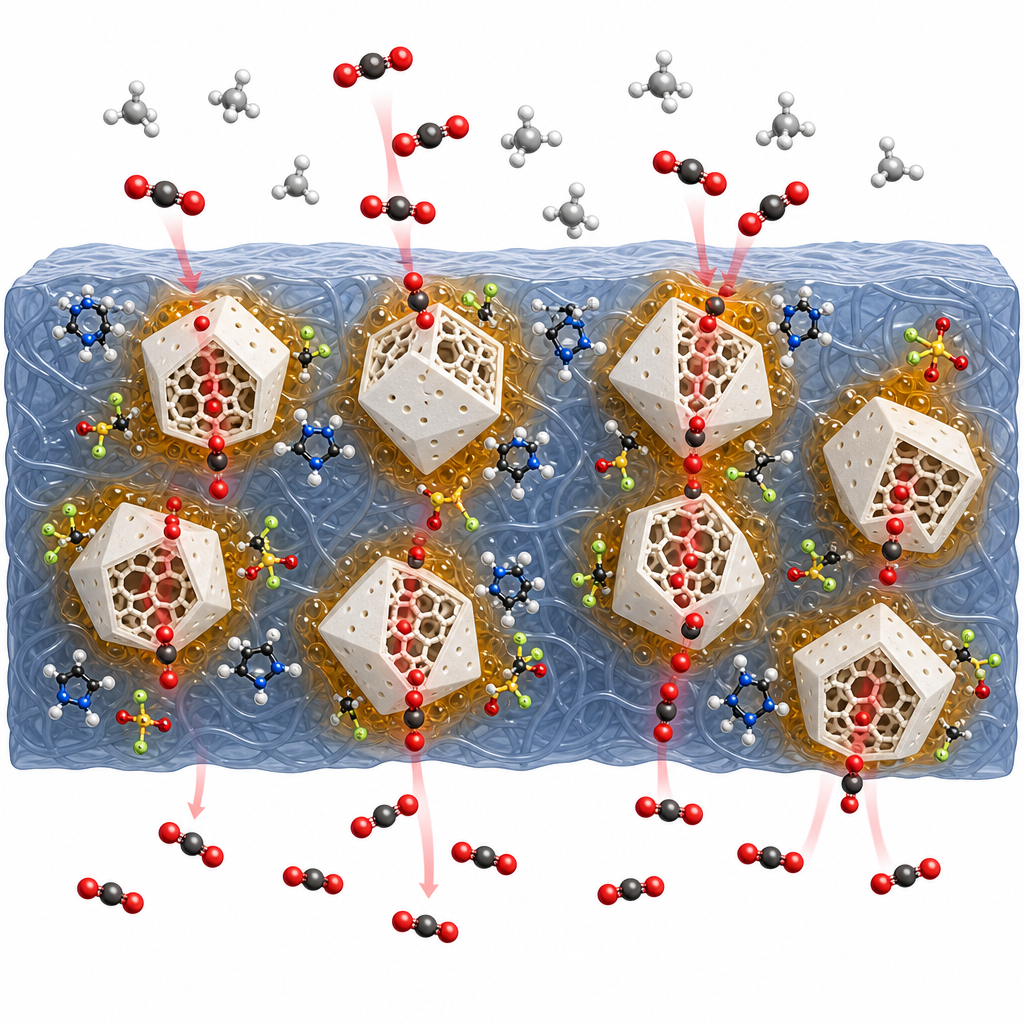
The experimental results showed that ionic liquid blending consistently improved the ideal CO2/CH4 selectivity of both the polymeric ILPMs and the SAPO-34-containing IL3Ms relative to the neat PES baseline. The PES_S20 mixed matrix membrane benefitted from the molecular sieving action of SAPO-34, and the further incorporation of emim[Tf2N] introduced additional CO2-philic absorption sites at the polymer-filler interface. The fluoromethyl group in the Tf2N anion is highlighted as a key contributor to enhanced CO2 solubility. Increasing ionic liquid loading from 10 to 20 wt% amplified the selectivity gain, although the authors note that high ionic liquid viscosity and cost remain practical challenges. Compared with conventional supported ionic liquid membranes (SILMs) and poly(ionic liquid) membranes, which can suffer from liquid displacement at elevated pressures, the blended IL3M approach offers improved mechanical robustness because the ionic liquid is distributed within a solid polymer-filler matrix.
The demonstrated improvements have direct relevance to natural gas sweetening, biogas upgrading, and post-combustion CO2 capture, where CO2/CH4 or CO2/N2 selectivity at moderate-to-high feed pressures is the limiting performance metric. The approach is also of interest for membrane developers working on hybrid facilitated-transport materials, CO2-philic polymer composites, and zeolite-polymer interface engineering. The authors suggest that the IL3M concept can be extended by tuning the cation-anion combination of the ionic liquid and by exploring other small-pore zeotypes alongside SAPO-34.
For researchers pursuing similar mixed matrix membrane work, the SAPO-34 used here is available as a stock product in ACS Material's molecular sieves catalog, alongside related zeotypes such as SAPO-11, SSZ-13, and ZSM-5. The consistent pore geometry of commercial SAPO-34 helped the authors achieve reproducible CO2/CH4 size discrimination, and the same grade is suitable for laboratory-scale membrane casting, adsorption screening, and methanol-to-olefin catalysis studies.How ACS Material products were used
- SAPO-34 (Molecular Sieves) — “Commercial SAPO-34 has been purchased from ACS Material in powder form having the kinetic diameter of 0.38 nm.”
Product Performance in this StudySAPO-34 served as the inorganic molecular sieve filler embedded in the polyethersulfone matrix to form mixed matrix membranes. Its pore-size selectivity (0.33 nm CO2 vs 0.38 nm CH4) contributed to enhanced CO2/CH4 ideal selectivity in the synthesized membranes.
Related product categories
Frequently asked questionsWhy is SAPO-34 effective for CO2/CH4 separation in mixed matrix membranes?
SAPO-34 has a uniform pore aperture of about 0.38 nm, which is close to the kinetic diameter of CH4 (0.38 nm) but larger than that of CO2 (0.33 nm). This narrow size differentiation allows CO2 molecules to pass through the zeolite pores more readily than CH4, providing molecular sieving selectivity when dispersed in a polymer matrix such as polyethersulfone for natural gas sweetening applications.
How does adding an ionic liquid improve polyethersulfone membranes?
Blending an ionic liquid such as emim[Tf2N] into polyethersulfone introduces CO2-philic absorption sites and helps fill defects at the polymer-filler interface in mixed matrix membranes. The fluoromethyl groups in the Tf2N anion increase CO2 solubility, raising the ideal CO2/CH4 selectivity. Unlike supported ionic liquid membranes, blended designs keep the ionic liquid dispersed within the solid matrix, reducing liquid displacement at elevated operating pressures.
What is the role of the SAPO-34 kinetic diameter in membrane design?
The kinetic diameter of SAPO-34 pores determines which gas molecules can diffuse through the zeolite framework. At 0.38 nm, SAPO-34 selectively admits CO2 (0.33 nm) while restricting larger species like CH4. This makes pore-size matching a critical design parameter when choosing a zeolite filler for CO2 separation membranes, because mismatched pore sizes either lose selectivity or sacrifice permeability.