-
SAPO-34 Reference for Fe/SAPO-34 NH3-SCR - Chalmers, 2016
May 29, 2026 | ACS MATERIAL LLCAndonova, S. et al. (2016). The effect of iron loading and hydrothermal aging on one-Pot synthesized Fe/SAPO-34 for ammonia SCR. *Applied Catalysis B: Environmental*. https://doi.org/10.1016/j.apcatb.2015.07.007
Applied Catalysis B: Environmental · 2016
Chalmers University researchers used commercial SAPO-34 from ACS Material as a CHA-structure reference to benchmark Fe/SAPO-34 NH3-SCR catalysts for diesel NOx control.
About this research
Researchers at Chalmers University, working in collaboration with Ford Motor Company, used commercial SAPO-34 supplied by ACS Material as a reference material to benchmark a novel one-pot synthesized Fe/SAPO-34 catalyst system for ammonia selective catalytic reduction (NH3-SCR) of NOx. Published in Applied Catalysis B: Environmental in 2016, the study demonstrates that a Fe/SAPO-34 catalyst containing just 0.27 wt% Fe, when paired with a commercial Cu/CHA monolith, achieves high NOx conversion across the broad 200–800 °C temperature range typical of modern diesel exhaust aftertreatment systems. The commercial SAPO-34 reference was used to confirm the chabazite (CHA) framework structure of the in-house-synthesized materials by XRD.
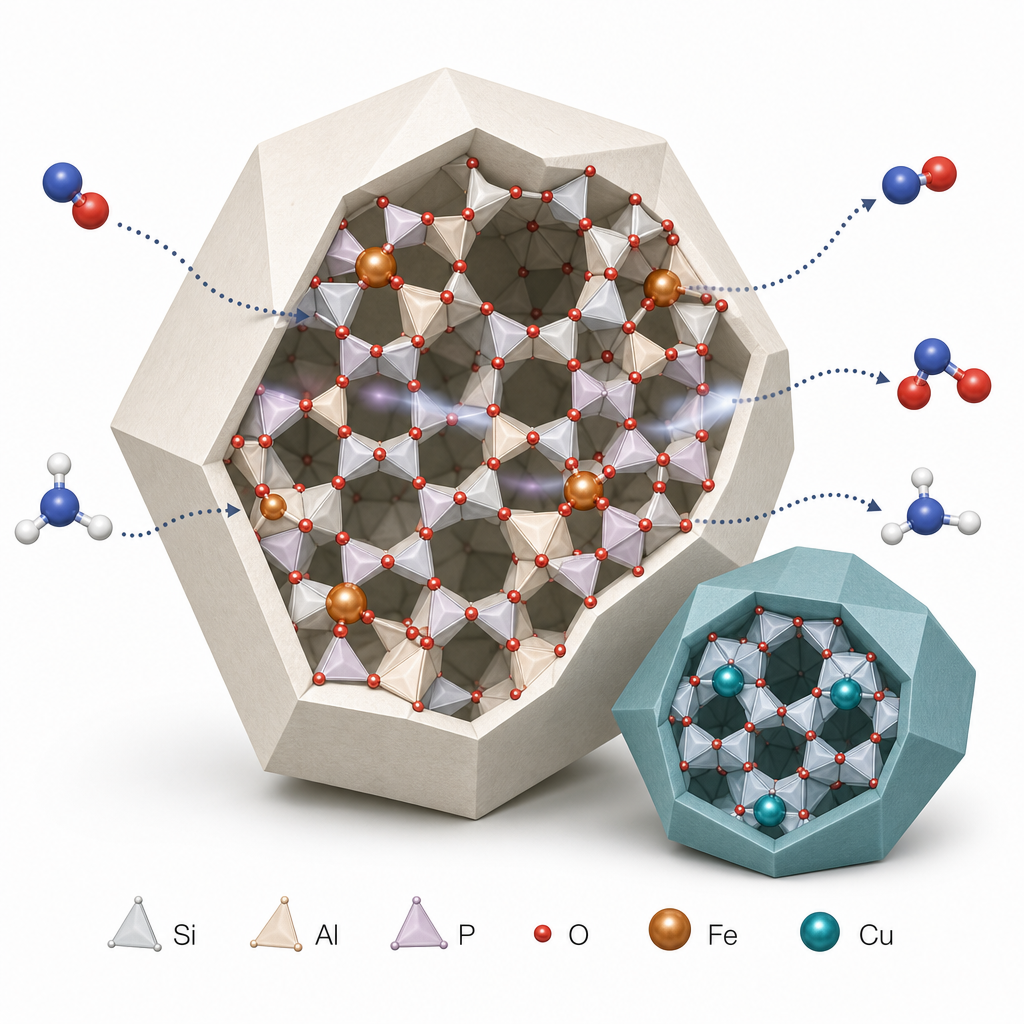
Lean-burn diesel and gasoline engines deliver superior fuel economy but require effective NOx abatement to meet stringent emission standards. NH3-SCR over Cu-exchanged small-pore CHA zeolites such as Cu/SSZ-13 and Cu/SAPO-34 is now the industry standard, but these catalysts lose activity above ~450 °C, exactly the temperature range encountered during periodic diesel particulate filter (DPF) regeneration. Fe-zeolites are known to excel at high temperatures, but conventional aqueous ion exchange struggles to insert Fe3+ (hydrated diameter ~9 Å) into the narrow ~3.8 Å pores of CHA-type sieves. The work addresses this gap by incorporating iron directly into the SAPO-34 framework during hydrothermal synthesis, then combining the resulting Fe/SAPO-34 with conventional Cu/CHA to span the entire diesel operating window.
The ACS Material commercial SAPO-34 served as the structural fingerprint against which the laboratory-synthesized Fe/SAPO-34 samples were validated. X-ray diffraction patterns of the in-house pure SAPO-34 and the three Fe-loaded variants (SF-1 at 0.27 wt%, SF-2 at 0.47 wt%, SF-3 at 1.03 wt% Fe) were directly overlaid with the ACS Material SAPO-34 reference. The characteristic CHA reflections of the synthesized materials nearly coincided with those of the commercial sample, confirming that the morpholine-templated hydrothermal route (adapted from Prakash et al.) reproduces the canonical CHA topology. The commercial reference also helped identify subtle d-spacing shifts: the main (100) reflection shifted from 5.391 Å (2θ = 19.10°) in pure SAPO-34 to 5.421 Å (2θ = 18.99°) for SF-3, evidence of unit cell expansion when Fe3+ (0.63 Å) substitutes for Al3+ (0.53 Å) in the framework. Without a reliable, commercially produced SAPO-34 of known phase purity, distinguishing genuine Fe-incorporation effects from synthesis artifacts would have been considerably more difficult.
The key activity data are striking. ICP-AES confirmed Fe loadings of 0.27, 0.47, and 1.03 wt%; BET surface areas of 606–671 m²/g and pore volumes of 0.32–0.37 cm³/g indicated that Fe incorporation did not occlude the micropores. NH3-TPD showed that even after hydrothermal aging at 800 °C for 80 h, the Fe/SAPO-34 retained substantial NH3 storage capacity, confirming framework stability. In standard NH3-SCR (350 ppm NO, 350 ppm NH3, 14% O2, 5% H2O, 5% CO2, GHSV 30,300 h⁻¹), the SF-1 catalyst (0.27 wt% Fe) outperformed the others. After aging at 800 °C for 80 h it delivered higher NOx conversion than commercial Cu/CHA at 600–750 °C. Pushing aging to 900 °C for 4 h still preserved 50–60% NOx conversion across 650–900 °C, whereas Cu/CHA dropped to negative NOx conversion at 750–800 °C due to non-selective NH3 oxidation. The sequential dual-bed configuration (1 cm Fe/SAPO-34 upstream of 1 cm Cu/CHA, both aged at 800 °C for 80 h) reached about 55% NOx conversion at 700 °C, compared to under 20% for Cu/CHA alone, while preserving the low-temperature activity of Cu/CHA below 350 °C.
The practical implications extend across the diesel aftertreatment supply chain. Catalyst developers targeting Euro 7 and EPA 2027 emission limits need SCR systems that survive DPF regeneration excursions above 700 °C without losing low-temperature deNOx. The Fe/SAPO-34 + Cu/CHA dual-bed architecture demonstrated here offers a route to broaden the operating window without resorting to Fe/ZSM-5 or Fe/BEA, which suffer from hydrocarbon poisoning and poor hydrothermal stability. Beyond mobile sources, the same chemistry is relevant to stationary power-plant SCR, marine diesel aftertreatment, and any process requiring high-temperature ammonia abatement. The authors explicitly point to one-pot Fe incorporation as a scalable alternative to ion exchange for small-pore CHA zeolites.
For researchers exploring SAPO-34 chemistry, zeolite framework engineering, or SCR catalyst formulation, commercial SAPO-34 of the type supplied by ACS Material provides a consistent, well-characterized CHA-structure reference. Reliable reference materials are essential for distinguishing genuine framework substitution effects from synthesis variability, as demonstrated in this study. ACS Material offers SAPO-34 and a broad range of related zeolitic molecular sieves (ZSM-5, SSZ-13, SAPO-11, beta zeolite, Y-type zeolites) suitable for SCR catalyst development, methanol-to-olefin conversion, and adsorbent screening.How ACS Material products were used
- SAPO-34 zeolite (Molecular Sieves) — “pure commercial SAPO-34 (ACS Material, LLC) and commercial Cu/CHA (washcoated monoliths) catalysts were also used as reference materials.”
Product Performance in this Study
The commercial SAPO-34 from ACS Material served as the structural reference material against which the in-house Fe/SAPO-34 catalysts were benchmarked. XRD confirmed that the synthesized Fe/SAPO-34 nearly coincided with the reflections of this commercial SAPO-34, validating successful formation of the CHA chabazite framework.
Related product categories
Frequently asked questions
Why use commercial SAPO-34 as a reference in zeolite catalyst research?
Commercial SAPO-34 provides a consistent, well-characterized CHA-structure benchmark. In this Chalmers study, XRD patterns of three in-house Fe/SAPO-34 samples were overlaid with commercial SAPO-34 from ACS Material to confirm that the morpholine-templated hydrothermal synthesis reproduced the correct chabazite framework. The reference also allowed researchers to detect subtle d-spacing shifts caused by Fe3+ substitution for Al3+, providing direct evidence of framework incorporation rather than surface deposition.
How does Fe loading affect Fe/SAPO-34 performance in NH3-SCR?
Lower Fe loading performs better. Among 0.27, 0.47, and 1.03 wt% Fe samples, the lowest loading (0.27 wt%, SF-1) showed the highest NOx conversion and best hydrothermal stability. Higher Fe content (1.03 wt%) caused unit cell expansion, reduced crystallinity, and lowered Al content in the framework. The 0.27 wt% Fe catalyst maintained 50–60% NOx conversion at 650–900 °C even after aging at 900 °C for 4 hours.
Why combine Fe/SAPO-34 with Cu/CHA for diesel SCR?
The two catalysts cover complementary temperature ranges. Cu/CHA gives high NOx conversion below 400 °C but loses activity and over-oxidizes NH3 above 550 °C. Fe/SAPO-34 excels at 600–750 °C, exactly the regime encountered during diesel particulate filter regeneration. A sequential 1 cm Fe/SAPO-34 + 1 cm Cu/CHA bed, both aged at 800 °C for 80 hours, achieved roughly 55% NOx conversion at 700 °C versus under 20% for Cu/CHA alone, while preserving low-temperature performance.