-
SAPO-34 Synthesis for Methanol-to-Olefin - Jilin University, 2018
May 28, 2026 | ACS MATERIAL LLCSun, Q., Xie, Z., & Yu, J. (2018). The state-of-the-art synthetic strategies for SAPO-34 zeolite catalysts in methanol-to-olefin conversion. *National Science Review*. https://doi.org/10.1093/nsr/nwx103
Jilin University · National Science Review · 2018
Jilin University review of state-of-the-art SAPO-34 zeolite synthesis for methanol-to-olefin (MTO) conversion, with ACS Material SAPO-34 used in post-treatment studies.
About this research
Researchers at Jilin University, in collaboration with SINOPEC, published a comprehensive review in National Science Review surveying state-of-the-art synthetic strategies for SAPO-34 zeolite catalysts in methanol-to-olefin (MTO) conversion, with SAPO-34 supplied by ACS Material featuring in tabulated post-treatment studies that probed acid, base, and organic-base leaching of the parent zeolite. The article maps the field across mixed-template, dry-gel conversion, microwave-assisted, ultrasound-assisted, seed-assisted, hard-templating, soft-templating, and post-synthesis modification routes. It also discusses the industrialization of SAPO-34 catalysts in commercial MTO plants in China and outlines current limitations of zeolite synthesis for large-scale ethylene and propylene production.
MTO has become one of the most successful non-petrochemical routes for producing light olefins from coal, natural gas, and biomass via methanol. SAPO-34, with its CHA framework, large 0.94 nm cages, narrow 0.38 nm eight-ring pore openings, and moderate acidity, delivers ethylene-plus-propylene selectivities above 80% at 350–500 °C. Its main drawback is rapid deactivation: bulky polymethylbenzenium intermediates trapped in the cages convert to coke that blocks active sites. The field has therefore focused on shrinking SAPO-34 crystals to nanometer dimensions and introducing secondary meso- or macropores to improve mass transport, retard coke formation, and extend catalyst lifetime.
In the post-treatment section of the review, the authors compile literature studies in which SAPO-34 supplied by ACS Material served as the starting zeolite for leaching experiments. Treatment in mineral acid media (HCl, H4EDTA, Na2H2EDTA) and in NaOH solution produced strongly amorphous products, indicating that the SAPO framework is unstable under conventional aluminosilicate-style de-alumination or desilication. In contrast, leaching of ACS Material SAPO-34 in organic bases such as TEAOH or DEA preserved crystallinity, providing a viable post-synthesis route to hierarchical porosity. Complementary fluoride-assisted etching protocols (dilute HF with NH4F, ultrasonic HF–NH4F) and TEAOH leaching were also tabulated, producing mosaic nanoparticle morphologies and connected meso/macropore networks inside SAPO-34 crystals.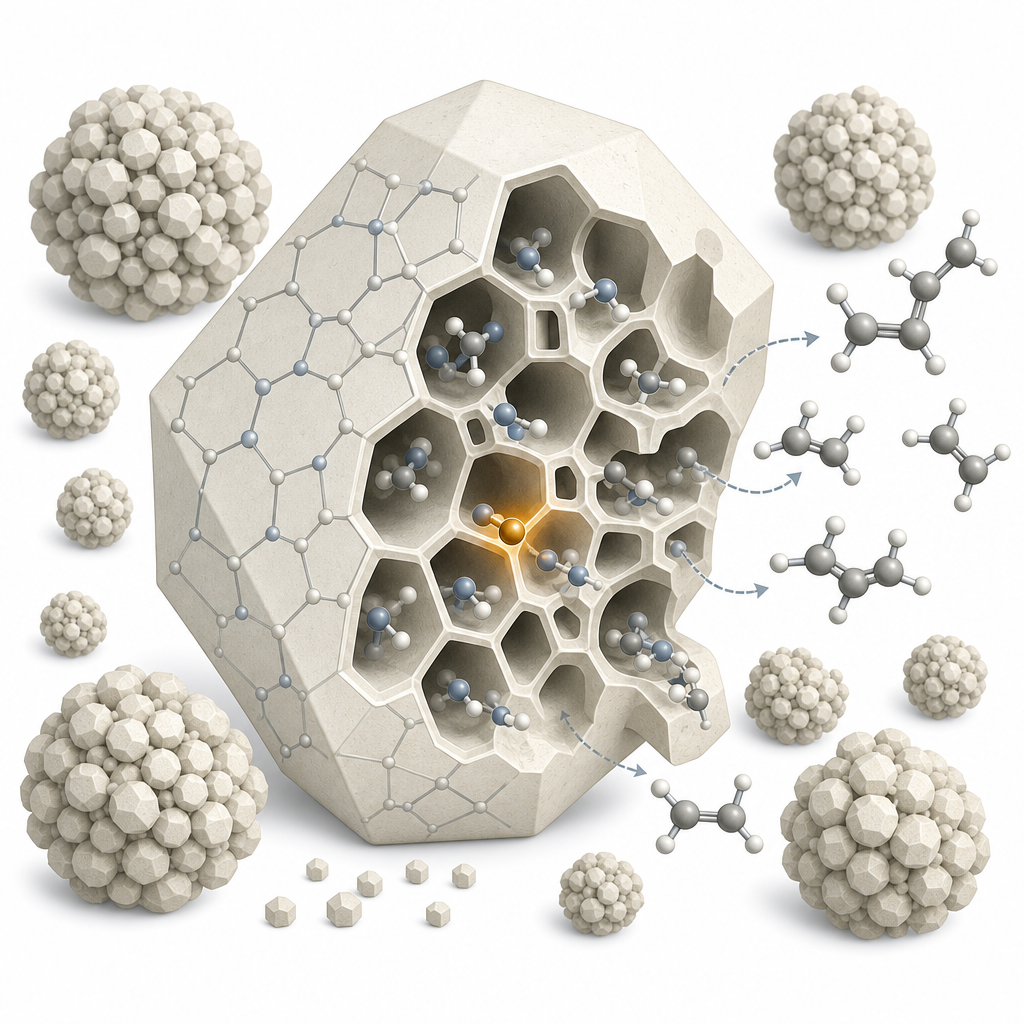
Across the synthesis methods reviewed, the catalytic gains are substantial. Mixed-template SAPO-34 catalysts using TEAOH/MOR (75% MOR/25% TEAOH) reached MTO lifetimes up to 840 min at 450 °C and WHSV = 1 h⁻¹. TEAOH/DEA combinations gave 545 min at 425 °C. Concentrated-gel nanosheet SAPO-34 with low silicon content delivered the longest reported lifetime of 1206 min at WHSV = 2 h⁻¹, with a low coking rate of 0.06 mg/min. Microwave-assisted synthesis shortened crystallization from days to about 1 h and produced ~80 nm spherical aggregates of ~20 nm crystallites. Ultrasonic pretreatment yielded ~50 nm SAPO-34 with more than twice the lifetime of conventional hydrothermal samples. A seed-assisted, stainless-steel tubular-reactor route crystallized nanosized SAPO-34 in just 10 min. Hierarchical SAPO-34 synthesized via the seed route improved ethylene+propylene selectivity to 85.0% with a 4-fold longer lifetime. Industrially, DMTO technology has been licensed to more than 20 plants representing roughly 11 Mt/year of ethylene plus propylene, and a SINOPEC commercial unit using nanosheet hierarchical SAPO-34 has operated stably for over 5 years with methanol conversion above 99% and combined ethylene+propylene yield around 81%.
The review will be useful for researchers working on coal-to-olefin chemistry, zeolite engineering, and heterogeneous catalysis. Its catalogue of templates, post-treatment chemistries, and morphology–performance relationships supports the design of next-generation SAPO-34 catalysts with tailored hierarchical porosity and controlled silicon distributions. The authors highlight aminothermal, ionothermal, and phase-transformation routes as promising green alternatives, and call for cost-effective syntheses that reduce TEAOH consumption while maintaining nanosized crystals. The framework instability observed in acid and NaOH leaching of ACS Material SAPO-34 underscores the need for milder, framework-preserving modifications such as organic-base or fluoride etching.
For researchers reproducing or benchmarking SAPO-34 modification studies, SAPO-34 supplied by ACS Material provides a consistent reference parent zeolite, and the broader molecular sieve product line covers related CHA-type SAPO-34, SSZ-13, ZSM-5, and SAPO-11 catalysts used in MTO and related light-olefin chemistries. The review's tabulated leaching outcomes can guide selection of post-treatment conditions that preserve crystallinity while generating the hierarchical mesoporosity required for prolonged MTO catalyst lifetime.How ACS Material products were used
- SAPO-34 (Molecular Sieves) — “Leaching in acid media (HCl, H4EDTA, and Na2H2EDTA) Supplied by ACS Material ... Leaching in NaOH solution Supplied by ACS Material ... Leaching in organic bases (TEAOH or DEA) Supplied by ACS Material”
Product Performance in this StudySAPO-34 zeolite supplied by ACS Material was used as the parent material for post-synthesis hierarchical pore generation studies. Acid and NaOH leaching produced strongly amorphous products, while organic-base leaching preserved crystallinity, illustrating the relative framework sensitivity of SAPO-34 to different post-treatment chemistries.
Related product categories
Frequently asked questionsWhy is SAPO-34 the preferred catalyst for methanol-to-olefin conversion?
SAPO-34 has a CHA framework with 0.94 nm cages and narrow 0.38 nm eight-ring pore openings, combined with moderate Brønsted acidity. This combination provides strong shape selectivity for small olefins, giving ethylene-plus-propylene selectivity above 80% with near-complete methanol conversion at 350–500 °C, while excluding bulkier products. Its hydrothermal stability also makes it robust under industrial MTO operating conditions.
How do nanosized SAPO-34 crystals improve MTO catalyst lifetime?
Smaller SAPO-34 crystals shorten the intracrystalline diffusion path, allowing reactants and light-olefin products to leave the cages before bulky polymethylbenzenium intermediates condense into coke. This raises mass-transfer efficiency and lowers the coking rate. In the literature reviewed, nanosheet SAPO-34 with low silicon content reached MTO lifetimes of 1206 min at WHSV = 2 h⁻¹ with a coking rate of just 0.06 mg/min.
What does post-synthesis leaching do to SAPO-34 zeolite?
Post-synthesis leaching aims to generate mesopores in microporous SAPO-34, but the SAPO framework is sensitive to harsh media. Acid leaching with HCl, H4EDTA or Na2H2EDTA and treatment in NaOH solution typically render SAPO-34 strongly amorphous, while leaching in organic bases such as TEAOH or DEA preserves crystallinity. Fluoride etching with HF/NH4F also produces hierarchical pores while retaining the CHA framework.