-
SAPO-34 Zeolite Coating for Solar DEC Cooling - Politecnico di Torino, 2016
Jun 22, 2026 | ACS MATERIAL LLCSimonetti, M. et al. (2016). Experimental testing of the buoyant functioning of a coil coated with SAPO34 zeolite, designed for solar DEC (Desiccant Evaporative Cooling) systems of buildings with natural ventilation. *Applied Thermal Engineering*. https://doi.org/10.1016/j.applthermaleng.2016.02.072
Applied Thermal Engineering · 2016
Politecnico di Torino tested a SAPO-34 zeolite-coated coil for solar desiccant evaporative cooling, achieving fan-free buoyancy-driven dehumidification of 2.5 g/kg.
About this research
Researchers at Politecnico di Torino, working with CNR-ITAE Messina and the Università di Messina, used SAPO-34 zeolite supplied by ACS Material to build and experimentally validate a finned-coil adsorption stage for solar Desiccant Evaporative Cooling (DEC) systems driven entirely by natural buoyant airflow. The prototype, named NADEH (Natural Airflow DEHumidification stage), achieved a stable convective airflow of approximately 135 m³/h during regeneration at 80 °C without any auxiliary fan, and demonstrated reproducible cyclic dehumidification of incoming summer air at 30 °C and 12.5 g/kg moisture content. The work, published in Applied Thermal Engineering (2016), proves the operative concept of a fully passive, solar-thermal-driven desiccant cooling stage suitable for residential retrofits.
Reducing electrical energy consumption in building cooling and ventilation is a central target of the EU's energy directives. While mechanical ventilation can account for up to 50% of a home's electricity use, passive and hybrid ventilation schemes have historically struggled to integrate active dehumidification because adsorption beds typically require fan-driven airflow. Solar-thermally regenerated open desiccant cycles are attractive because they can use widely deployed water solar collectors, but the literature contains very few demonstrations of coupling such cycles with purely natural ventilation. The challenge addressed by this paper is to engineer a sorption bed with sufficient adsorbent loading, sufficient heat-exchange surface, and low enough pressure drop that buoyancy alone—generated by sorption heat and regeneration heat—can sustain the airflow.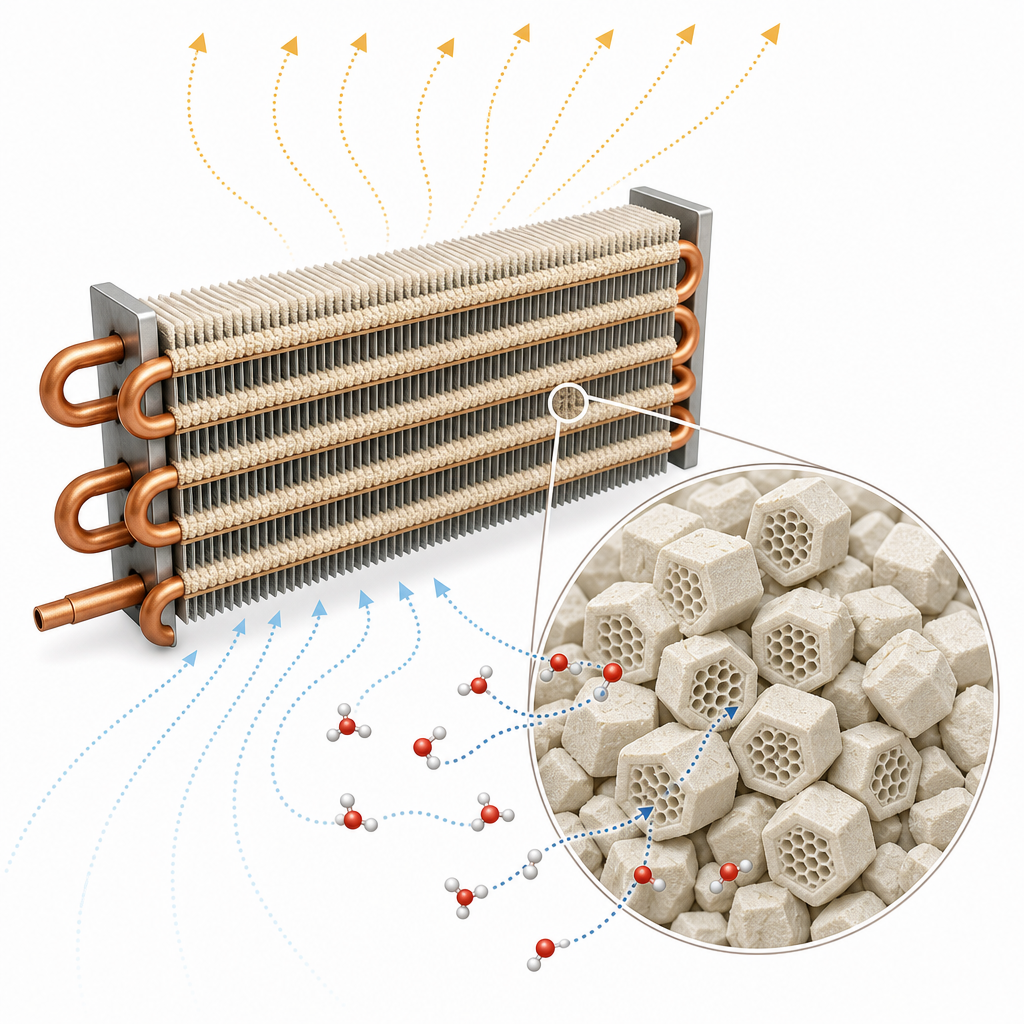
The authors selected SAPO-34, a silicoaluminophosphate zeolite with a CHA-type three-dimensional pore structure and 0.38 nm window. SAPO-34 offers a type-V water-vapor isotherm, moderate hydrophilicity, high water uptake (0.30–0.32 g/g at 25 °C and 100% RH), and a regeneration temperature of only 60–100 °C—well within what flat-plate or evacuated-tube solar collectors can deliver. The starting SAPO-34 powder was acquired from ACS Material with surface area ≥550 m²/g, pore volume ≥0.27 cm³/g, and ~2 μm particle size. The powder was dispersed (80 wt%) in a hydrolysed N-propyl-trimethoxy-silane binder solution and spray-deposited onto a degreased copper/aluminium finned coil (480 × 150 mm, 8 mm fin spacing, 6.4 m² exchange area) using a bilayer protocol with curing at 80 °C. Thermogravimetric measurements on the coated coupons showed an S-shaped adsorption curve characteristic of pure SAPO-34, with only a small loss in capacity attributable to the 20 wt% inert binder fraction.
Two experimental campaigns were carried out in the H/NAC laboratory using a two-chamber NADEH box with calibrated air-flow flanges, a 1000 L solar-heated water storage, and controllable air-handling units producing 30 °C / 12–14 g/kg inlet air. In Test 1, a complete 23-minute regeneration with 80 °C water raised the outlet air to 63 °C and drove a peak natural airflow of ~135 m³/h; the subsequent adsorption phase removed approximately 100 g of water in 45 minutes. In Test 2, an intermittent operation with 3–6 minute regeneration pulses and 32–52 minute adsorption phases was monitored across six successive cycles. The average dehumidification rate was approximately 2.5 g/kg, equivalent to a wet-bulb temperature reduction from 21.4 °C to 19.6 °C at the design inlet condition. Repeated ad/desorption tests on the coating confirmed fully reversible water uptake with no hysteresis, validating the SAPO-34 layer for durable cycling.
The demonstrated technology targets low-energy residential and small-commercial cooling, particularly retrofits where existing solar thermal collectors can supply regeneration heat. By eliminating the supply fan, the system removes one of the largest parasitic electrical loads in conventional DEC installations and aligns with passive-house and nearly-zero-energy building standards. The authors identify clear optimization paths: cooling the sorbent at the end of desorption to recover heat into domestic hot water, hybrid ventilation assistance during adsorption, and tuning of fin spacing for the buoyancy regime. The work also points toward broader applications of finned-coil adsorbent coatings in adsorption heat pumps, dehumidification wheels alternatives, and atmospheric water harvesting.
The sorbent at the heart of this study—SAPO-34 with ≥550 m²/g surface area and ~2 μm particle size—is available from ACS Material for researchers developing adsorption chillers, desiccant cooling demonstrators, low-temperature heat-pump beds, and water-sorption materials. The data reported here provide a useful benchmark for groups designing coated-coil adsorbers and evaluating silicoaluminophosphate zeolites against classical 4A or 13X aluminosilicates.How ACS Material products were used
- SAPO-34 (Molecular Sieves) — “The specific SAPO-34 used in this work as starting material for coating preparation was acquired from ACSMaterials®, with the following main technical parameters: surface area ≥550 m2/g; pore volume ≥0.27 cm3/g; and particle size ~2 μm.”
Product Performance in this StudyThe SAPO-34 zeolite from ACS Material served as the active adsorbent coating on the finned-coil heat exchanger, enabling buoyancy-driven dehumidification with a measured water capacity of 0.30–0.32 g/g. It successfully drove natural-convection desorption/adsorption cycles, with full reversibility and no hysteresis.
Related product categories
Frequently asked questionsWhy is SAPO-34 preferred over classical 4A or 13X zeolites for solar desiccant cooling?
SAPO-34 is a silicoaluminophosphate with a CHA-type three-dimensional pore network and a type-V water adsorption isotherm. This gives it moderate hydrophilicity, high water uptake of 0.30–0.32 g/g, and a regeneration temperature window of only 60–100 °C. Classical aluminosilicate zeolites such as 4A and 13X require considerably higher regeneration temperatures, making SAPO-34 better matched to flat-plate or evacuated-tube solar thermal collectors used in residential systems.
How does a SAPO-34 coated finned coil drive natural ventilation in a desiccant cooling system?
Hot water at around 80 °C from a solar collector flows through the finned coil and heats the SAPO-34 coating during regeneration, generating a buoyancy pressure that pulls air upward through the bed. During adsorption, the exothermic sorption heat itself warms the bed and sustains a similar upward natural-convection airflow. The Politecnico di Torino prototype achieved about 135 m³/h of fan-free airflow during 80 °C regeneration.
What dehumidification performance can a SAPO-34 coated coil achieve under buoyancy-only operation?
In the NADEH prototype tested with 30 °C and 12.5 g/kg inlet air, intermittent cycles using 3–6 minute regenerations at 80 °C produced an average dehumidification of approximately 2.5 g/kg of moisture removed, equivalent to lowering the wet-bulb temperature from 21.4 °C to 19.6 °C. A complete 23-minute regeneration adsorbed about 100 g of water in the subsequent 45-minute adsorption phase, confirming reproducible cycling without any auxiliary fan.