-
SAPO-34 Zeolite for Biobutanol Recovery - VUB, 2017
Jun 15, 2026 | ACS MATERIAL LLCPerre, S. V. d., Gelin, P., & Claessens, B. (2017). Intensified biobutanol recovery by using zeolites with complementary selectivity. *ChemSusChem*. https://doi.org/10.1002/cssc.201700667
ChemSusChem · 2017
Vrije Universiteit Brussel researchers paired Si-LTA with ACS Material SAPO-34 to recover biobutanol from ABE fermentation vapor at 99.7 mole% purity.
About this research
Researchers led by Vrije Universiteit Brussel report a vapor-phase adsorptive recovery scheme for biobutanol that pairs an all-silica LTA zeolite with commercial SAPO-34 obtained from ACS Material, achieving a butanol purity of 99.7 mole% at near-complete recovery from a simulated acetone–butanol–ethanol (ABE) fermentation vapor. The two adsorbents have complementary selectivity: Si-LTA preferentially captures n-butanol while SAPO-34 (the polar chabazite analogue) traps residual water and ethanol. The result is a sequential two-column process that addresses the longstanding cost problem of distilling dilute butanol from fermentation broths.
Biobutanol is attractive as both a drop-in biofuel and a platform chemical for butadiene, butyl acrylate, dibutyl ether, and plasticizer precursors. However, ABE fermentation produces only 2–3 wt% total solvents in a 3:6:1 acetone:butanol:ethanol ratio in water, and conventional distillation can consume more energy than is stored in the butanol itself. Adsorptive recovery is the leading alternative to distillation, gas stripping, pervaporation, and liquid–liquid extraction, but most prior work focused on liquid-phase contacting, where competing acids, salts, and microbial fouling complicate operation. Working from the fermenter head space in vapor phase avoids those issues, and the present study shows that hydrophobic, shape-selective zeolites can resolve butanol cleanly even in the presence of substantial water vapor.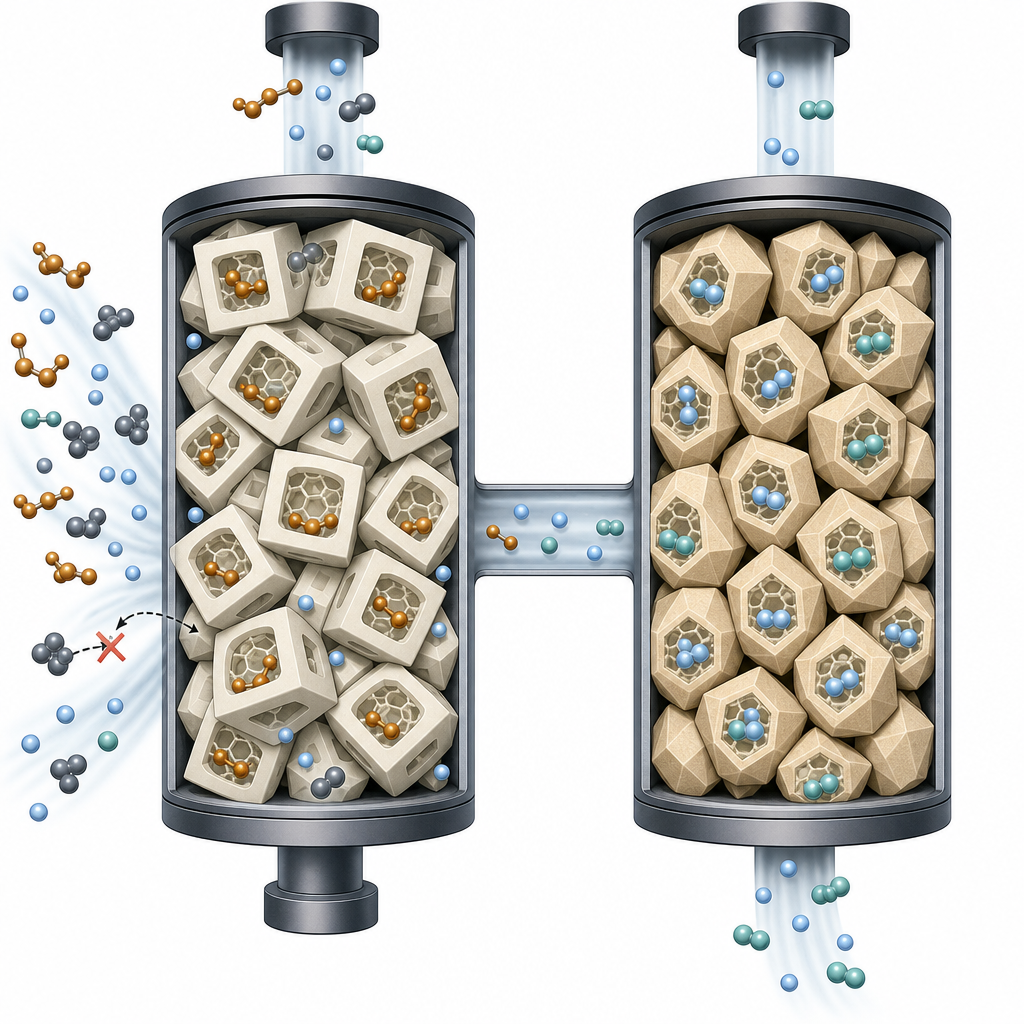
The second column in the cascade used SAPO-34 supplied by ACS Material (Medford, USA), a hydrophilic silicoaluminophosphate with the CHA topology. Si-LTA crystals (average ~2.5 µm) performed the bulk butanol capture from the humid ABE vapor; the loaded column was then thermally desorbed (up to 120 °C, 1 °C min⁻¹) under helium and the effluent passed through the SAPO-34 polishing column held at 40 °C for the first 50 minutes of desorption. SAPO-34 was chosen over hydrophobic Si-CHA because it combines the chabazite cage's strong ethanol selectivity and butanol rejection with high water affinity, allowing it to remove both impurities in one step. The packed column geometry (10 cm × 0.21 cm i.d., 250–500 µm pellets) and on-line GC analysis followed standard breakthrough protocols. SAPO-34 had been previously characterized by the group and showed only negligible catalytic conversion of ethanol or acetone at 40 °C, well below the temperatures used in MTO/ETO chemistry.
Single-component vapor isotherms at 40 °C showed Si-LTA adsorbed butanol with a type-I profile (~1.6 mmol g⁻¹) while excluding acetone by molecular sieving (kinetic diameter 4.7 Å versus an LTA window of ~4.2 Å). Water uptake on Si-LTA stayed below 2.0 mmol g⁻¹ at 85% RH, confirming a near defect-free hydrophobic framework, supported by ²⁹Si BD-MAS NMR. DFT calculations placed butanol interaction energies at −64.6 kJ mol⁻¹ on Si-LTA and −70.9 kJ mol⁻¹ on Si-CHA, both well above water (−25 kJ mol⁻¹). In ABE breakthrough experiments at 89 mol% water vapor, Si-LTA loaded 1.458 mmol g⁻¹ butanol versus only 0.060 mmol g⁻¹ ethanol and 0.006 mmol g⁻¹ acetone, preserving selectivity in humid conditions. With Si-LTA alone, a butanol purity of 65.5 mole% was obtained at >99.5% recovery. Adding the SAPO-34 polishing column lifted purity to 99.7 mole% at the same recovery, and to 99.9 mole% at 90% recovery. By comparison, prior reports on silicalite, ZIF-8, ZSM-5, and activated carbon F-400 typically reached 15–88 wt% butanol concentrations, often at lower recovery.
The demonstrated purity-recovery combination is directly relevant to integrated biorefineries seeking to displace petroleum-derived butanol. Coupling adsorption to a fermenter's vapor head space avoids product inhibition, cell clogging, and the low-pH stability problems of liquid-phase adsorbents, while the absence of fermentable sugars and organic acids in vapor reduces competitive adsorption. The complementary-selectivity strategy generalizes to other dilute biobased chemicals where one adsorbent captures the target and a second traps polar impurities. The authors suggest extension to additional small biobased molecules recovered from aqueous mixtures, and the approach is compatible with gas-stripping front-ends already proposed in the literature.
For researchers working on bioalcohol recovery, zeolite membranes, or adsorptive separations, the SAPO-34 used in this study is available from ACS Material in the molecular sieves catalog, along with Si-CHA-type and other framework structures suitable for adsorption and catalysis testing. The paper documents specific loadings, selectivities, and desorption profiles that can serve as a benchmark for sourcing and qualifying chabazite-type adsorbents in downstream-processing R&D.How ACS Material products were used
- SAPO-34 (Molecular Sieves) — “Commercial SAPO-34 was obtained from ACS Material (Medford, USA) and was already extensively characterized in a previous study.”
Product Performance in this StudySAPO-34 served as the second adsorption column with selectivity complementary to Si-LTA. It removed essentially all water and most of the ethanol from the Si-LTA effluent, raising butanol purity to 99.7 mole% at near-complete recovery.
Related product categories
Frequently asked questionsWhy is SAPO-34 effective as a polishing adsorbent for biobutanol purification?
SAPO-34 has the chabazite (CHA) topology, whose ~3.8 × 4.2 Å eight-membered ring windows kinetically reject n-butanol while readily admitting ethanol and water. As the polar aluminosilicate analogue of Si-CHA, it also has strong water affinity. Placed downstream of a Si-LTA butanol-capture column, SAPO-34 simultaneously traps residual ethanol and water from the desorption stream, raising butanol purity from about 65 mole% to 99.7 mole% at near-complete recovery.
How does vapor-phase adsorption compare to liquid-phase recovery of biobutanol?
Vapor-phase operation captures solvents directly from the fermenter head space, where the ABE/water ratio is more favorable than in the broth. It avoids competition from organic acids and sugars, eliminates adsorbent fouling by microbial cells and inorganic salts, and bypasses the low-pH stability problems that affect liquid-phase adsorbents. The present study showed Si-LTA retained butanol selectivity even at 89 mol% water vapor in the feed.
What butanol purity and recovery can a two-column zeolite cascade achieve?
Using Si-LTA followed by SAPO-34 as a complementary polishing column, the authors obtained butanol at 99.7 mole% purity with greater than 99.5% recovery, and 99.9 mole% purity at 90% recovery. These values are substantially higher than reported for silicalite (88.5 wt%), ZIF-8 (20 wt% with methanol displacement), ZSM-5 (84.3 wt%), or activated carbon F-400 (15 wt%) in earlier liquid-phase studies.