-
SAPO-34 Zeolite for Cu/SAPO-34 NH3-SCR Catalysts - PNNL, 2015
May 29, 2026 | ACS MATERIAL LLCGao, F. et al. (2015). Synthesis and evaluation of Cu/SAPO-34 catalysts for NH 3 -SCR 2: Solid-State ion exchange and one-Pot synthesis. *Applied Catalysis B: Environmental*. https://doi.org/10.1016/j.apcatb.2014.07.029
Applied Catalysis B: Environmental · 2015
PNNL researchers used ACS Material SAPO-34 to synthesize Cu/SAPO-34 catalysts via solid-state ion exchange and one-pot routes for diesel NH3-SCR.
About this research
Researchers at Pacific Northwest National Laboratory (PNNL) used SAPO-34 chabazite zeolite purchased from ACS Material as a reference substrate to develop reproducible Cu/SAPO-34 catalysts for ammonia selective catalytic reduction (NH3-SCR) of diesel-engine NOx emissions, comparing solid-state ion exchange (SSIE) and one-pot synthesis routes. Published in Applied Catalysis B: Environmental in 2015, the study by Gao, Walter, Washton, Szanyi, and Peden establishes that both alternative routes can generate well-defined Cu/SAPO-34 catalysts containing predominately isolated Cu2+ ions, the active species for NOx reduction, while clarifying the conditions under which competing CuO clusters and copper aluminate phases form and degrade selectivity.
Cu/SAPO-34 is one of the commercial Cu/chabazite SCR catalysts deployed for diesel-engine exhaust after-treatment, but its synthesis via traditional aqueous ion exchange suffers from irreversible SAPO-34 hydrolysis that lowers surface area, pore volume, and crystallinity. As a result, samples produced by solution ion exchange are not well-defined enough for fundamental structure–function studies or for lab-to-lab comparisons. The paper addresses this bottleneck by systematically evaluating SSIE and one-pot synthesis as cleaner pathways to model Cu/SAPO-34 catalysts. The work matters for emissions-control researchers, automotive catalyst developers, and zeolite chemists who need quantitative links between Cu speciation in CHA frameworks and NH3-SCR performance under realistic GHSV and water-containing feeds.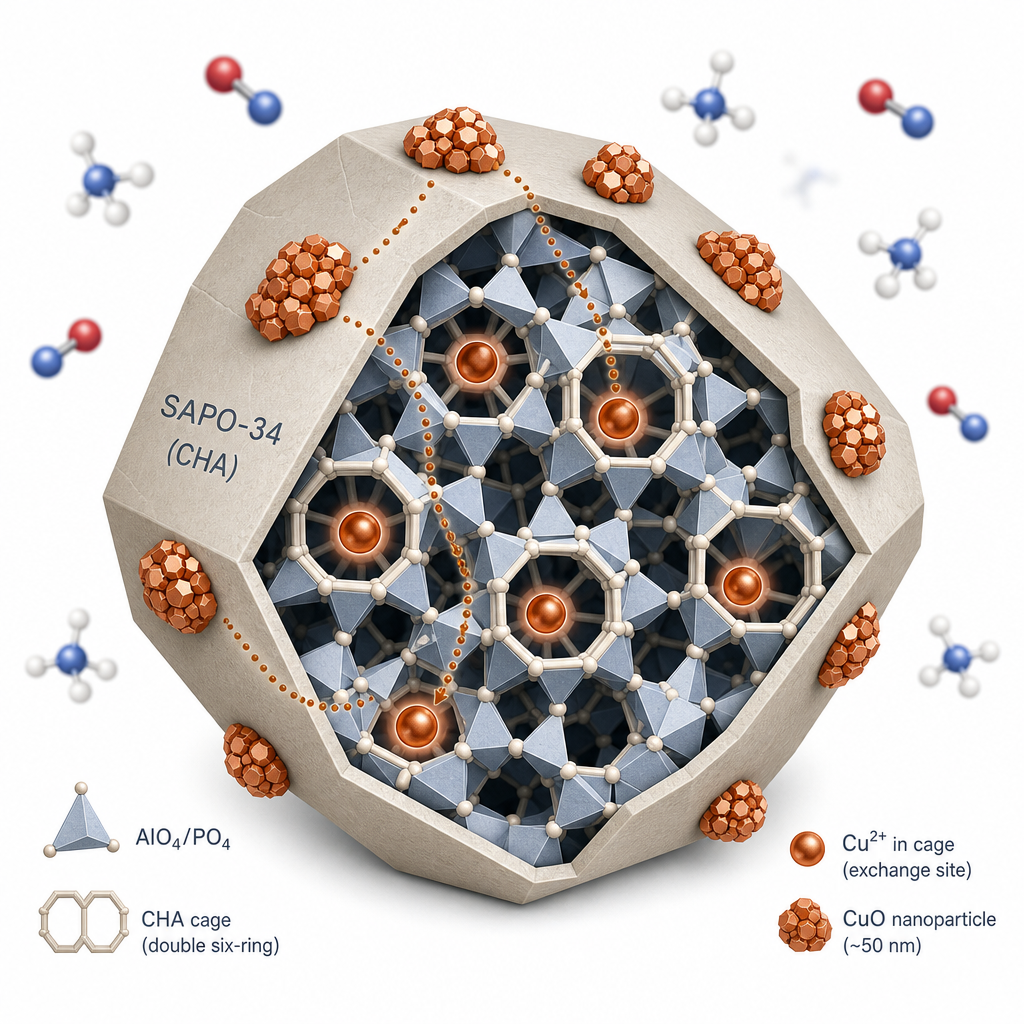
The ACS Material SAPO-34 product, designated SAPO-34-ACS in the paper, was used as one of two principal substrates for SSIE Cu-loading studies. Its BET surface area was measured at 564 m²/g with a micropore volume of 0.273 cm³/g, essentially identical to an in-house SAPO-34-MOR sample (549 m²/g, 0.268 cm³/g), making it ideal for direct comparison. SSIE was performed by thoroughly mixing 1 g of SAPO-34-ACS with controlled amounts of nano-CuO (approximately 50 nm Sigma-Aldrich) in a mortar at loadings ranging from 5.75 to 60.0 mg CuO per gram of zeolite, followed by calcination in air at temperatures up to 800 °C for periods up to 16 h. The resulting Cu/SAPO-34 powders were pressed, crushed, and sieved (60–80 mesh) before NH3-SCR testing in a plug-flow reactor at ~400,000 h⁻¹ GHSV with feed gas containing 350 ppm NO, 350 ppm NH3, 14% O2, and 2.5% H2O.
TPR and EPR confirmed that SSIE on SAPO-34-ACS proceeds at temperatures as low as 600 °C, with the Cu2+ → Cu+ reduction feature near 240–250 °C growing as calcination time and temperature increased. After 16 h at 800 °C, about 67% of the loaded CuO converted to isolated Cu2+ ions at a total Cu loading of ~1.2 wt%, with the remainder persisting as EPR-silent CuO clusters. XRD verified that the chabazite framework was largely preserved, though a tridymite (SiO2) phase appeared at 2θ = 21.3°, signaling partial decomposition of highly defective regions. At the highest 60.0 mg/g loading, strong CuO and tridymite diffraction peaks appeared together with a new EPR feature near 3310 G and a broad high-temperature TPR reduction at ~500 °C, assigned to a copper aluminate phase. BET surface area for this over-loaded sample dropped to 309 m²/g (versus 494 m²/g at 5.75 mg/g), and EPR-active Cu2+ reached 2.31 wt%. Catalytically, isolated Cu2+ ions were highly active and selective for standard NH3-SCR, while residual CuO and weakly bound Cu species catalyzed non-selective NH3 oxidation above 350 °C. Below ~155 °C, the reaction appeared kinetically limited.
These results give catalyst designers a practical recipe for building well-defined Cu/SAPO-34 SCR catalysts without the hydrolysis problems of aqueous exchange, and they identify Cu loading and calcination severity as the levers that control the balance between selective Cu2+ sites and parasitic CuO. The findings are directly applicable to heavy-duty diesel emission control, lean-burn engine after-treatment, stationary NOx abatement, and broader Cu-zeolite catalysis (for example, methane-to-methanol and oxidation reactions on chabazite-type frameworks). The systematic SSIE protocol also provides a model-catalyst platform for ongoing structure–function and operando spectroscopy studies on small-pore zeolites.
For researchers pursuing similar Cu-zeolite or NH3-SCR work, SAPO-34 and related molecular sieves are available from ACS Material's molecular sieves catalog, including ZSM-5, SAPO-11, SAPO-34, SSZ-13, and other chabazite-family zeolites suitable for ion exchange, one-pot Cu incorporation, and NOx-reduction catalyst development. The PNNL study indicates that commercially sourced SAPO-34 with high BET surface area and well-developed microporosity is a reliable starting substrate when reproducible Cu speciation is required.How ACS Material products were used
- SAPO-34 Zeolite (SAPO-34-ACS) (Molecular Sieves) — “One of these samples was purchased from ACS Material®, and is denoted here as SAPO-34-ACS.”
Product Performance in this StudyThe commercially purchased SAPO-34-ACS substrate served as one of the two key SAPO-34 frameworks used for both solid-state ion exchange and Cu loading studies. It exhibited a BET surface area of 564 m²/g and micropore volume of 0.273 cm³/g, essentially identical to the in-house SAPO-34-MOR sample, which made it ideal as a reference substrate for systematic comparison and for probing Cu loading effects in Cu/SAPO-34 NH3-SCR catalyst synthesis.
Related product categories
Frequently asked questionsWhy is SAPO-34 a preferred zeolite for NH3-SCR catalysts?
SAPO-34 has the small-pore chabazite (CHA) framework, which stabilizes isolated Cu2+ ions and resists hydrocarbon poisoning while remaining selective toward N2 in NH3-SCR of NOx. Its 8-membered ring pores limit the formation of unwanted large intermediates, and its silicoaluminophosphate composition provides moderate acidity. These features make Cu/SAPO-34 one of the leading commercial catalysts for diesel engine exhaust after-treatment.
How does solid-state ion exchange create active Cu2+ sites in SAPO-34?
In solid-state ion exchange, CuO powder is physically mixed with H-form SAPO-34 and calcined in air at 600–800 °C. Protons in the zeolite react with CuO to form isolated Cu2+ ions at exchange sites, releasing water. This route avoids the hydrolysis of SAPO-34 that occurs in aqueous ion exchange. The PNNL study found that at 800 °C for 16 h about 67% of the loaded CuO converts to isolated Cu2+ ions.
What happens when Cu loading on SAPO-34 is too high?
Excessive Cu loading leaves unreacted CuO clusters and promotes formation of weakly bound Cu species and copper aluminate phases from partial SAPO-34 decomposition. These species are highly active for non-selective ammonia oxidation above 350 °C, reducing NOx conversion selectivity. BET surface area also drops sharply, from ~494 m²/g at 5.75 mg CuO/g to 309 m²/g at 60 mg CuO/g, signaling framework damage.