-
SBA-15 and H-ZSM-5 SANS Analysis - University of Adelaide, 2018
Jun 25, 2026 | ACS MATERIAL LLCMadani, S. H. et al. (2018). Particle and cluster analyses of silica powders via small angle neutron scattering. *Powder Technology*. https://doi.org/10.1016/j.powtec.2017.12.061
Powder Technology · 2018
University of Adelaide researchers used SANS with Guinier-Porod and mass-surface fractal models to characterize ACS Material SBA-15 and H-ZSM-5 silica powders.
About this research
Researchers at the University of Adelaide, working with the Australian Nuclear Science and Technology Organisation (ANSTO) and the University of South Australia, used small angle neutron scattering (SANS) on SBA-15 mesoporous silica and H-ZSM-5 zeolite purchased from ACS Material LLC to extract particle, cluster, and fractal dimensions of silica powders. By fitting Guinier-Porod and mass-surface fractal models to scattering curves from the QUOKKA instrument at the OPAL reactor, the team demonstrated that SANS-derived dimensions agree closely with nitrogen-adsorption-based BET radii and that the SBA-15 sample shows clear two-dimensional Bragg peaks consistent with ordered cylindrical pore packing.
Silica powders are workhorse adsorbents and catalyst supports, used to remove heavy metals and dyes from water, capture volatile organic compounds from exhaust streams, and serve as scaffolds for ionic-liquid-based CO2 sorbents. Pore architecture and primary-particle morphology dominate their performance, but gas adsorption alone cannot resolve closed or blind pores, nor can it cleanly separate primary particle scattering from cluster-level structure. SANS is complementary because neutrons probe length scales from ~1 nm to roughly a micron and distinguish solid and void phases via contrast. The open question this paper addresses is how well modern Guinier-Porod and combined mass-surface fractal models, when applied with rigorous uncertainty propagation, reproduce known textural parameters across silicas spanning ordered microporous zeolites, ordered mesoporous SBA-15, fumed silica, and disordered mesoporous silica.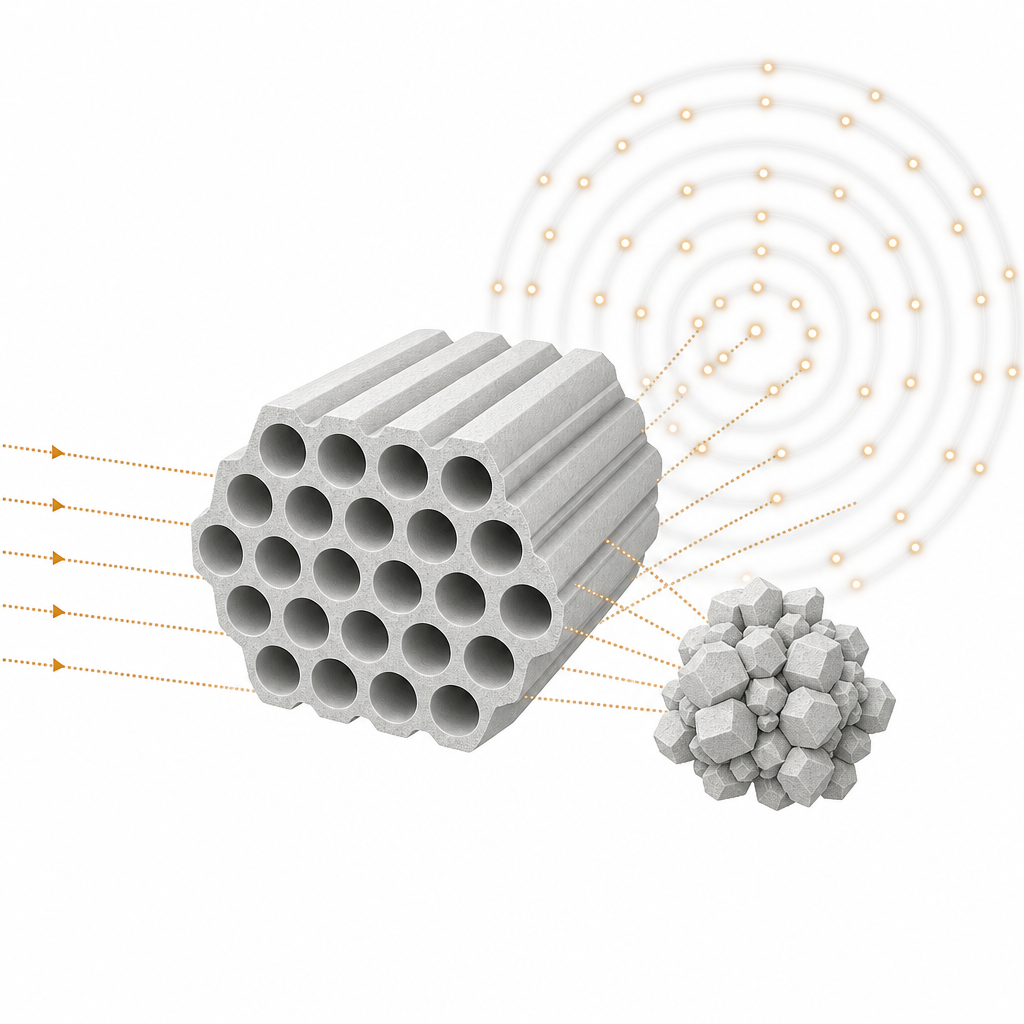
Two of the four silica samples were obtained from ACS Material LLC (Massachusetts, USA) and used as received. Sample S5 was a predominantly siliceous H-ZSM-5 zeolite (designated P26, SiO2:Al2O3 ≈ 26:1, Na content <0.1 wt%, water content <5 wt%, particle diameter 200–1000 nm with a dominant population near 300 nm). Sample S15 was SBA-15 with a reported mean cylindrical pore size of 8 ± 1 nm. Both materials were degassed at 393 K under 10⁻⁵ kPa for 12 hours before nitrogen adsorption at 77 K on Belsorp-Max (S15) and Micromeritics TriStar II 3020 (S5) systems. For SANS, powders were loaded into 1 mm demountable cells with quartz windows on QUOKKA at the OPAL reactor (sample masses: S5 = 103.2 mg, S15 = 69.9 mg). An incident wavelength of 5 Å and sample-detector distances of 2, 12, and 20 m gave a q-range of 0.00365–0.5010 Å⁻¹. Scattering data were reduced with Igor macros and fit in SasView 4.0.1 using the Guinier-Porod, power-law, and mass-surface fractal models.
For S5 (H-ZSM-5), the Guinier-Porod fit returned a radius of gyration Rg = 321.0 ± 1.7 Å, a Porod exponent near 4, and a derived primary particle radius Rp,G-P = 454.0 ± 2.2 Å, while the BET-equivalent particle radius was 43.5 ± 1.4 Å. Power-law fitting revealed two slopes of −4.0 and −3.8 at different q-ranges, statistically distinct and consistent with both smooth and slightly rough surface scattering. The mass-surface fractal model yielded Dm = 2.29 ± 0.19 and Ds = 2.0 ± 0.02, with cluster Rg agreeing with the Guinier-Porod result. For S15 (SBA-15), scattering up to q ≈ 0.02 Å⁻¹ was clearly Porod-like, and four distinct Bragg peaks were observed at q = 0.06847, 0.11853, 0.13818, and 0.18109 Å⁻¹, consistent with the [10], [11], [20], and [21] reflections of a 2D hexagonal pore lattice. These positions matched HRTEM images of the cylindrical-pore honeycomb. Across all four silicas, the inverse of the cluster correlation length reproduced the Porod-to-Guinier crossover q1, validating the combined analytical framework and confirming that mass-surface fractal modeling captures both primary particle and cluster-scale structure.
The study provides a transferable workflow for researchers who need to characterize silica adsorbents, catalyst supports, and ionic-liquid host matrices beyond what nitrogen adsorption alone can deliver. Direct applications include CO2 capture sorbents built on supported ionic liquids, heavy-metal remediation adsorbents, ZSM-5 catalysts in petrochemical conversion, and SBA-15 templates for nanoparticle synthesis. The authors note that this work is a foundation for follow-up SANS studies of the same pores partially filled with ionic liquids, where contrast variation and partial pore filling will reveal accessible versus blind pore populations. The same methodology should extend to other ordered mesoporous silicas (KIT-6, MCM-41) and to characterizing aging or activation effects in industrial catalysts.
For researchers studying mesoporous silica, zeolites, or hierarchical porous materials, the SBA-15 and H-ZSM-5 powders used in this work are available from ACS Material LLC's molecular sieves catalog. The paper demonstrates that commercial SBA-15 from ACS Material exhibits the expected ordered 2D hexagonal pore lattice by both SANS and HRTEM, and that commercial H-ZSM-5 (P26) gives clean, model-conformant scattering across multiple length scales. These results support the use of these materials as reproducible reference solids for SANS method development, fractal analysis benchmarking, and downstream adsorbent or catalyst formulation studies.How ACS Material products were used
- H-ZSM-5 zeolite P26 (sample S5) (Molecular Sieves) — “Sample S5 was the predominantly silica content zeolite H-ZSM-5 obtained as P26, reported as (SiO2)26·Al2O3... Samples S5 and S15 were purchased from ACS Material LLC (Massachusetts, USA)”
- SBA-15 mesoporous silica (sample S15) (Molecular Sieves) — “Sample S15 was SBA-15 reported to have a mean (cylindrical) pore size of 8 ± 1 nm... Samples S5 and S15 were purchased from ACS Material LLC (Massachusetts, USA)”
Product Performance in this StudySBA-15 provided a hierarchically-ordered mesoporous silica reference with well-defined cylindrical pores (~8 nm). SANS revealed clear 2D Bragg peaks (q = 0.0685, 0.1185, 0.1382, 0.1811 Å⁻¹) consistent with ordered honeycomb pore packing, confirming the material's structural integrity.
Related product categories
Frequently asked questionsHow does SANS complement nitrogen adsorption for characterizing SBA-15 and H-ZSM-5?
Nitrogen adsorption gives BET surface area and pore size from accessible pores, but cannot probe blind or closed pores and cannot separate primary particle from cluster-scale structure. SANS resolves length scales from about 1 nm to nearly a micron via neutron-contrast between silica and void, captures fractal dimensions of mass and surface, and reveals Bragg peaks from ordered pore lattices, providing structural information that adsorption alone misses.
What does the Guinier-Porod model reveal about silica powders?
The Guinier-Porod model empirically merges Guinier and Porod scattering laws so a single fit covers small and large q. It returns a radius of gyration Rg, a Porod exponent m, and a shape parameter s that distinguishes spheres, rods, and platelets. For ACS Material SBA-15 and H-ZSM-5, Porod exponents near 4 indicated relatively smooth surfaces, and derived particle radii agreed with BET-equivalent values.
Why are Bragg peaks important in SANS of SBA-15?
Bragg peaks in the SANS pattern of SBA-15 mark long-range periodicity in the pore lattice. In this study, four peaks at q = 0.0685, 0.1185, 0.1382, and 0.1811 Å⁻¹ correspond to the [10], [11], [20], and [21] reflections of a 2D hexagonal arrangement of cylindrical pores. Their presence confirms that the commercial SBA-15 retains the honeycomb pore architecture expected from HRTEM.