-
SBA-15 Mesoporous Molecular Sieve
Aug 16, 2018 | ACS MATERIAL LLCFor decades, chemists faced a frustrating gap: zeolites offered exquisitely ordered pores, but only at the sub-nanometer scale, too small for bulky molecules; ordinary porous silicas could be made with wider pores, but those pores were disordered and irregular. SBA-15 — Santa Barbara Amorphous No. 15 — closed that gap. With uniform, parallel mesopores you can tune from roughly 5 to 30 nm, unusually thick and robust pore walls, and a surface area above 550 m²/g, it became one of the most widely used mesoporous materials in catalysis, drug delivery, separation, and nanofabrication. This article explains what SBA-15 is, how it forms, how its structure governs its behavior, and where it is put to work — with links to the SBA-15 and related molecular sieves available from ACS Material.
What is SBA-15?
SBA-15 is an ordered mesoporous silica: a solid built from amorphous silica (SiO₂) walls arranged so that the empty space between them forms a regular, repeating array of cylindrical channels. The channels pack in a two-dimensional hexagonal pattern — each pore surrounded by six neighbors — described by the plane group p6mm.2 It was first reported in 1998 by Dongyuan Zhao and co-workers in the group of Galen Stucky at the University of California, Santa Barbara, which is where the "SBA" name comes from.2
The word "mesoporous" is precise. The IUPAC classification divides porous solids by pore width: microporous below 2 nm (the realm of zeolites), mesoporous from 2 to 50 nm, and macroporous above 50 nm. The first ordered mesoporous silicas — the M41S family, including the famous MCM-41 — were discovered by Mobil researchers in 1992 using small surfactant molecules as templates.1 SBA-15 arrived six years later and solved two practical limitations of MCM-41 at once: by switching to a large non-ionic block-copolymer template it reached substantially larger pores, and by growing much thicker silica walls it gained markedly better hydrothermal and mechanical stability.2
The structure: pores, walls, and a hidden micropore network
It helps to picture SBA-15 as a bundle of drinking straws packed in a honeycomb. The hollow interiors are the mesopores; the straw walls are the silica framework. Two features set SBA-15 apart from earlier mesoporous silicas, and both trace back to the same cause — the polymer template.
First, the pore walls are thick, typically on the order of 3 to 6 nm, several times thicker than the roughly 1 nm walls of MCM-41. Thicker walls are the structural reason SBA-15 survives boiling water, steam, and repeated thermal cycling far better than thin-walled mesoporous silicas — a property that matters enormously for any catalyst or adsorbent meant to be regenerated and reused.2
Second, those walls are not solid. During synthesis the poly(ethylene oxide) segments of the template thread into the forming silica, and when they are removed they leave behind a network of micropores and small mesopores that connect neighboring main channels through the walls.4 This complementary porosity has real consequences. It means the main channels are interconnected rather than strictly isolated, which improves molecular access and is essential when SBA-15 is used as a hard template to cast replica materials. It also complicates surface-area measurement: because micropores fill at very low pressure, the standard Brunauer–Emmett–Teller (BET) analysis and the t-plot method can misrepresent the true surface area, and careful geometric models are needed to separate genuine mesopore surface from micropore contributions.5 Importantly, the amount of microporosity is not fixed — it depends on synthesis conditions, and raising the synthesis temperature progressively shrinks the micropore volume until it nearly disappears for material aged near 130 °C.5
Because the silica framework itself is amorphous, SBA-15 shows no sharp peaks in wide-angle X-ray diffraction. Its order is a meso-scale order — the regular spacing of the channels, not of atoms — so its signature appears at very low angles, as a strong (100) reflection with weaker (110) and (200) peaks confirming the hexagonal lattice.2
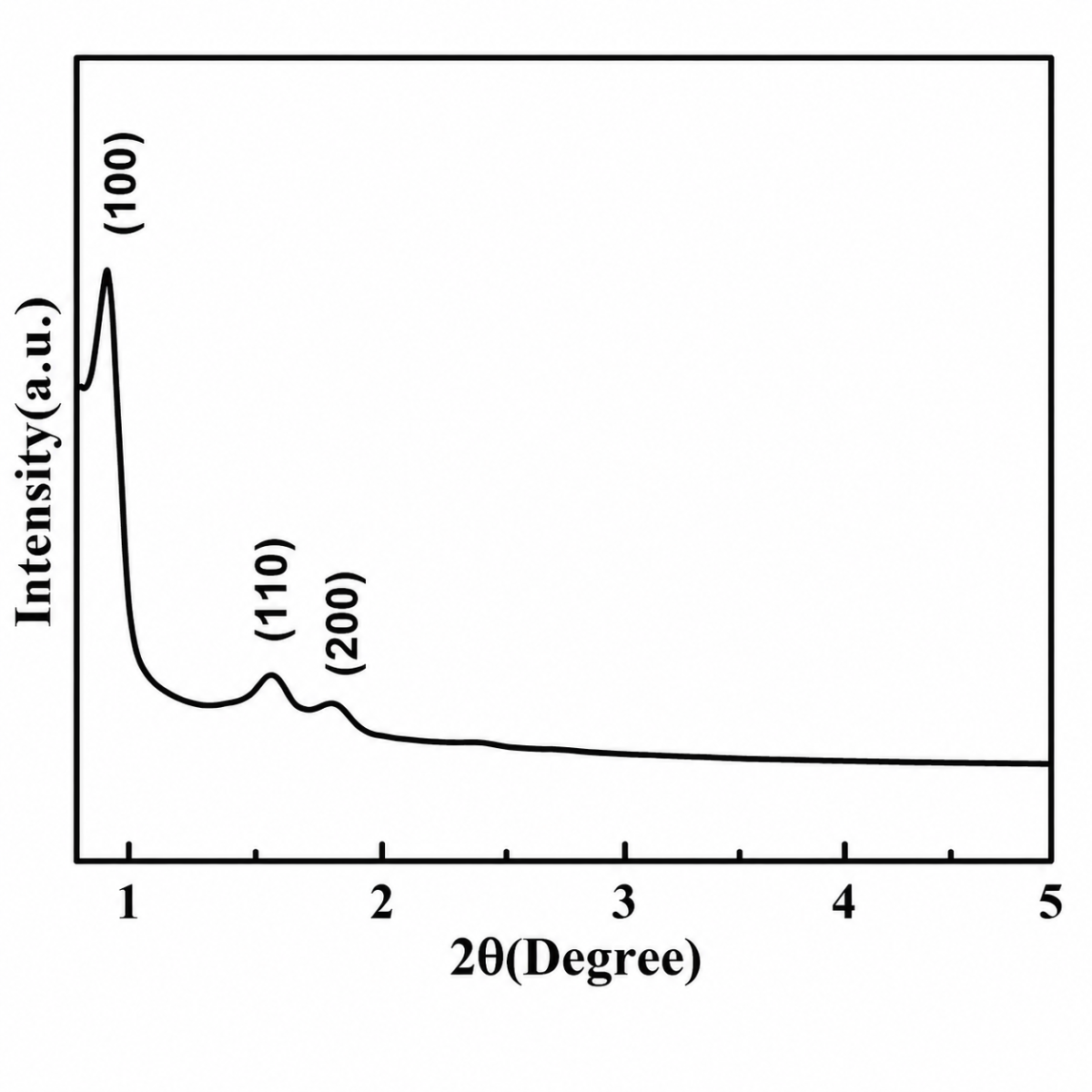
Figure 1. Typical XRD analysis of ACS Material mesoporous silica molecular sieve SBA-15. The low-angle (100), (110), and (200) reflections confirm the ordered 2-D hexagonal (p6mm) mesostructure, while the absence of sharp wide-angle peaks reflects the amorphous silica walls. How SBA-15 is made: cooperative self-assembly
SBA-15 is synthesized by a hydrothermal, soft-templating route built around Pluronic P123, a commercially available triblock copolymer with the structure EO₂₀PO₇₀EO₂₀ (PEO₂₀-PPO₇₀-PEO₂₀) — two water-loving poly(ethylene oxide) blocks flanking a water-avoiding poly(propylene oxide) block.2 In water under strongly acidic conditions, these molecules self-assemble into micelles, and the micelles in turn organize into a hexagonal liquid-crystalline arrangement.
A silica source — usually tetraethyl orthosilicate (TEOS) — is then added. TEOS hydrolyzes and condenses preferentially around the hydrophilic PEO corona of the micelles, depositing a silica framework that faithfully copies the template's geometry. This cooperative organization of surfactant and inorganic precursor is the heart of the mechanism. A typical preparation stirs P123 in acidic water, adds TEOS, holds the mixture around 35–40 °C while the mesostructure forms, then ages it at a higher temperature (commonly near 80–100 °C) to thicken and strengthen the walls and widen the pores.2
The final and essential step is template removal. The solid is filtered and dried, then the organic copolymer is burned out — ACS Material's SBA-15, for example, is calcined in air at 823 K (550 °C) for 6 hours — leaving a fine white powder of pure mesoporous silica with its channels now open and empty. Solvent extraction with ethanol or acid–solvent reflux is a milder alternative that can recover the template for reuse and preserve more surface silanol groups for later functionalization.2
SBA-15 at a glance — typical ACS Material specifications
- Structure: 2-D hexagonal mesopores, plane group p6mm
- Pore diameter: ~6–11 nm (tunable in synthesis, broadly ~5–30 nm across the literature)
- BET surface area: ≥550 m²/g
- Pore volume: ~1.46 cm³/g
- Particle size: ~1–4 µm
- Framework: amorphous silica with thick (~3–6 nm) walls; abundant surface silanols
- Appearance: white powder, calcined and ready to use
Tuning the pore size
One of the most useful aspects of SBA-15 is how readily its dimensions can be dialed in. Three handles dominate. Aging temperature and time are the simplest: higher temperatures and longer aging swell the micelles and enlarge the mesopores while thinning the wall micropores.5 Swelling agents such as 1,3,5-trimethylbenzene partition into the hydrophobic micelle cores and push the pores wider, reaching diameters well beyond the standard range. And the choice of copolymer — varying the relative lengths of the PEO and PPO blocks — changes the micelle geometry and therefore the pore size and even the symmetry of the final material.3 This tunability is exactly why SBA-15 became a research workhorse: the same chemistry yields a family of materials matched to molecules of very different sizes.
Functionalization: giving inert silica a job
Pure siliceous SBA-15 is chemically rather inert — its framework is electronically neutral and it has little intrinsic catalytic acidity.9 Its value as a functional material comes from the dense population of silanol (Si–OH) groups lining the pore walls, which serve as anchor points for a vast range of chemistry. Two general strategies are used.
Post-synthesis grafting reacts organosilanes (for example aminopropyl- or mercaptopropyl-trialkoxysilanes) with the surface silanols after the silica is made, attaching functional groups to the pore walls. Co-condensation instead mixes the organosilane with TEOS during synthesis, so functional groups are built into the framework from the start, giving more uniform distribution though sometimes at the cost of order. Beyond organic groups, heteroatoms (such as aluminum, titanium, or zirconium) can be incorporated to introduce acidity or redox activity, and metal oxides, single-site species, and metal nanoparticles can be deposited inside the channels.6 The confined geometry of the mesopores does more than hold these species in place — it can stabilize nanoparticles against sintering and even influence reaction selectivity.
What SBA-15 is used for
Almost every use of SBA-15 comes back to one idea: it is a molecular-scale container whose pores are large enough, uniform enough, and stable enough to host useful guests. The interactive tool below shows that size-matching principle directly — compare how a microporous zeolite, MCM-41, and SBA-15 admit or exclude molecules of increasing size.
Heterogeneous catalysis and catalyst supports
The single most important and widely studied application of SBA-15 is as a catalyst support. Its high surface area disperses active phases into many small, accessible particles; its large, uniform pores let bulky reactants and products diffuse in and out with far less hindrance than in microporous zeolites; and its thick walls let the whole assembly survive harsh reaction and regeneration conditions.9 Functionalized SBA-15 has been deployed across an enormous range of reactions — acid- and base-catalyzed organic transformations, selective oxidations, and more — as reviewed comprehensively in recent literature.6 Two classic examples illustrate the range: SBA-15 supports for hydrodesulfurization catalysts that strip sulfur from fuels, where the ordered mesopores improve dispersion of the active metal sulfides,9 and SBA-15-supported iron and cobalt catalysts for Fischer–Tropsch synthesis, where confinement of the metal nanoparticles inside the channels can improve their dispersion and stability during the conversion of synthesis gas to hydrocarbons.6
Drug delivery and controlled release
The discovery in 2001 that ordered mesoporous silica could load and slowly release a drug — demonstrated first with ibuprofen in MCM-41 — opened a major field.7 SBA-15 is especially attractive here because its larger pores accommodate bigger drug molecules and even proteins, while its widely studied biocompatibility, enormous internal volume, and easily modified surface allow loading and release to be engineered.8 The release rate can be tuned through pore size, particle morphology, and surface functional groups, and pH- or temperature-responsive coatings can act as molecular "gates" that hold cargo until a trigger is applied.10 Because the drug sits inside a rigid, separate host environment, the platform can often be applied without chemically modifying the therapeutic itself.8
Enzyme immobilization and biocatalysis
SBA-15's larger pores make it one of the better mesoporous hosts for immobilizing enzymes and other proteins, which are simply too large to fit inside zeolites or small-pore MCM-41.11 Trapping an enzyme inside a pore that just exceeds its own diameter can dramatically improve its stability against heat, pH swings, and organic solvents, while allowing it to be recovered and reused — the central goal of industrial biocatalysis. Matching pore size to molecular size is the key design rule, and SBA-15's tunable, large pores make that matching practical for a wide spread of proteins.11
Adsorption, separation, and environmental cleanup
Functionalized mesoporous silicas are versatile adsorbents.12 SBA-15 grafted with amine groups captures carbon dioxide from gas streams; grafted with thiol groups it binds heavy-metal ions such as mercury and lead from contaminated water; and its large pores suit the uptake of bulky organic pollutants and biomolecules. The combination of high capacity (from the surface area), selectivity (from the chosen functional groups), and reusability (from the robust framework) is what makes ordered mesoporous silica an enduring platform for pollution control, gas storage, and separations.12
Hard templates for nanomaterials
Finally, SBA-15 is a premier hard template for casting other ordered nanostructures. Filling its interconnected channels with a carbon precursor, carbonizing it, and then dissolving away the silica yields CMK-3, an ordered mesoporous carbon that is essentially a negative replica of the SBA-15 pore system.13 The same nanocasting approach produces ordered metal, metal-oxide, and polymer nanostructures — and it works precisely because the wall micropores connect the main channels, so the replica holds together as a single rigid framework after the template is removed.13
SBA-15 versus other ordered mesoporous sieves
SBA-15 belongs to a broad family of ordered mesoporous materials, each with a different pore geometry and size range suited to different tasks. The table below places the most common members — all available from ACS Material — in context.
Material Pore symmetry Typical pores Distinguishing feature SBA-15 2-D hexagonal (p6mm) ~5–30 nm Thick, stable walls; large tunable pores; the all-round workhorse MCM-41 2-D hexagonal (p6mm) ~2–5 nm The original ordered mesoporous silica; thin walls, smaller pores MCM-48 3-D cubic (Ia3d) ~2–5 nm Interpenetrating 3-D channels resist blockage SBA-16 3-D cubic cage (Im3m) ~5–10 nm Cage-like pores with multiple openings; good mass transfer KIT-6 3-D cubic (Ia3d) ~4–12 nm Large interconnected 3-D network; excellent for nanocasting FDU-12 / KIT-5 3-D cubic cage large cages Spherical cage pores for hosting large guests The recurring theme is geometry. One-dimensional channel systems such as SBA-15 and MCM-41 are simple and well understood; three-dimensional networks such as MCM-48, KIT-6, and SBA-16 trade some simplicity for resistance to pore blocking and easier diffusion. The right choice depends on the size of your guest molecule and the demands of your process — and SBA-15's blend of large, tunable pores and rugged stability is why it remains the default starting point for so much work.
Choosing and sourcing SBA-15
For most laboratory work the relevant parameters are pore diameter (does it comfortably admit your molecule?), surface area and pore volume (how much can it hold?), particle size and morphology (how does it pack and how fast can things diffuse?), and stability (will it survive your conditions and regeneration cycles?). ACS Material supplies calcined, ready-to-use SBA-15 along with a high-surface-area grade and a wide range of related mesoporous sieves and ordered mesoporous carbons.
SBA-15 Calcined mesoporous silica with 2-D hexagonal (p6mm) channels, ~6–11 nm pores, BET surface area ≥550 m²/g and ~1.46 cm³/g pore volume. Supplied as a ready-to-use white powder. View product › High Surface Area SBA-15 An SBA-15 grade optimized for maximum specific surface area, suited to applications where adsorption capacity and active-site dispersion are paramount. View product › SBA-16 A cage-type mesoporous silica with a 3-D cubic (Im3m) structure, offering cage pores with multiple openings and favorable mass transfer for guest molecules. View product › Molecular Sieves & Ordered Mesoporous Carbons The full ACS Material range, including MCM-41, MCM-48, KIT-6, KIT-5, FDU-12, mesoporous silica nanospheres, and CMK-3 ordered mesoporous carbon. Browse catalog ›Frequently asked questions
What does "SBA-15" stand for?
SBA stands for Santa Barbara Amorphous, after the University of California, Santa Barbara, where the material was first reported in 1998. The "15" is the laboratory designation for this particular structure. "Amorphous" refers to the silica walls, which lack atomic-scale crystallinity even though the pores themselves are highly ordered.How is SBA-15 different from MCM-41?
Both are 2-D hexagonal ordered mesoporous silicas, but SBA-15 is made with a large block-copolymer template (Pluronic P123) instead of a small surfactant. The result is larger pores (roughly 5–30 nm versus about 2–5 nm for MCM-41) and much thicker, more robust walls, giving SBA-15 superior hydrothermal and mechanical stability. SBA-15 walls also contain a connecting micropore network that MCM-41 largely lacks.What pore size and surface area does ACS Material SBA-15 have?
ACS Material SBA-15 has a typical pore diameter of about 6–11 nm, a BET surface area of at least 550 m²/g, and a pore volume of roughly 1.46 cm³/g, with particle sizes around 1–4 µm. It is supplied as a calcined, ready-to-use white powder.Why are the thick walls of SBA-15 important?
Wall thickness (typically 3–6 nm) is the main reason SBA-15 is so stable. Thick silica walls resist collapse under heat, steam, and mechanical stress far better than the thin walls of earlier mesoporous silicas, which is critical for catalysts and adsorbents that must be regenerated and reused many times.Can the pore size of SBA-15 be adjusted?
Yes. Pore size is controlled mainly by the aging temperature and time during synthesis, by adding swelling agents such as 1,3,5-trimethylbenzene to the micelle cores, and by selecting copolymer templates with different block lengths. This tunability lets a single chemistry be matched to molecules of very different sizes.What is SBA-15 used for?
The main uses are as a catalyst support, a drug-delivery and controlled-release carrier, a host for immobilizing enzymes, a functionalized adsorbent for CO₂ capture and heavy-metal or pollutant removal, and a hard template for casting ordered nanomaterials such as CMK-3 mesoporous carbon.How is the polymer template removed after synthesis?
Most commonly by calcination — heating in air (ACS Material uses 823 K / 550 °C for 6 hours) to burn out the copolymer and leave open, empty channels. A milder alternative is solvent or acid–solvent extraction, which can recover the template and preserve more surface silanol groups for subsequent functionalization.References
- Kresge, C. T.; Leonowicz, M. E.; Roth, W. J.; Vartuli, J. C.; Beck, J. S. Ordered Mesoporous Molecular Sieves Synthesized by a Liquid-Crystal Template Mechanism. Nature 1992, 359 (6397), 710–712. https://doi.org/10.1038/359710a0
- Zhao, D.; Feng, J.; Huo, Q.; Melosh, N.; Fredrickson, G. H.; Chmelka, B. F.; Stucky, G. D. Triblock Copolymer Syntheses of Mesoporous Silica with Periodic 50 to 300 Angstrom Pores. Science 1998, 279 (5350), 548–552. https://doi.org/10.1126/science.279.5350.548
- Zhao, D.; Huo, Q.; Feng, J.; Chmelka, B. F.; Stucky, G. D. Nonionic Triblock and Star Diblock Copolymer and Oligomeric Surfactant Syntheses of Highly Ordered, Hydrothermally Stable, Mesoporous Silica Structures. J. Am. Chem. Soc. 1998, 120 (24), 6024–6036. https://doi.org/10.1021/ja974025i
- Ryoo, R.; Ko, C. H.; Kruk, M.; Antochshuk, V.; Jaroniec, M. Block-Copolymer-Templated Ordered Mesoporous Silica: Array of Uniform Mesopores or Mesopore–Micropore Network? J. Phys. Chem. B 2000, 104 (48), 11465–11471. https://doi.org/10.1021/jp002597a
- Galarneau, A.; Cambon, H.; Di Renzo, F.; Fajula, F. True Microporosity and Surface Area of Mesoporous SBA-15 Silicas as a Function of Synthesis Temperature. Langmuir 2001, 17 (26), 8328–8335. https://doi.org/10.1021/la0105477
- Verma, P.; Kuwahara, Y.; Mori, K.; Raja, R.; Yamashita, H. Functionalized Mesoporous SBA-15 Silica: Recent Trends and Catalytic Applications. Nanoscale 2020, 12 (21), 11333–11363. https://doi.org/10.1039/D0NR00732C
- Vallet-Regí, M.; Rámila, A.; del Real, R. P.; Pérez-Pariente, J. A New Property of MCM-41: Drug Delivery System. Chem. Mater. 2001, 13 (2), 308–311. https://doi.org/10.1021/cm0011559
- Chaudhary, Z.; Khan, G. M.; et al. Mesoporous Silica Nanoparticles for Bio-Applications. Frontiers in Materials 2020, 7, 36. https://doi.org/10.3389/fmats.2020.00036
- Huirache-Acuña, R.; Nava, R.; Peza-Ledesma, C. L.; Lara-Romero, J.; Alonso-Núñez, G.; Pawelec, B.; Rivera-Muñoz, E. M. SBA-15 Mesoporous Silica as Catalytic Support for Hydrodesulfurization Catalysts — Review. Materials 2013, 6 (9), 4139–4167. https://doi.org/10.3390/ma6094139
- Maleki, A.; Kettiger, H.; et al. Structure-Property Relationship for Different Mesoporous Silica Nanoparticles and Its Drug Delivery Applications: A Review. Frontiers in Chemistry 2022, 10, 823785. https://doi.org/10.3389/fchem.2022.823785
- Hartmann, M. Ordered Mesoporous Materials for Bioadsorption and Biocatalysis. Chem. Mater. 2005, 17 (18), 4577–4593. https://doi.org/10.1021/cm0485658
- Wu, Z.; Zhao, D. Ordered Mesoporous Materials as Adsorbents. Chem. Commun. 2011, 47 (12), 3332–3338. https://doi.org/10.1039/C0CC04909C
- Jun, S.; Joo, S. H.; Ryoo, R.; Kruk, M.; Jaroniec, M.; Liu, Z.; Ohsuna, T.; Terasaki, O. Synthesis of New, Nanoporous Carbon with Hexagonally Ordered Mesostructure. J. Am. Chem. Soc. 2000, 122 (43), 10712–10713. https://doi.org/10.1021/ja002261e
This article is provided by ACS Material LLC for educational purposes. Pore sizes, surface areas, and other parameters are typical values that vary with synthesis conditions and grade; consult the product datasheet for specifications of a given material. Property values and application examples are drawn from the peer-reviewed literature cited above.