-
Si–rGO Anode for Li-Ion Batteries — University of Wisconsin, 2015
Jun 11, 2026 | ACS MATERIAL LLCGao, X. et al. (2015). A multilayered silicon-reduced graphene oxide electrode for high performance lithium-ion batteries. *ACS Applied Materials & Interfaces*. https://doi.org/10.1021/acsami.5b01230
University of Wisconsin · ACS Applied Materials & Interfaces · 2015
University of Wisconsin researchers built a multilayered silicon/reduced graphene oxide lithium-ion anode using ACS Material graphene oxide dispersion.
About this research
Researchers at the University of Wisconsin used ACS Material aqueous graphene oxide dispersion to fabricate a multilayered silicon/reduced graphene oxide (Si/rGO) anode that delivers high-capacity lithium-ion storage with improved cycle stability. Published in ACS Applied Materials & Interfaces (2015), the study by Gao, Li, Xie, Guan, and Yuan demonstrates a low-cost, self-encapsulating route in which porous micrometer-sized Si particles are wrapped by N-doped rGO sheets through pH-controlled electrostatic assembly. The work directly addresses the chronic mechanical failure that plagues silicon anodes during lithiation/delithiation, offering a scalable architecture compatible with conventional slurry-cast electrode manufacturing.
Silicon is the most attractive next-generation anode material for lithium-ion batteries because its theoretical capacity (~4200 mAh/g) is roughly ten times that of graphite. However, silicon undergoes nearly 300% volume change during cycling, which pulverizes particles, breaks electrical contact with the current collector, and rapidly degrades the solid electrolyte interphase. Nanostructured silicon and carbon coatings have been explored extensively, but nanoscale syntheses are typically expensive and difficult to scale. The challenge facing the field is to combine the cost advantages of micron-sized bulk silicon with a buffering, conductive matrix that accommodates strain and maintains percolation. Graphene and reduced graphene oxide are ideal candidates: mechanically flexible, electronically conductive, and chemically tunable. The Wisconsin team's approach attacks this exact problem by pairing inexpensive porous Si with a graphene wrap-around architecture.
The ACS Material aqueous graphene oxide dispersion served as the carbon precursor for the entire composite. According to the experimental section, "reduced graphene oxide is prepared for efficient graphene coating on the porous macro Si particles, which was prepared from commercially available aqueous graphene oxide dispersion (ACS Material)." The GO dispersion was mixed with hydrazine and ammonia and heated at 95 °C for one hour to produce nitrogen-doped rGO. The pH was tuned to approximately 7.5–8 with ammonia to ensure that the rGO sheets and the surface-charged porous Si particles carried opposite charges. When the etched silicon (prepared by Ag-catalyzed HF/H2O2 chemical etching of commercial Si powder) was added at a 9:1 Si:GO weight ratio and briefly sonicated, electrostatic attraction drove spontaneous encapsulation. During subsequent filtration, gravity combined with the self-assembled wrapping produced a stacked, multilayered film in which graphene sheets act as a soft template separating successive layers of porous Si particles. The composite was then washed, filtered, and vacuum-dried at 60 °C.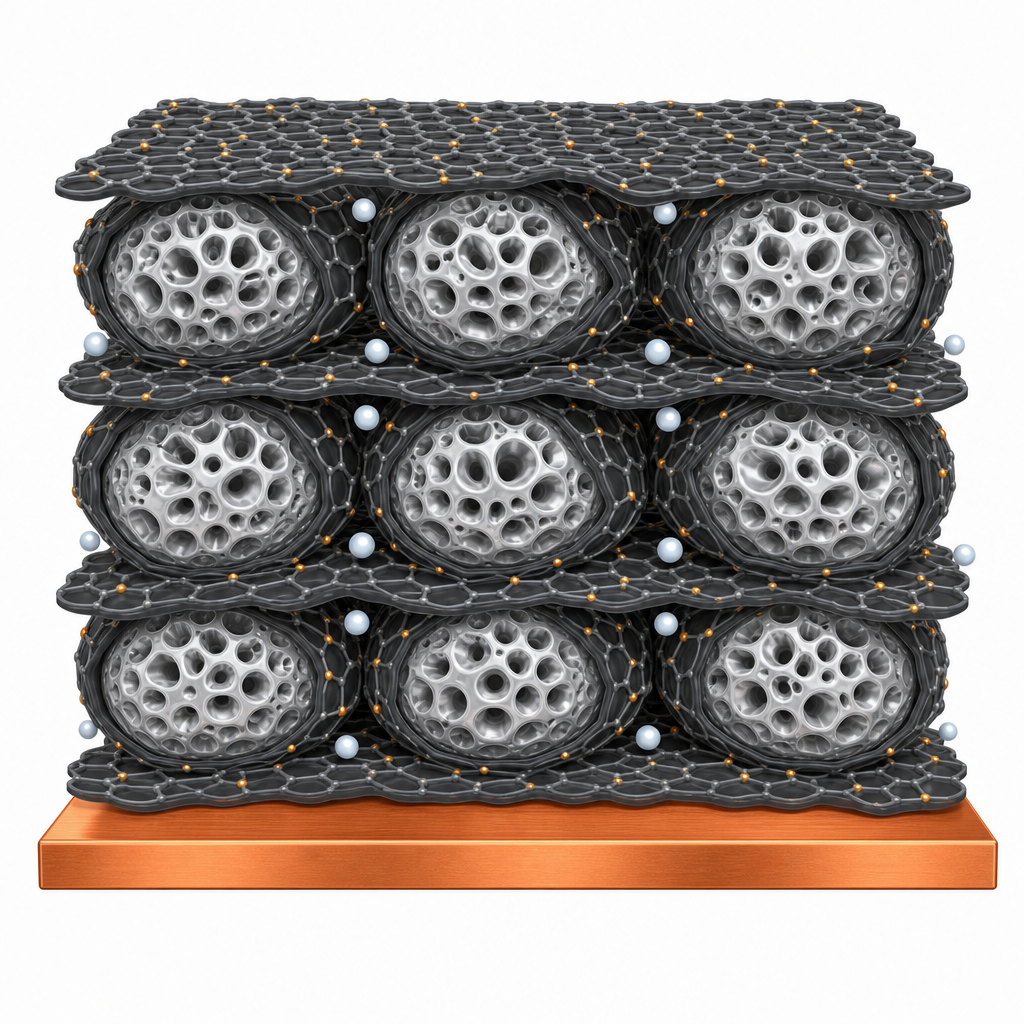
Morphological analysis with Hitachi S-4800 SEM and H9000NAR TEM confirmed that micron-scale silicon particles were fully enfolded by well-separated rGO films, with no restacking of graphene observed during reduction or coating. The Ag-catalyzed etching introduced abundant nanopores throughout each Si particle, and importantly, these pores survived the graphene-coating step intact—providing internal void volume to accommodate lithiation-induced expansion. SEM imaging of composite edges revealed the layered architecture in cross section, and TGA/DSC verified the targeted graphene loading. Coin cells (CR2032) were assembled with the Si/rGO composite, carbon black, and alginate binder in a 7:2:1 ratio on copper foil, paired with a lithium metal counter electrode, 1.0 M LiPF6 in EC/EMC (40:60) with 1 wt% vinylene carbonate, and a Celgard-2320 separator. Galvanostatic cycling was performed between 0 and 1 V on a LANHE CT2001A tester, while AC impedance over 100 kHz to 0.1 Hz was measured with a VersaSTAT 3F. The combination of porous Si providing internal strain relief and the multilayered rGO providing electronic conduction, mechanical buffering, and SEI stabilization gave the electrode high specific capacity and notably improved capacity retention compared with bare porous Si. BET N2 adsorption further confirmed the preserved porosity, while Raman spectroscopy (632.8 nm) verified the characteristic D and G bands of reduced graphene oxide.
The multilayered Si/rGO architecture is directly relevant to commercial efforts to push lithium-ion anode capacities above the graphite ceiling without sacrificing cycle life. Because the route uses bulk Si powder, inexpensive wet chemistry, and standard slurry casting, it is more compatible with existing electrode-manufacturing lines than many nanowire- or thin-film-based strategies. The same self-encapsulating concept could be extended to other high-capacity anode chemistries that suffer volume change, including Ge, SiO, Sn, and metal sulfides. It is also a useful design template for cathode composites where polysulfide or transition-metal dissolution must be suppressed. Follow-up directions identified by the field include pairing the architecture with prelithiation, optimized binders, and dry-room slurry processing for pouch-cell scale-up.
For researchers working on silicon anodes, graphene-wrapped composites, or any electrode chemistry requiring a conductive and mechanically compliant 2D coating, the aqueous graphene oxide dispersion used here is available from ACS Material along with related products including reduced graphene oxide, single-layer GO powder, and high-density GO formulations. The paper's results show that off-the-shelf GO dispersions can be reduced and assembled into high-performance battery electrodes without specialized equipment, lowering the barrier for groups entering silicon-anode or graphene-composite research.How ACS Material products were used
- Aqueous Graphene Oxide Dispersion (Graphene Series) — “Reduced graphene oxide is prepared for efficient graphene coating on the porous macro Si particles, which was prepared from commercially available aqueous graphene oxide dispersion (ACS Material).”
Product Performance in this StudyThe ACS Material aqueous graphene oxide dispersion was converted into N-doped reduced graphene oxide that successfully encapsulated porous silicon particles to form a multilayered Si/rGO composite. The resulting electrode delivered high capacity and stable cycling, confirming that the GO precursor enabled uniform, restacking-free graphene coatings.
Related product categories
Frequently asked questionsWhy use reduced graphene oxide as a coating for silicon anodes in lithium-ion batteries?
Reduced graphene oxide provides a flexible, electronically conductive wrap that buffers silicon's nearly 300% volume change during lithiation and delithiation. The 2D sheets maintain electrical contact between Si particles and the current collector, suppress pulverization, and help stabilize the solid electrolyte interphase. Starting from an aqueous graphene oxide dispersion also allows pH-tuned electrostatic self-assembly, producing uniform coatings without high-temperature CVD or complex nanostructure synthesis.
How is porous silicon prepared for high-capacity battery anodes?
In this study, porous micrometer-sized silicon was made by metal-assisted chemical etching of commercial bulk Si powder. After cleaning, AgNO3 in HF deposits Ag nanoparticles on the silicon surface, then H2O2 drives localized oxidation and etching beneath the catalyst, producing well-dispersed nanopores. Residual Ag is removed with HNO3. The resulting porous Si retains its micron size but contains internal voids that accommodate lithiation-induced expansion.
What weight ratio of silicon to graphene oxide works best for Si/rGO anodes?
The Wisconsin team used a 9:1 Si:GO weight ratio when combining porous silicon particles with the ACS Material aqueous graphene oxide dispersion. This ratio provided enough rGO to fully encapsulate each Si particle and form a multilayered film during filtration, while keeping the active silicon content high enough to deliver capacity well above conventional graphite anodes.