-
Silver Nanowire EEG Earphone Electrodes - Korea University, 2018
Jun 11, 2026 | ACS MATERIAL LLCLee, J. H. et al. (2018). Flexible conductive composite integrated with personal earphone for wireless, real-time monitoring of electrophysiological signs. *ACS Applied Materials & Interfaces*. https://doi.org/10.1021/acsami.8b06484
Korea University · ACS Applied Materials & Interfaces · 2018
Korea University built a wireless EEG earphone using AgNW/CNT/PDMS elastomeric electrodes with silver nanowires from ACS Material for real-time brain monitoring.
About this research
Researchers at Korea University demonstrated a wireless, real-time electroencephalography (EEG) earphone built around a flexible AgNWs/CNTs/PDMS elastomeric electrode that uses silver nanowires supplied by ACS Material as the key conductive filler. Published in ACS Applied Materials & Interfaces in 2018, the work integrates dry conductive composite electrodes with a 3D-printed canal-type earphone frame and a Bluetooth signal-acquisition circuit, enabling simultaneous music playback and continuous brainwave recording that streams to a smartphone. The resulting device records alpha and theta EEG signals comparable in quality to commercial wet Ag/AgCl electrodes.
Wearable electrophysiological monitoring is a fast-growing area at the intersection of materials science, flexible electronics, and digital health. Conventional gel-based Ag/AgCl electrodes deliver good signal quality but dry out, irritate skin, and are unsuitable for daily wear. Dry alternatives based on metallic nanowires, carbon nanotubes, graphene, or conductive polymers in elastomer matrices offer skin-conformal contact and reusable form factors, but balancing low impedance with mechanical compliance is still an open challenge. Embedding such electrodes in everyday objects - watches, glasses, or earphones - would let consumers and clinicians monitor brain activity, attention, and drowsiness without dedicated hardware. The Korea University group addresses this by adapting a familiar canal-type earphone into a discreet EEG sensor, an approach with direct relevance to consumer neurotech, driver-fatigue alerting, and ambulatory sleep studies.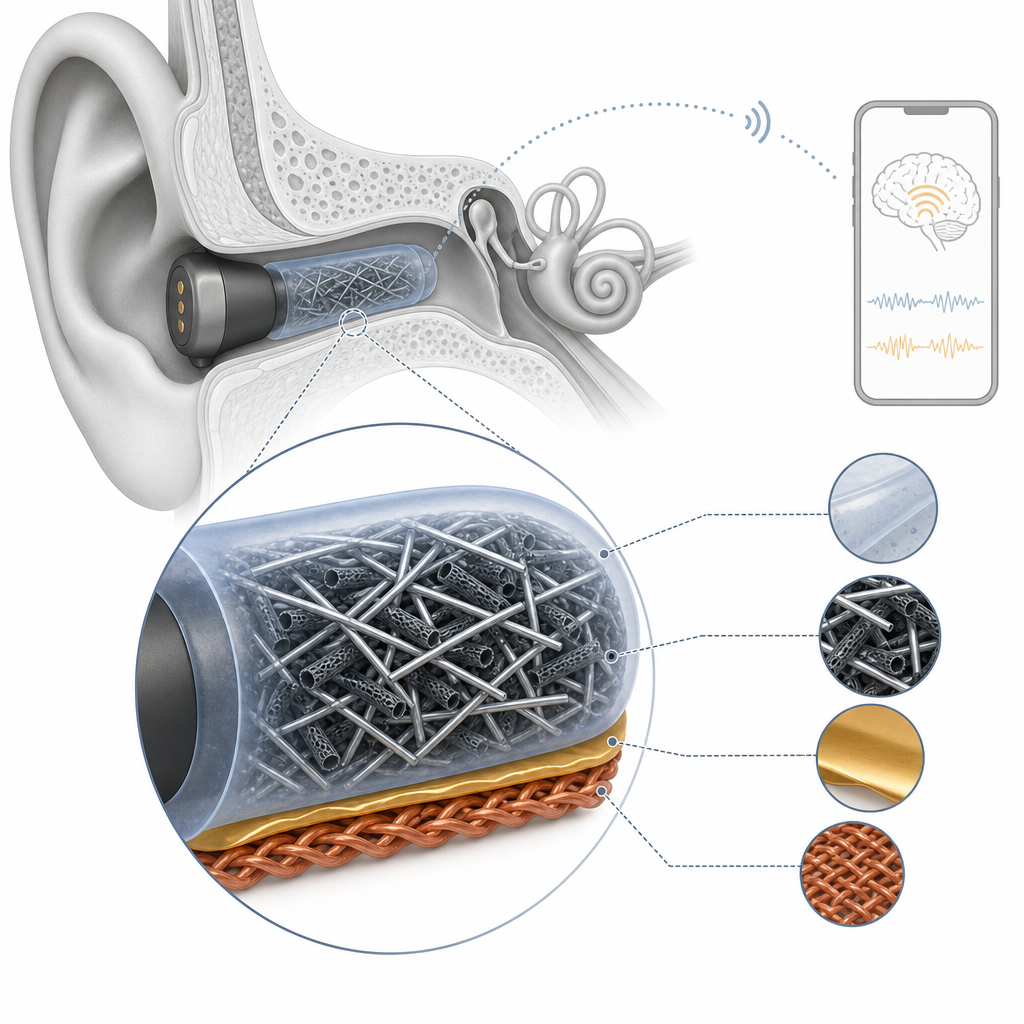
The ACS Material silver nanowires (reported in the Experimental section as "AgNWs (silver nanowires, D: 50 µm, L: 200 µm, ACS Material)") were combined with multi-walled carbon nanotubes (Hanwha CM-250) and PDMS to form the conductive elastomer. AgNWs and MWCNTs were each dispersed in IPA by sonication for 10 minutes, blended with low-viscosity silicone oil and Sylgard 184 base, and heated at 60 °C to drive off solvent before curing agent addition and thermal curing at 80 °C for 2 hours. The cured composite (~200 µm thick) was laminated onto a memory-foam ear cushion together with a thin gold film and a Ni/Cu fabric interconnect, defining source, reference, and ground electrodes. The silver nanowires provide percolating, high-aspect-ratio metallic pathways that complement the entangled CNT network and dramatically lower composite impedance, while PDMS maintains stretchability and skin conformality inside the curved ear canal.
Quantitatively, adding 3 wt% AgNWs to a 5 wt% CNT/PDMS matrix lowered impedance by three orders of magnitude versus the CNT-only composite and by ten orders of magnitude versus AgNW-only PDMS. Skin-electrode contact impedance matched commercial wet Ag/AgCl electrodes. The composite withstood twisting up to 360°, bending, and folding with negligible fractional impedance change, and survived 30% tensile-strain fatigue cycling. Combining the composite with memory foam reduced the effective Young's modulus from 4 MPa (bulk CNT composite) to 40 kPa, enabling soft ear-canal contact. 3D finite-element analysis predicted peak strain of 7.6% and peak interfacial pressure of 11 kPa during full insertion. Crosstalk testing showed that EEG and audio sounds occupy separable frequency bands, with musical interference appearing only above 40 Hz. Alpha rhythms near 10 Hz were reliably captured when subjects closed their eyes, and positioning the reference and source electrodes upward (closer to the brain) maximized power amplitude. In a drowsiness study with ten subjects, the system flagged reaction times longer than 700 ms as sleep onset and resolved the awake-to-drowsy transition through clear increases in alpha (8-12 Hz) and theta (3-7 Hz) band power after ~500 s.
The wireless EEG earphone points toward consumer-grade neurotechnology embedded in personal audio devices: driver and operator fatigue monitoring, attention tracking for e-learning platforms, ambulatory sleep diagnostics, and brain-computer-interface front ends that do not require a dedicated headset. Because the conductive composite is compatible with standard PDMS casting and can be patterned by simple lamination, the approach is scalable to other curved, skin-contacting form factors such as in-ear hearables, earbud-style hearing aids, and behind-the-ear patches. The authors note that integrating the wireless acquisition electronics directly into the soft electrode stack is a logical next step toward a fully self-contained EEG earphone.
For researchers building dry bioelectrodes, stretchable conductors, or hybrid metallic-nanowire/CNT composites, this study illustrates how silver nanowire morphology and loading dictate composite conductivity and skin-contact performance. The silver nanowires used here are available from ACS Material's Nanowire Series, alongside related carbon nanotube and PDMS-compatible materials suitable for similar wearable electrophysiology, transparent electrode, and printable conductor projects.How ACS Material products were used
- Silver Nanowires (AgNWs) (Nanowire Series) — “AgNWs (silver nanowires, D: 50 µm, L: 200 µm, ACS Material) were mixed with IPA”
Product Performance in this StudyACS Material silver nanowires were a key conductive filler in the AgNWs/CNTs/PDMS elastomeric electrode. Adding AgNWs to CNTs/PDMS lowered the composite impedance by three to ten orders of magnitude compared with single-filler controls, enabling dry electrode performance comparable to commercial wet Ag/AgCl electrodes.
Related product categories
Frequently asked questionsHow do silver nanowires improve the conductivity of CNT/PDMS dry electrodes?
Silver nanowires add long, high-aspect-ratio metallic pathways that bridge the entangled CNT network inside PDMS. In this study, adding 3 wt% AgNWs to a 5 wt% CNT/PDMS matrix lowered the composite impedance by three orders of magnitude versus CNT-only PDMS and by ten orders of magnitude versus AgNW-only PDMS, while the resulting skin-contact impedance matched commercial wet Ag/AgCl electrodes.
What is an AgNW/CNT/PDMS composite used for in wearable electronics?
AgNW/CNT/PDMS composites are stretchable conductive elastomers used as dry electrodes for electrophysiological signals such as EEG, ECG, and EMG. They conform to curved skin surfaces, retain conductivity under bending and stretching, and avoid the drying and irritation issues of gel electrodes. In this paper the composite served as in-ear EEG electrodes integrated with a memory-foam earphone for real-time brainwave monitoring.
Why does combining AgNWs with carbon nanotubes work better than either filler alone?
AgNWs and CNTs have complementary geometries: CNTs form a dense fibrous network at low loading, while longer AgNWs bridge gaps between CNT bundles and provide highly conductive metallic shortcuts. The dual-filler composite reaches percolation at lower total filler content, giving lower impedance without sacrificing the elasticity of PDMS. This produced electrodes that withstood 360° twisting, folding, and 30% tensile fatigue with negligible impedance change.