-
Silver Nanowire Electrodes for DSSCs - University of Sharjah, 2017
Jun 22, 2026 | ACS MATERIAL LLCAlami, A. H., Rajab, B., & Aokal, K. (2017). Assessment of silver nanowires infused with zinc oxide as a transparent electrode for dye-Sensitized solar cell applications. *Energy*. https://doi.org/10.1016/j.energy.2017.03.171
Energy · 2017
University of Sharjah researchers used ACS Material silver nanowires to build flexible transparent electrodes that boosted dye-sensitized solar cell efficiency by two orders of magnitude over ITO.
About this research
Researchers at the University of Sharjah used silver nanowires supplied by ACS Material as the active component of transparent photo-electrodes for dye-sensitized solar cells (DSSCs), demonstrating an order-of-magnitude improvement in cell performance over conventional indium-tin-oxide (ITO) electrodes. The work, published in Energy (2017), shows that spin-coated Ag NW meshes—optionally infused with a zinc oxide filler layer—combine high visible-NIR transmission (>80%), low sheet resistance, and mechanical flexibility, making them a practical replacement for brittle, vacuum-deposited transparent conductive oxides in third-generation photovoltaics.
The broader research context centers on the persistent trade-off between transparency and conductivity in solar-cell electrodes. ITO dominates the transparent conductive oxide (TCO) market but requires vacuum deposition, depends on scarce indium, and cracks on flexible substrates. Fluorine-doped tin oxide (FTO) is more stable but less transparent. Metallic nanowire meshes, particularly silver, offer conductivities approaching those of bulk metal, can be processed from solution at room temperature, and bend with their substrates. These features make Ag NWs attractive for flexible DSSCs, perovskite solar cells, organic photovoltaics, OLEDs, and touch panels—all areas where researchers actively seek scalable, low-temperature alternatives to sputtered TCOs.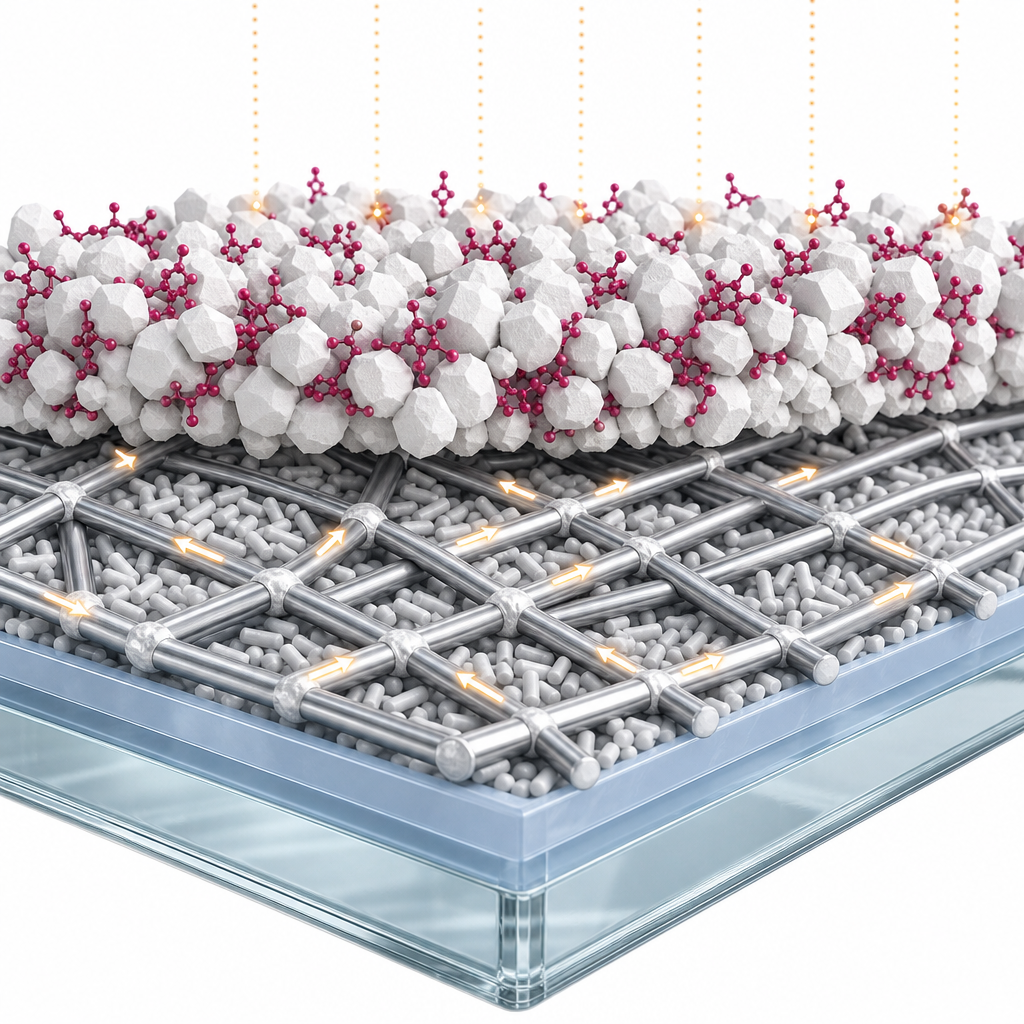
The ACS Material silver nanowires were supplied as a 20 mg/mL ethanol suspension with average wire diameter of 60 nm and length of 20–30 µm, as quoted in the experimental section: "The nanowires used were suspended in ethanol (from ACS Material) with a concentration of 20 mg/ml and an average diameter of 60 nm and length of 20-30 µm." Ethanol was chosen over aqueous suspensions for faster evaporation and more uniform film formation. The dispersion was diluted and applied to glass or ITO substrates using a WS-650 spin coater at ~5000 rpm in two injection stages (0.5 mL, a 30-second pause, then the remainder) to control mesh density. A separate ZnO nanopowder layer (30–40 nm, diluted to 5 wt%) was then spin-coated under nitrogen to fill the gaps between wires, followed by a low-temperature TiO2 layer from Solaronix. The full stack was annealed in air at 200 °C for 30 minutes, fusing the Ag NW junctions and removing residual surfactant.
Microstructural and electrical characterization confirmed that the ACS Material nanowires formed a continuous, percolating network. SEM at 50 kX showed clear nanowire junctions before annealing and dark fused contact points afterward, while AFM compared 1 mg/mL and 0.25 mg/mL solutions and identified the lower concentration as optimal for subsequent ZnO infiltration. Two-probe resistance measurements showed that annealing dropped sheet resistance from ~75 to ~10 Ω/sq for two-layer films at 0.25 mg/mL. Pure Ag NW films exhibited ~98 Ω/sq with 82.5% visible transmission, while Ag NW/ZnO composites measured 71 Ω/sq at 55.5% transmission. Depositing Ag NWs directly on commercial ITO produced a hybrid electrode at 80.5% transmission and only 15 Ω/sq—a measurable improvement over the 20 Ω/sq of the bare ITO reference. In the full DSSC tests using a beetroot-derived natural dye and an iodide/triiodide electrolyte, the ITO-only cell delivered Voc ≈ 0.03 V, while the Ag NW cell reached Voc ≈ 0.55 V, corresponding to an efficiency increase of roughly two orders of magnitude. Adding Ag NWs to ITO improved both Voc and Isc relative to ITO alone, and Ag NW/ZnO cells matched the Voc of pure Ag NW cells with about 20% lower current but better mechanical and thermal stability.
The results support several application directions. Flexible DSSCs, perovskite photovoltaics, semi-transparent solar windows, and bendable OLED displays all benefit from spin-coatable transparent electrodes that survive bending and avoid indium dependency. The authors point out that pairing Ag NWs with synthetic ruthenium dyes and a xenon-based solar simulator should yield substantially higher absolute efficiencies, and that ZnO infill is justified wherever long-term mechanical, thermal, or environmental stability outweighs a modest current penalty. The platform is also compatible with roll-to-roll manufacturing, an important consideration for industrial-scale flexible electronics.
For researchers working on transparent conductors, flexible solar cells, or printable electronics, the silver nanowire suspensions used in this study—available in ACS Material's Nanowire Series—offer a reproducible starting material with characterized diameter and length. The paper documents a practical processing window, including the 0.25 mg/mL dilution, two-layer spin-coating recipe, and 200 °C / 30-minute anneal, that other groups can adapt as a baseline for further optimization with ZnO, TiO2, or composite fillers.How ACS Material products were used
- Silver Nanowires in Ethanol Suspension (Nanowire Series) — “The nanowires used were suspended in ethanol (from ACS Material) with a concentration of 20 mg/ml and an average diameter of 60 nm and length of 20-30 µm.”
Product Performance in this StudyThe ACS Material silver nanowire suspension was spin-coated to form transparent photo-electrodes with ~82.5% visible transmission and a sheet resistance reduced from ~75 to ~10 Ω/sq after annealing, enabling DSSCs whose efficiency was roughly two orders of magnitude higher than an ITO-only baseline.
Related product categories
Frequently asked questionsHow do silver nanowires outperform ITO as a transparent electrode in dye-sensitized solar cells?
Silver nanowire meshes combine sub-100 nm wire diameters with metallic conductivity, giving sheet resistance as low as 10 Ω/sq after annealing while keeping visible transmission above 80%. In the Sharjah study the Ag NW photo-electrode raised open-circuit voltage from 0.03 V on ITO to 0.55 V and increased DSSC efficiency by roughly two orders of magnitude, because the high surface-area mesh hosts more TiO2 and shortens the carrier path.
Why is a ZnO filler layer added on top of silver nanowires?
Spin-coated Ag NW meshes contain dead spots where mesoporous TiO2 cannot bridge wires, hurting lateral charge transport. A ZnO nanoparticle layer fills these gaps, provides a continuous electron-extraction path to the nearest nanowire, and reinforces the mesh mechanically and thermally. In this work the ZnO infill cut sheet resistance from 98 to 71 Ω/sq, at the cost of about 20% lower photocurrent.
What annealing condition is best for silver nanowire transparent electrodes?
Heating at 200 °C for 30 minutes in air is the consensus optimum and was used in this study. The treatment fuses nanowire-nanowire junctions and removes residual surfactant from synthesis, dropping sheet resistance from about 75 Ω/sq to 10 Ω/sq for a two-layer film without harming visible transmission. Longer or hotter anneals break the wires into disconnected droplets and increase resistance.