-
Silver Nanowire Electrodes for Stretchable E-Skins - Sookmyung, 2022
Jun 24, 2026 | ACS MATERIAL LLCSon, H. J. et al. (2022). Stretchable and conductive Li-complexed poly (3-hexylthiophene) nanofibrils/elastomer composites for printed electronic skins. *ACS Applied Nano Materials*. https://doi.org/10.1021/acsanm.2c02810
Sookmyung Women’s University · ACS Applied Nano Materials · 2022
Sookmyung Women's University used ACS Material silver nanowires to build stretchable Ag nanowire/Ecoflex electrodes for printed Li-P3HT/SBS strain and pulse e-skin sensors.
About this research
Researchers at Sookmyung Women's University fabricated stretchable electronic skins using silver nanowires purchased from ACS Material to build conductive Ag nanowire/Ecoflex electrodes, on top of which they printed Li-complexed poly(3-hexylthiophene) nanofibril/SBS active layers that achieved an electrical conductivity of 1.27 × 10⁻³ S cm⁻¹. The team designed a composite of Li-complexed P3HT nanofibrils (Li-P3HT) and poly(styrene-b-butadiene-b-styrene) (SBS) as the conductive, stretchable sensing layer. By combining the high-conductivity nanowire electrode platform with the percolated polymer nanofibril network, the work demonstrates high-performance strain and pulse sensors suitable for wearable health monitoring and soft robotic skin.
Electronic skins (e-skins) demand active layers that combine high electrical conductivity with mechanical stretchability, a long-standing challenge for semiconducting polymers. Hard or brittle fillers such as carbon nanostructures and metal nanoparticles can degrade durability because mechanical stress concentrates at the filler–matrix interface, while many metallic and organic dopants suffer from poor environmental stability—iodine evaporates rapidly and gold-precursor doping vanishes once nanoparticles form. Stretchable two-terminal resistive sensors also require robust, conductive interconnects that survive repeated deformation. This research addresses both the dopant-stability problem (using electrochemically stable Li-TFSI) and the need for highly conductive, highly stretchable electrodes. The application area—wearable biosignal sensing, body-motion detection, and skin for soft robots—relies on conductive nanocomposites and metal-nanowire electrodes that can be screen- or inkjet-printed onto soft substrates.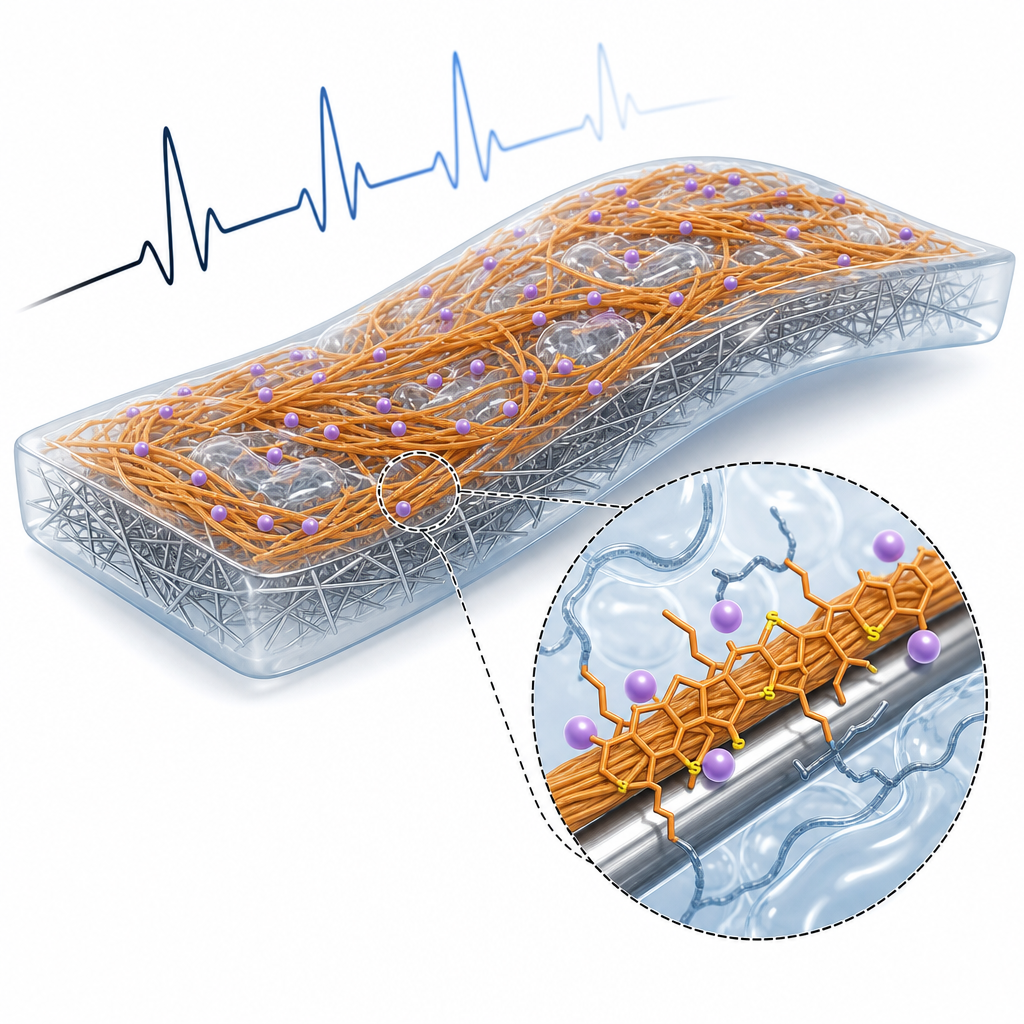
The silver nanowire solution from ACS Material had a specified length of 100–200 μm and a diameter of 70 nm. To form the stretchable electrodes, the nanowire solution was dropped onto a polyimide stencil mask (5 × 5 array, channel length 30–150 μm) attached to a glass slide. After drying, the substrate was annealed at 150 °C for 3 minutes. The polyimide mask was then removed and an Ecoflex prepolymer/initiator mixture (1:1 weight ratio) was spin-coated over the patterned nanowires at 350 rpm for 30 s and cured at 25 °C for 2 hours. Peeling the cured film from the glass slide produced free-standing Ag nanowire/Ecoflex electrodes. The viscous Li-P3HT/SBS solution (α = 0.67, Li-TFSI = 4.5 μM) was subsequently spin-coated directly onto these electrodes through a stencil mask at 2000 rpm for 15 s to define the active sensing layers. The high aspect ratio of the silver nanowires gave the electrode network its exceptional conductivity and strain tolerance, making the nanowires central to device operation.
The Ag nanowire/Ecoflex electrodes were stretchable up to 630% strain, with an initial conductivity of 5962 S cm⁻¹ that retained 5679 S cm⁻¹ at 50% strain and still measured 2383 S cm⁻¹ at 300% strain. Li complexation increased the hole concentration of the polymer composite from 7.78 × 10¹⁷ to 2.56 × 10¹⁹ cm⁻³, raising conductivity from 2.23 × 10⁻⁴ to 1.27 × 10⁻³ S cm⁻¹ (5.7 times higher than pristine P3HT/SBS) and reducing the polymer–nanowire contact resistance from 343.5 to 38.8 kΩ. At 50% strain the composite conductivity remained 5.84 × 10⁻⁴ S cm⁻¹, still 2.6 times higher than the unstretched pristine material, and 98.2% of conductivity was retained after 1000 stretching cycles at 50% strain. The strain sensor showed a gauge factor of 3.7 retained over 10–50% strain with a fast 34 ms average response time. Finger-joint resistance increased linearly from 2.3 × 10⁷ to 15.5 × 10⁷ Ω as bending angle rose from 0 to 90°. A 5 × 5 pulse sensor array attached to the wrist detected a 75 bpm pulse, and devices retained 92.6% of initial conductivity over 800 h at 25 °C and 25% relative humidity without encapsulation.
This platform enables thin, skin-conformal strain and pulse sensors for wearable health-monitoring devices, artificial skin, and soft robotics. Because the Li-P3HT/SBS solution viscosity can be tuned by one-dimensional nanofibril growth, the active layer is compatible with spin coating, inkjet printing, and screen printing, extending its usefulness to scalable printed electronics. The highly conductive, highly stretchable silver nanowire/Ecoflex electrodes are broadly applicable to flexible displays, transparent conductors, and stretchable interconnects. The authors highlight environmentally stable Li-TFSI doping as a route to durable organic semiconductor devices and point toward integration with wireless platforms for biosignal and body-motion tracking.
For researchers developing stretchable conductors, transparent electrodes, or printed wearable sensors, the silver nanowires used here are available from ACS Material's Nanowire Series. The high-aspect-ratio nanowires supported electrode conductivity above 5900 S cm⁻¹ with strain tolerance to several hundred percent, as the paper's own measurements show, making them a practical building block for soft electronic skins and related flexible-electronics research.How ACS Material products were used
- Silver Nanowire solution (length = 100-200 μm, diameter = 70 nm) (Nanowire Series) — “The Ag nanowire solution (length = 100−200 μm, diameter = 70 nm) was purchased from ACS Material.”
Product Performance in this StudyThe ACS Material silver nanowire solution formed the stretchable Ag nanowire/Ecoflex electrodes, which delivered an initial conductivity of 5962 S cm⁻¹ and retained 5679 S cm⁻¹ at 50% strain, providing a robust conductive substrate for the printed Li-P3HT/SBS sensors.
Related product categories
Frequently asked questionsWhat are silver nanowires used for in stretchable electronic skins?
In this study silver nanowires form the conductive network of Ag nanowire/Ecoflex stretchable electrodes. After patterning and Ecoflex encapsulation, the electrodes reached an initial conductivity of 5962 S cm⁻¹, stretched up to 630% strain, and retained 5679 S cm⁻¹ at 50% strain, providing a robust conductive platform for printed Li-P3HT/SBS strain and pulse sensors.
Why is silver nanowire aspect ratio important for stretchable electrode performance?
Long, thin silver nanowires (here 100–200 μm long, 70 nm diameter) form percolation networks that maintain electrical pathways even as the elastomer substrate deforms. The high aspect ratio lets the conductive network survive large strains, enabling the electrodes to keep conductivity above 2300 S cm⁻¹ at 300% strain and to support reliable resistive sensing in wearable devices.
How does Li-TFSI doping improve the conductivity of P3HT nanofibril composites?
Lithium ions from Li-TFSI coordinate with sulfur lone pairs on the thiophene backbone, raising the hole concentration from 7.78 × 10¹⁷ to 2.56 × 10¹⁹ cm⁻³. This boosted composite conductivity from 2.23 × 10⁻⁴ to 1.27 × 10⁻³ S cm⁻¹ and lowered polymer–nanowire contact resistance to 38.8 k�. Li-TFSI's electrochemical stability also gave the films 92.6% conductivity retention over 800 hours.