-
Silver Nanowire Electrodes for Stretchable EL Devices - DGIST, 2018
Jul 07, 2026 | ACS MATERIAL LLCSong, S. et al. (2018). Patternable and Widely Colour-Tunable Elastomer-Based Electroluminescent Devices. *Scientific Reports*. https://doi.org/10.1038/s41598-018-21726-x
Scientific Reports · 2018
DGIST researchers built patternable, color-tunable PDMS electroluminescent devices using ACS Material AgNWs-40 silver nanowire stretchable electrodes.
About this research
Researchers at DGIST (Daegu Gyeongbuk Institute of Science and Technology) demonstrated patternable, widely color-tunable stretchable alternating-current electroluminescent (ACEL) devices using ACS Material silver nanowires (AgNWs-40, dispersed in ethanol) as the transparent compliant electrodes on both faces of a PDMS/ZnS:Cu phosphor emitting stack. By screen-printing different ZnS:Cu phosphor formulations into stripes and modulating the driving frequency between 10 Hz and 50 kHz at 400 Vpp, the team produced multiple emission colors and patterned images within a single stretchable device. The work was published in Scientific Reports in 2018.
Stretchable light-emitting devices are central to the emerging classes of wearable displays, electronic skin, biomedical indicators, and conformal signage. Conventional inorganic LEDs are rigid and brittle, so researchers have turned to elastomer-embedded phosphor composites that can withstand large strain without fracturing. PDMS-based ACEL devices sandwiched between mechanically compliant electrodes have attracted significant attention thanks to their simple fabrication, chemical inertness, mechanical robustness, and low cost. The remaining challenge is achieving a broad range of emission colors – ideally tunable in real time – without compromising stretchability or device area. This paper addresses that gap by combining frequency-dependent donor-acceptor pair emission in Cu-doped ZnS phosphors with screen-printable patterning, enabling a single elastomer device to display multiple colors on demand.
The ACS Material silver nanowires acted as the stretchable transparent electrodes that sandwich the PDMS+ZnS emitting layer. AgNWs-40 dispersed in ethanol were spin-coated onto PMMA-coated glass substrates at 300 rpm for the upper plate and 100 rpm for the bottom plate, followed by drying at 100 °C for 1 minute. The deliberately higher spin speed used on the top electrode produced a sparser, more transparent nanowire network so that emitted light could escape efficiently, while the denser bottom network provided a low-resistance back contact. Liquid PDMS (Wacker ELASTOSIL RT601, 9:1 base:curing agent) was then cast over the nanowires, cured, and peeled to yield two AgNW-embedded PDMS plates approximately 300 µm thick. Green (GG45), blue (GG65), and orange (GG13) ZnS:Cu phosphors were mixed with PDMS at a 7:3 weight ratio and screen-printed through patterned meshes onto one of these AgNW/PDMS plates, then capped with the second plate to complete the three-layer ACEL stack.
The frequency-driven emission tuning derives from donor-acceptor pair recombination in Cu-doped ZnS. At low frequency (10 Hz) the device emits in the green; raising the frequency populates deeper energy levels that shift emission toward blue, with intermediate frequencies producing intermediate hues. Devices were driven by 400 Vpp square waves over 10 Hz to 50 kHz. Four screen-printed stripes in a single device each adopted distinct CIE coordinates as the drive frequency was swept, producing visually independent color stripes within one monolithic stretchable film. Mixing two phosphor populations – for example ZnS(O) with ZnS(B) or ZnS(G) – broadened the accessible CIE color space substantially, enabling near-white and intermediate tones not reachable with single phosphors. Logo-patterned devices were stretched to roughly 40 % elongation without loss of emission, and continuous operation produced time-stable optical intensity integrated from 400 to 800 nm over the durability test window. The AgNW electrode network maintained current flow and light extraction throughout these stretching and frequency sweeps, validating its role as the compliant transparent contact.
The demonstration is directly relevant to wearable multifunctional displays, electronic skin, biomedical indicators, and flexible signage where pattern, color, and elasticity must coexist. Because color is controlled electronically rather than by changing materials, a single deposited device can serve as a dynamic multi-color display surface – useful for camouflage, status indicators on soft robotics, smart textiles, and adaptive lighting. The screen-printing route is scalable to large areas and arbitrary patterns, which complements roll-to-roll elastomer processing. Follow-up directions noted by the authors include broader color expression by exploring additional phosphor combinations and integrating the devices into sensors that couple mechanical strain with color output.
For researchers working on stretchable transparent electrodes, conductive percolation networks, or printed elastomer optoelectronics, the AgNWs-40 silver nanowires used in this study are available from ACS Material. The product's performance in this work – maintaining transparency at high spin-coat dilution and conductivity through repeated stretching – illustrates the kind of compliant contact behavior required for elastomer light-emitting devices and related soft electronics.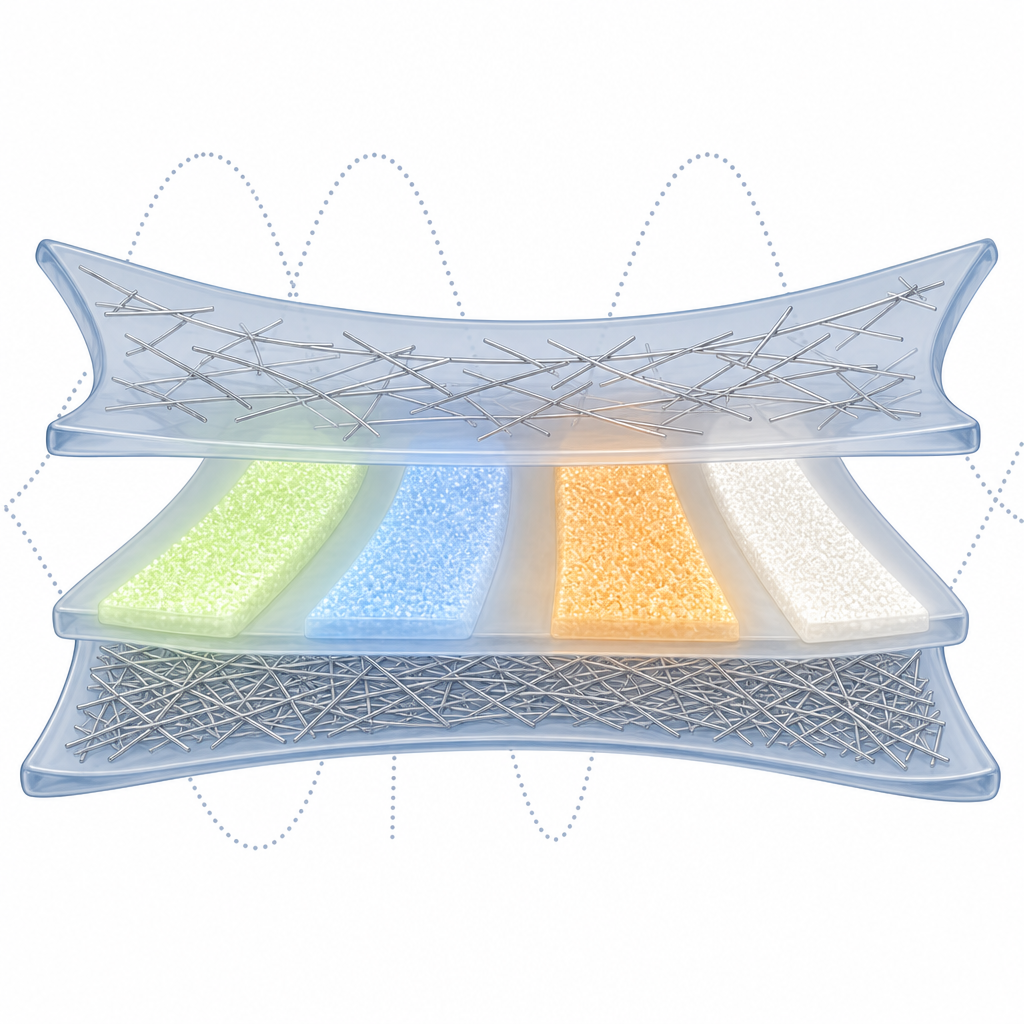
How ACS Material products were used
- Silver Nanowires (AgNWs-40) dispersed in ethanol (Nanowire Series) — “AgNWs dispersed in ethanol (AgNWs-40, ACS Material) were spin-coated onto a poly(methyl methacrylate) (PMMA)-coated glass substrate.”
Product Performance in this Study
The AgNWs from ACS Material formed the stretchable transparent electrodes on both faces of the PDMS sandwich. They enabled high optical transmission for light out-coupling and maintained electrical conductivity under stretching, making the intrinsically stretchable AC-driven electroluminescent device possible.
Related product categories
Frequently asked questions
Why are silver nanowires used as electrodes in stretchable electroluminescent devices?
Silver nanowire networks combine high optical transmittance with electrical conductivity that survives mechanical strain, making them well suited as transparent compliant electrodes for elastomer-based light-emitting devices. In this PDMS/ZnS:Cu ACEL device the AgNW films were embedded into both PDMS plates that sandwich the phosphor layer, providing the AC field for excitation while still allowing emitted light to exit through the top electrode.
How does frequency tune the emission color of ZnS:Cu phosphor in an ACEL device?
Cu-doped ZnS emits via donor-acceptor pair recombination between co-activator donors and Cu acceptors. At low electrical frequency the emission is dominated by green centers, while higher frequency populates deeper energy levels that shift emission toward shorter wavelengths in the blue. Sweeping the AC drive between 10 Hz and 50 kHz at 400 Vpp therefore shifts the CIE coordinates continuously without changing the device material set.
What stretchability does a PDMS-AgNW electroluminescent device achieve?
The reported device retained patterned light emission under manual stretching of around 40 percent elongation, demonstrated by a logo-patterned ACEL film operated at 400 Vpp and 1 kHz. The intrinsic compliance of the PDMS matrix combined with the percolating silver nanowire electrode network allows the device to deform without losing electrical contact or extinguishing the emission, which is required for wearable display and electronic-skin applications.