-
Silver Nanowire-Graphene Film Adhesion - Missouri S&T, 2019
Jun 29, 2026 | ACS MATERIAL LLCLi, Y., Wei, C., & Wu, C. (2019). Adhesion of silver nano wire graphene composite film. *Journal of colloid and interface science*.
Journal of colloid and interface science · 2019
Missouri S&T researchers used ACS Material silver nanowires to study how AgNW concentration controls adhesion and dry-transfer of AgNW-graphene composite films.
About this research
Researchers at Missouri University of Science and Technology used silver nanowires supplied by ACS Material to systematically quantify how AgNW concentration controls the adhesion of silver-nanowire/graphene (AgNW-GN) composite transparent conductive films to copper substrates. Published in the Journal of Colloid and Interface Science (2019), the study by Li, Wei, and Wu combined double cantilever beam (DCB) testing with digital image correlation (DIC), SEM, Raman spectroscopy, and AFM to extract full traction-separation relations (TSRs) for the epoxy/AgNW-GN/copper layered structure. They demonstrated a brittle-to-ductile interfacial fracture transition with increasing AgNW content and established a fracture-mechanics-based transfer criterion that predicts which interface fails during dry transfer.
Transparent conductive films are critical components in solar cells, OLEDs, and touch panels, and indium tin oxide (ITO) has long dominated this space despite its brittleness and the rising cost of indium. AgNW-graphene composites are a leading ITO alternative because the graphene contributes low sheet resistance from a single atomic layer while the nanowires bridge cracks and enhance fracture toughness. However, almost all prior work focused on electrical and optical performance, leaving adhesion - which governs whether a TCF can be cleanly dry-transferred from its growth substrate without delamination or device failure - largely unexplored. This paper fills that gap with the first systematic adhesion study of AgNW-GN composites.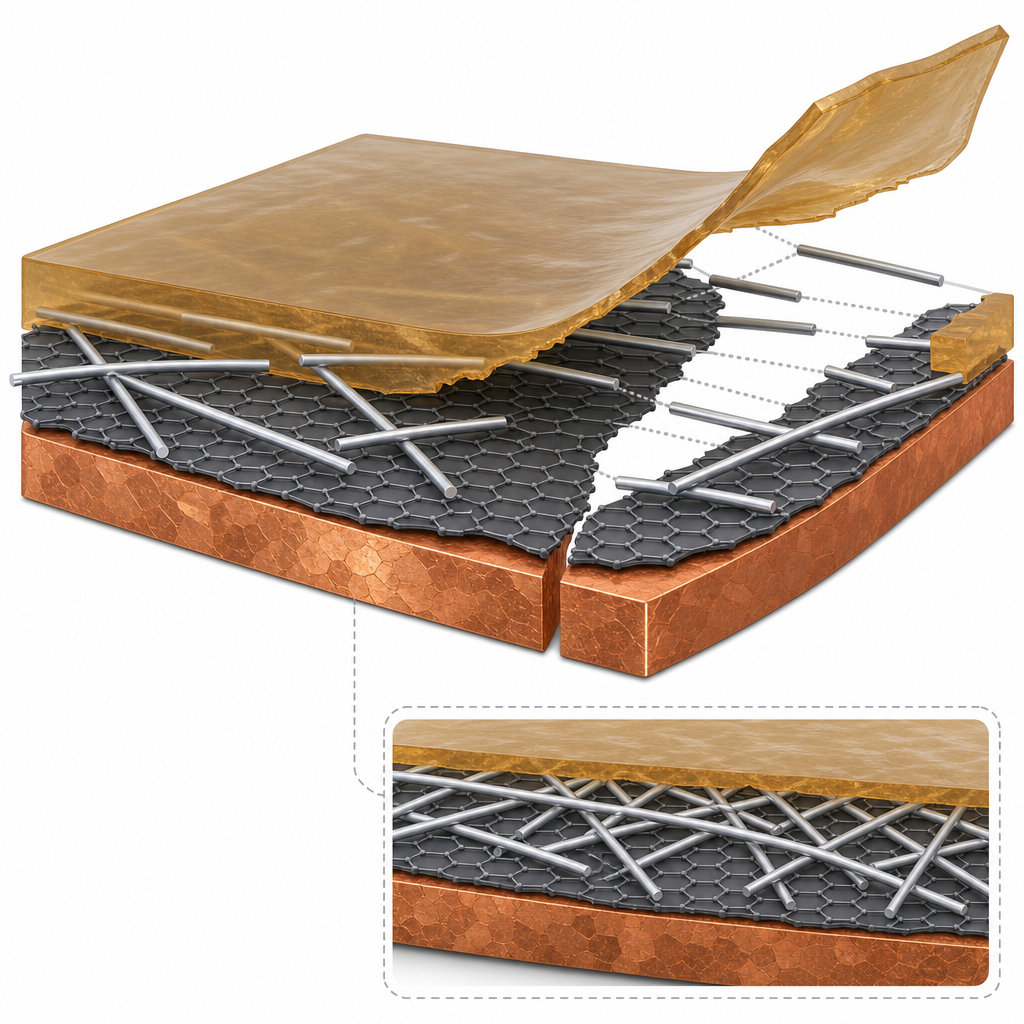
The ACS Material silver nanowires were supplied as a 20 mg/mL dispersion in isopropyl alcohol, with an average diameter of 30 nm and lengths of 10-20 μm. The team shook the stock dispersion for 5 minutes, then diluted it with IPA at volume ratios of 0:1, 1:1, 4:1, 8:1, and 12:1 (IPA:AgNW), creating five composite formulations plus a no-AgNW graphene control. After CVD graphene growth on copper foil, AgNW dispersions were spray-coated through a 0.3 mm airbrush at 15 cm distance and 0.1 MPa back pressure, then dried at 50 °C and thermally annealed at 150 °C for 20 minutes. SEM and AFM confirmed that the average AgNW spacing scaled with dilution, ranging from 0.85 μm at the highest AgNW loading to 4.67 μm at IPA/AgNW = 12. Specimens were bonded between silicon strips with Master Bond EP30 epoxy for the DCB experiments, with a 15 nm Au/Pd coating defining the initial crack.
The interfacial fracture toughness extracted from DCB-DIC measurements decreased monotonically from 6.01 J/m² for the no-AgNW control to 1.25 J/m² at the highest AgNW loading (IPA/AgNW = 0). Adhesion strength fell from approximately 22.7 MPa to 0.97 MPa over the same range. Conversely, the critical separation associated with the peak traction and the interaction range both increased substantially as more nanowires were added, with the average AgNW spacing varying from 0.85 to 4.67 μm and AgNW surface RMS roughness around 250 ± 10 nm. Raman mapping of delaminated interfaces showed that the fraction of graphene transferred onto the epoxy side dropped sharply as AgNW concentration rose - from near-complete transfer with no AgNW or at IPA/AgNW = 12 to almost no graphene transfer at IPA/AgNW = 0 - indicating a clear shift in the dominant failure interface. Using linear elastic fracture mechanics, the authors modeled the competing failure between the epoxy/AgNW-GN interface (treated as a central crack with periodic AgNW-induced defects) and the GN/Cu interface (treated as an edge crack), defined a dimensionless transfer index I, and fitted the apparent adhesion energy with an interfacial toughness ratio Γ ≈ 0.2 to within 4.1% average error.
These findings provide a quantitative design rule for AgNW-graphene transparent electrodes used in flexible displays, organic photovoltaics, ultraviolet LEDs, and touch sensors. Engineers can use the transfer index to choose AgNW spacing that favors clean release from the copper growth foil onto the target device substrate without sacrificing too much composite toughness. The work also clarifies why AgNW addition can hurt dry-transfer yield even though it improves intrinsic film toughness: the nanowires introduce non-conformal contact defects at the epoxy interface that shift failure to the weaker side. The authors indicate that future work will examine rate-dependent adhesion behavior and extend the analytical framework to other AgNW-2D composite systems.
For researchers working on transparent electrodes, flexible electronics, or 2D-material transfer processes, this paper demonstrates that nanowire morphology is as important as electrical performance in determining manufacturability. The silver nanowires used here are available from ACS Material in dispersions matching the dimensions reported, making it straightforward to reproduce or extend the study to new substrate systems and adhesive chemistries.How ACS Material products were used
- Silver Nanowire (AgNW) dispersion in isopropyl alcohol, 20 mg/mL, average diameter 30 nm, length 10-20 μm (Nanowire Series) — “AgNW was provided by ACS Material Inc, with concentration of 20 mg/mL in isopropyl alcohol (IPA). AgNW with an average diameter of 30 nm and length of 10-20 µm were shaken for 5 minutes before being dispersed in the suspension.”
Product Performance in this StudyThe ACS Material silver nanowires were the key variable in the study. They were spray-coated onto CVD graphene at five IPA dilution ratios to produce composite films whose adhesion to copper was measured. Higher AgNW loading reduced interfacial adhesion energy (from 6.01 to 1.25 J/m²) and shifted fracture behavior from brittle to ductile, enabling quantitative modeling of the dry-transfer competing failure mechanism.
Related product categories
Frequently asked questionsHow does silver nanowire concentration affect AgNW-graphene film adhesion to copper?
Increasing the silver nanowire concentration in an AgNW-graphene composite film systematically reduces its adhesion to copper. Interfacial fracture toughness drops from about 6.01 J/m² for graphene alone to 1.25 J/m² at the highest AgNW loading, and adhesion strength falls from roughly 22.7 MPa to under 1 MPa. The nanowires create non-conformal contact defects at the epoxy interface, weakening adhesion while making fracture more ductile.
Why are silver nanowire-graphene composites used as ITO replacements?
Silver nanowire-graphene composites offer low sheet resistance from the conductive graphene monolayer combined with enhanced fracture toughness from AgNW crack bridging. Unlike indium tin oxide, they remain conductive under bending and avoid the rising cost and brittleness of indium-based films. This makes them attractive transparent conductive films for flexible displays, organic photovoltaics, ultraviolet LEDs, and touchscreens where mechanical durability matters.
What silver nanowire dimensions work best for transparent conductive composite films?
The study used silver nanowires with an average diameter of 30 nm and lengths of 10-20 μm, supplied at 20 mg/mL in isopropyl alcohol. These dimensions balance optical transparency, percolation conductivity, and mechanical reinforcement of graphene. Spray coating produced AgNW spacings between roughly 0.85 and 4.67 μm depending on IPA dilution, allowing systematic control of composite morphology and adhesion behavior.