-
Silver Nanowire Heaters for Soft Actuators - NC State, 2017
Jun 25, 2026 | ACS MATERIAL LLCYao, S. et al. (2017). Soft electrothermal actuators using silver nanowire heaters. *Nanoscale*. https://doi.org/10.1039/c6nr09270e
Nanoscale · 2017
NC State researchers used ACS Material silver nanowires to build AgNW/PDMS Joule heaters powering soft electrothermal bimorph actuators and grippers.
About this research
Researchers at North Carolina State University demonstrated soft electrothermal bimorph actuators driven by silver nanowire (AgNW) heaters obtained from ACS Material, embedding the nanowires in polydimethylsiloxane (PDMS) to create stretchable, low-voltage Joule heaters that drive polyimide/PDMS bimorphs. Published in Nanoscale in 2017 by Yao, Cui, Cui and Zhu, the paper shows that the AgNW/PDMS heater architecture can power soft grippers and crawling walkers with large bending curvatures, fast response, and good stability. The work bridges nanomaterial-based transparent conductors and the rapidly growing field of soft robotics, where flexible, low-voltage heaters are a long-standing bottleneck.
Electrothermal bimorph actuators rely on the mismatch in thermal expansion between two bonded layers; when one layer is heated, the composite bends. The challenge is producing a heater that is itself soft, mechanically compliant, electrically efficient, and capable of being patterned into arbitrary shapes. Conventional metal foils are stiff, carbon-nanotube films often require high drive voltages, and ITO is brittle. Silver nanowire networks have emerged as a leading candidate because they combine high conductivity, optical transparency, and mechanical flexibility, making them well suited for wearable electronics, flexible displays, soft sensors, and biomimetic robots. This paper addresses how to translate AgNW transparent-conductor technology into a robust actuator platform that can perform real mechanical tasks such as gripping and locomotion.
The ACS Material silver nanowires were supplied in ethanol with an average diameter of 90 nm and length of 20-30 µm. The researchers shook the dispersion for five minutes, drop-cast it inside grooves defined by a mask on a Si substrate, and warmed the substrate at 50 °C to evaporate the solvent. After removing the mask, the patterned AgNWs were thermally annealed at 150 °C for 20 min to fuse the wire junctions and reduce contact resistance. Liquid PDMS (10:1 ratio) was spin-coated over the AgNW film, degassed, and cured at 100 °C for one hour. The composite heater was then peeled from the Si substrate, leaving the AgNWs embedded just below the PDMS surface. Copper leads were attached with silver epoxy. To form the bimorph actuator, commercial polyimide (Kapton) tape was laminated onto the conductive side of the AgNW/PDMS heater. The same process was used to fabricate U-shaped actuators for a four-finger gripper assembled on a polyurethane foam holder.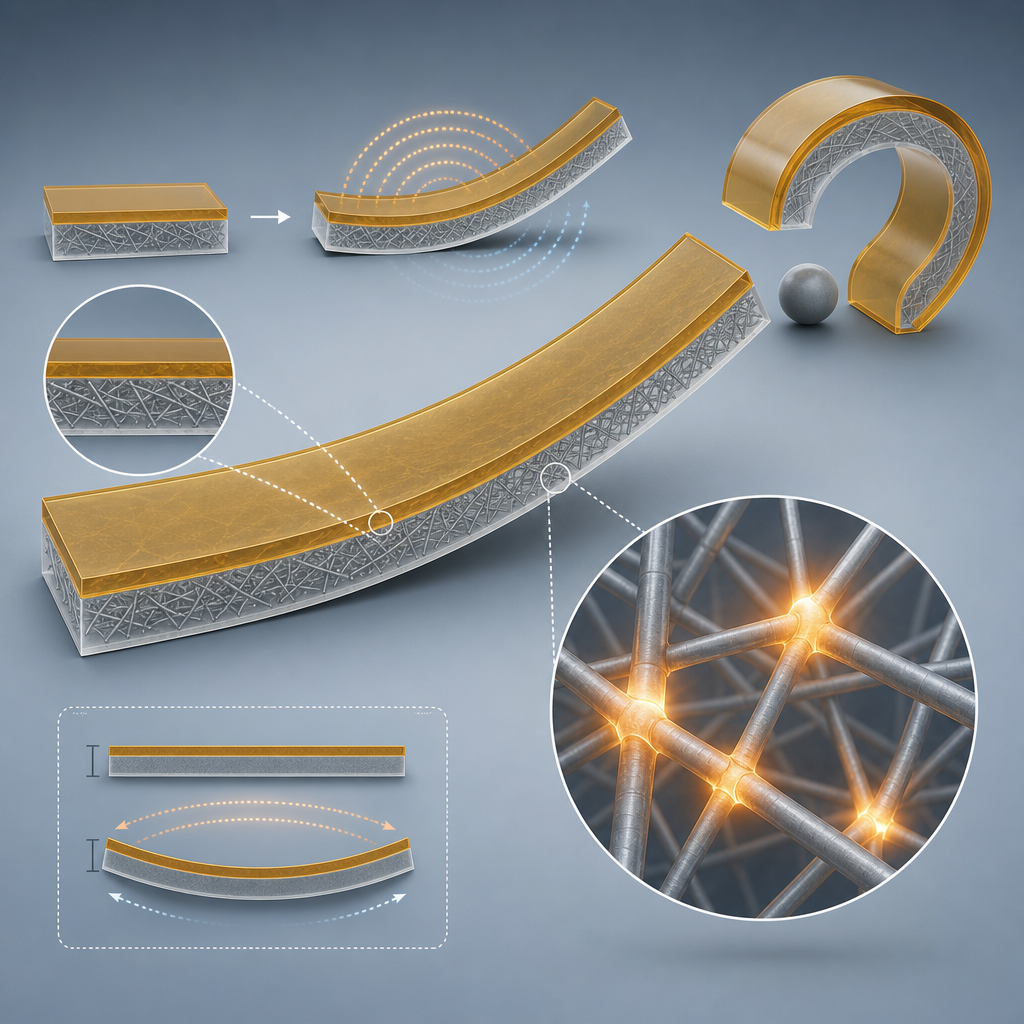
The AgNW/PDMS heaters delivered uniform Joule heating from room temperature up to roughly 200 °C, characterized in real time with a FLIR A655SC infrared camera and an Agilent 6631C power supply. The patterned AgNW network produced low sheet resistance, which translated to low driving voltages for actuation. The PI/AgNW/PDMS bimorph actuators reached large bending angles and high curvatures within seconds, and the thermal time constant was small enough that fast cyclic actuation was possible. Stability tests on the PI/AgNW/PDMS actuator (detailed in the supplementary information) showed reproducible bending over repeated heating-cooling cycles. The four-finger gripper, assembled from four U-shaped actuators, could grab and place small objects, while crawling walkers built on the same bimorph principle navigated flat ratchet surfaces and climbed both up and down stairs, as documented in supplementary movies. Compared to literature actuators based on carbon nanotubes or graphene heaters, the AgNW design achieved competitive curvature and response time while operating at lower voltage, an advantage attributed to the high intrinsic conductivity and well-connected nanowire network after annealing.
The demonstrated platform is directly relevant to soft robotics, biomimetic locomotion, micro-grippers for delicate object handling, and adaptive structures. Because the heater is embedded inside PDMS and patterned by a simple mask-and-drop-cast workflow, it is compatible with batch fabrication and arbitrary 2D heater geometries. The same AgNW/PDMS architecture could be extended to wearable thermotherapy devices, defogging films, deicing patches, and electrothermally tunable optical elements. The authors point toward further reductions in driving voltage by optimizing AgNW density and PI thickness, and toward integration with sensing layers to enable closed-loop soft actuators.
For researchers working on soft actuators, flexible heaters, or transparent conductors, silver nanowires of comparable specifications are available from ACS Material's Nanowire Series, including the same ethanol-dispersed AgNW grade used in this study. The paper provides a useful reference for processing parameters - drop-casting, thermal annealing at 150 °C, and PDMS encapsulation - that translate AgNW dispersions into functional electrothermal devices without elaborate cleanroom steps.How ACS Material products were used
- Silver Nanowire (in ethanol, avg. diameter 90 nm, length 20-30 µm) (Nanowire Series) — “AgNWs in ethanol (ACS Material) with average diameter of 90 nm and length of 20-30 µm were shaken for 5 minutes before use to disperse the nanowires in the solution.”
Product Performance in this StudyThe ACS Material silver nanowires formed a percolating conductive network embedded in PDMS to serve as the resistive Joule heater that drove the bimorph electrothermal actuator. Their high aspect ratio and conductivity enabled low driving voltages, uniform heating, and reliable bending response.
Related product categories
Frequently asked questionsHow do silver nanowire heaters drive soft electrothermal bimorph actuators?
Silver nanowires form a percolating conductive network embedded in PDMS that acts as a Joule heater when current flows through it. The generated heat causes the AgNW/PDMS layer to expand more than a bonded polyimide layer, producing controlled bending. Because AgNW networks have low sheet resistance and high flexibility, the heater operates at low driving voltages while reaching temperatures sufficient for fast, large-curvature actuation in soft robotic devices.
Why are silver nanowire dispersions in ethanol useful for flexible heater fabrication?
Ethanol-dispersed silver nanowires can be drop-cast or sprayed through a mask and then mildly heated to evaporate the solvent, leaving a patterned conductive network without complex cleanroom processing. After thermal annealing near 150 °C, nanowire junctions fuse, dropping contact resistance and improving uniformity. Encapsulating the patterned network in PDMS produces a soft, stretchable Joule heater compatible with bimorph actuators, wearable warming devices, and transparent electrodes.
What advantages do AgNW/PDMS heaters offer over carbon nanotube or graphene heaters in soft robotics?
AgNW networks generally have higher intrinsic conductivity than CNT or graphene films of comparable transparency, which lowers the driving voltage required to reach actuation temperatures. They also withstand bending and can be patterned into arbitrary heater geometries via masked drop-casting. In this Nanoscale paper, the AgNW/PDMS bimorph actuators achieved large bending curvatures and fast response times sufficient to power four-finger grippers and crawling walkers.