-
Silver Nanowire Ink for Stretchable Sensors - Michigan State University, 2018
Jun 16, 2026 | ACS MATERIAL LLCCai, L. et al. (2018). Direct printing for additive patterning of silver nanowires for stretchable sensor and display applications. *Advanced Materials Technologies*. https://doi.org/10.1002/admt.201700232
Electrical and Computer Engineering Michigan State University East Lansing MI 48824 USA · Advanced Materials Technologies · 2018
Researchers at Michigan State University directly printed ACS Material silver nanowires into biaxially stretchable conductors, pressure sensor arrays, and EL displays.
About this research
Researchers at Electrical and Computer Engineering Michigan State University East Lansing MI 48824 USA developed a direct-write printing process using a water-based silver nanowire (AgNW) dispersion purchased from ACS Material, LLC to additively pattern long AgNWs (up to ~40 µm) for stretchable electronics. Published in Advanced Materials Technologies in 2018, the work demonstrates that long nanowires—normally considered unprintable because they exceed the empirical a/50 nozzle limit—can be patterned with sharp, uniform edges by combining careful ink rheology with a controlled meniscus-based deposition technique. The printed AgNWs were used to build biaxially stretchable conductors, an ultrasensitive 10×10 capacitive pressure sensor array, and stretchable electroluminescent (EL) displays.
Patterning silver nanowire networks remains a key bottleneck in flexible and stretchable device manufacturing. Drop casting and rod coating produce uniform films but cannot pattern; stencil and spray methods waste material and are limited to millimeter resolution. Direct inkjet printing of AgNWs is notoriously difficult because long nanowires clog nozzles and dilute aqueous inks suffer coffee-ring and bleeding artifacts. Shortening nanowires through ultrasonication or adding polymer thickeners alleviates these problems but kills stretchability and conductivity. A printing method that retains long nanowires is therefore highly desirable for wearable electronics, electronic skin, stretchable lighting, and printed photovoltaics, where mechanical compliance and electrical performance must coexist.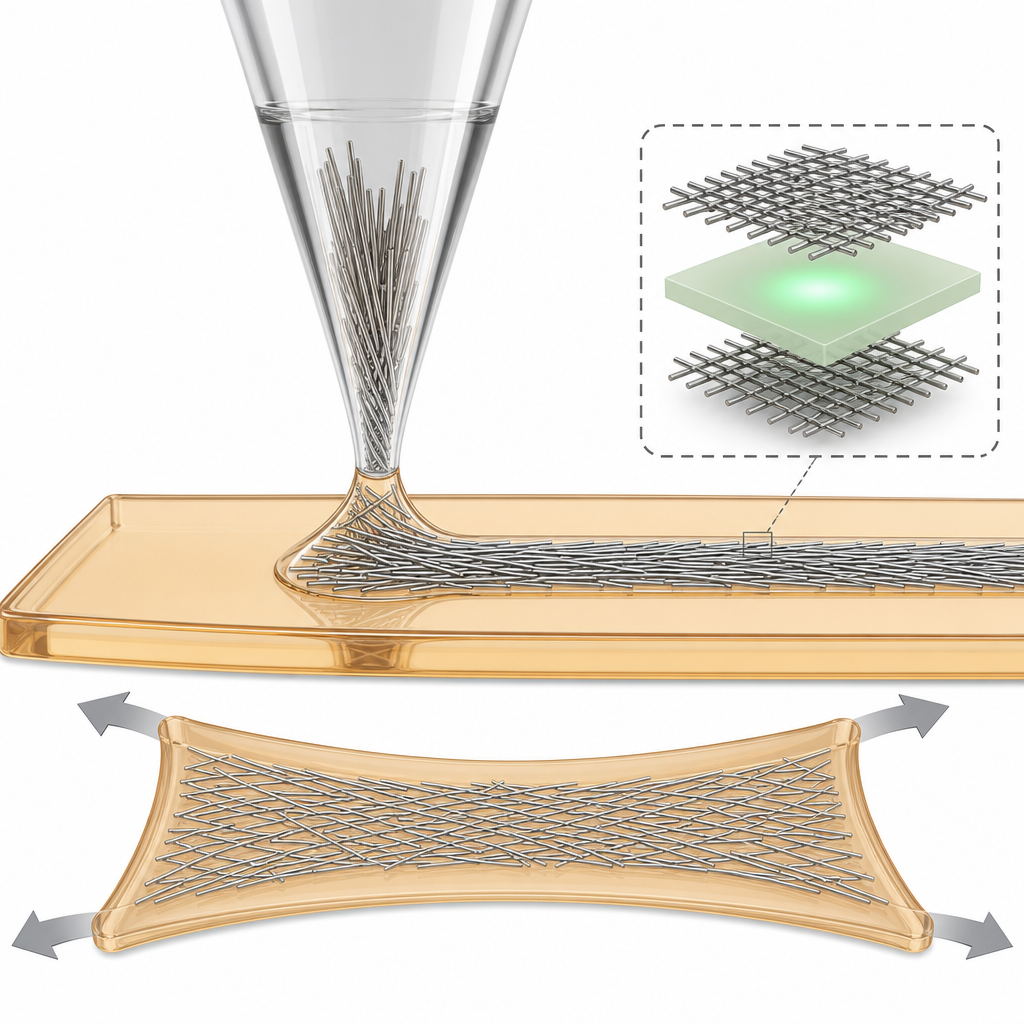
The ACS Material water-based AgNW dispersion served as the foundational ink. After centrifugation to remove silver particle aggregates, 20 vol% ethylene glycol was added to mitigate the coffee-ring effect, and 0.01 vol% Triton X-100 was included when printing onto O₂-plasma-treated PDMS to adjust surface energy. The ink was loaded by capillary action into a glass micropipette (~200 µm nozzle) mounted on a Sonoplot Microplotter. The micropipette tip was brought into contact with the substrate, forming a liquid meniscus that was dragged along a predefined trajectory at 5 mm s⁻¹ on a ~60 °C stage. Solvent evaporated almost immediately after meniscus passage, depositing AgNWs without bleeding. Three AgNW length grades (4.4, 15.6, and 38.5 µm) were studied, and flow-induced alignment within the nozzle allowed even the longest nanowires to pass cleanly. About 40 printing passes typically yielded conductive features.
The printed features showed strong length-dependent electrical and electromechanical behavior. Resistance dropped by more than an order of magnitude during the first printing passes and then plateaued, consistent with percolation, and resistance scaled linearly with feature length for all nanowire grades, confirming uniform distribution across ~5000 µm-long, ~500 µm-wide patterns. At 20% tensile strain, 4.4 µm AgNW patterns saw resistance rise nearly tenfold, whereas 38.5 µm AgNWs showed only a 90% change. After printing onto biaxially prestretched PDMS (30% in each direction), the resistance increased just 38% (from 145 to 200 Ω) at 125% areal strain, and the pattern survived 500 stretching cycles with little change. An LED driven through the stretchable interconnect showed essentially overlapping I–V curves up to 125% areal strain and remained lit at 156%. The 10×10 capacitive pressure sensor array, using printed parallel AgNW lines on PDMS with Ecoflex 0010 as dielectric, achieved 10.6% kPa⁻¹ sensitivity and detected pressures down to ~100 Pa, reproducing 2D pressure profiles of M-, S-, and U-shaped objects with high fidelity. Stretchable EL displays based on PDMS/phosphor composites emitted at ~510 nm for green phosphors, scaled luminance with AC frequency (10 Hz–1 kHz) and amplitude (300 V–2 kV), and withstood >1000 cycles of 20% strain, including a polychrome "MSU" display.
The direct printing approach addresses a real manufacturing gap for wearable electronics, electronic skin, soft robotics, and stretchable lighting. Because the method retains long nanowires, it preserves the conductivity and stretchability needed for biaxial deformation while eliminating shadow masks and material waste. The authors note that the same strategy should generalize to other 1D systems, including semiconducting nanowires, opening a route to printed, mechanically compliant transistors, photodetectors, and solar cells. Future improvements include reducing nozzle openings to push line widths below the current ~270 µm for higher-resolution sensor arrays, and using more robust contact metallization to extend EL display lifetime under cyclic strain.
For researchers working on printable transparent conductors, stretchable electrodes, or wearable sensors, the silver nanowire dispersion used in this study is available from ACS Material's nanowire portfolio. The product offered the long, uniform nanowires required for percolating, stretchable networks—an essential precursor for groups exploring electronic skin, flexible displays, and printed optoelectronics.How ACS Material products were used
- Copper Nanowire in Water (1g) (Nanowire Series) — “Water-based AgNW dispersion was purchased from ACS Materials, LLC.”
Product Performance in this StudyThe water-based silver nanowire dispersion from ACS Material served as the core ink feedstock. After centrifugation and rheology tuning, it enabled direct printing of well-defined AgNW features with nanowire lengths up to ~40 µm, supporting biaxially stretchable conductors, pressure sensors, and EL displays.
Related product categories
Frequently asked questionsWhy are long silver nanowires preferred for stretchable conductors?
Longer silver nanowires retain interwire contacts under tensile strain because they have greater curvature and bridge cracks more effectively. In this study, patterns made with 38.5 µm AgNWs showed only ~90% resistance increase at 20% strain, while 4.4 µm AgNW patterns increased nearly tenfold. Long nanowires also achieve percolation with fewer printing passes and produce lower baseline resistance, enabling biaxially stretchable conductors that survive 156% areal strain.
How does direct meniscus printing of AgNW ink avoid nozzle clogging?
The meniscus-based direct write process uses a glass micropipette with a ~200 µm opening, large enough to accommodate AgNWs that average tens of micrometers in length. Flow-induced alignment as nanowires pass through the nozzle, observed on the inner pipette wall, allows long wires to flow cleanly. Periodically expelling aggregates and tuning ink composition with ethylene glycol further reduces clogging and edge roughness compared to conventional inkjet printing.
What sensitivity can a printed AgNW capacitive pressure sensor achieve?
The printed AgNW pressure sensor array reached a sensitivity of 10.6% kPa⁻¹ in the low-pressure regime and detected pressures as low as ~100 Pa, well below the typical human-skin sensing range. The 10×10 array used parallel printed AgNW lines on PDMS with Ecoflex 0010 as the dielectric, and successfully reproduced 2D pressure profiles of M-, S-, and U-shaped objects, demonstrating its potential for electronic skin applications.