-
Silver Nanowire Stretchable Strain Sensors - University of Houston, 2018
Jun 11, 2026 | ACS MATERIAL LLCKim, H., Thukral, A., & Yu, C. (2018). Highly Sensitive and Very Stretchable Strain Sensor Based on a Rubbery Semiconductor. *ACS Applied Materials & Interfaces*. https://doi.org/10.1021/acsami.7b17709
University of Houston · ACS Applied Materials & Interfaces · 2018
University of Houston researchers used ACS Material silver nanowires to build rubbery P3HT/PDMS strain sensors with gauge factor 32 and 100% stretchability.
About this research
Researchers at the University of Houston, led by Cunjiang Yu, used silver nanowires (AgNWs) purchased from ACS Material to build a highly sensitive and very stretchable strain sensor that operates entirely in a rubber format. By embedding the AgNWs into polydimethylsiloxane (PDMS) as conductive interconnects and pairing them with a solution-processed rubbery semiconductor made of poly(3-hexylthiophene) nanofibrils (P3HT-NFs) percolated in PDMS, the team demonstrated a strain sensor with a gauge factor of 32, R² > 0.996 linearity, and degree of hysteresis below 12% under uniaxial strain up to 100%. The work was published in ACS Applied Materials & Interfaces in 2018.
Stretchable strain sensors are increasingly important for wearable electronics, health monitoring, soft robotics, and human-machine interfaces, where devices must conform to skin or moving machinery and survive large mechanical deformations. Conventional metal-foil strain gauges have low gauge factors (below 5), and crystalline silicon piezoresistors, while sensitive (GF up to ~200), tolerate less than 3% strain before failure. Composite approaches that blend conductive fillers with elastomers have improved stretchability, but typically suffer from low sensitivity, irreversible response, or large hysteresis. Achieving simultaneously high gauge factor, high linearity, low hysteresis, and large strain tolerance in a simple, scalable fabrication route remains an open challenge that this study directly addresses by introducing a fully rubbery semiconductor-based sensor.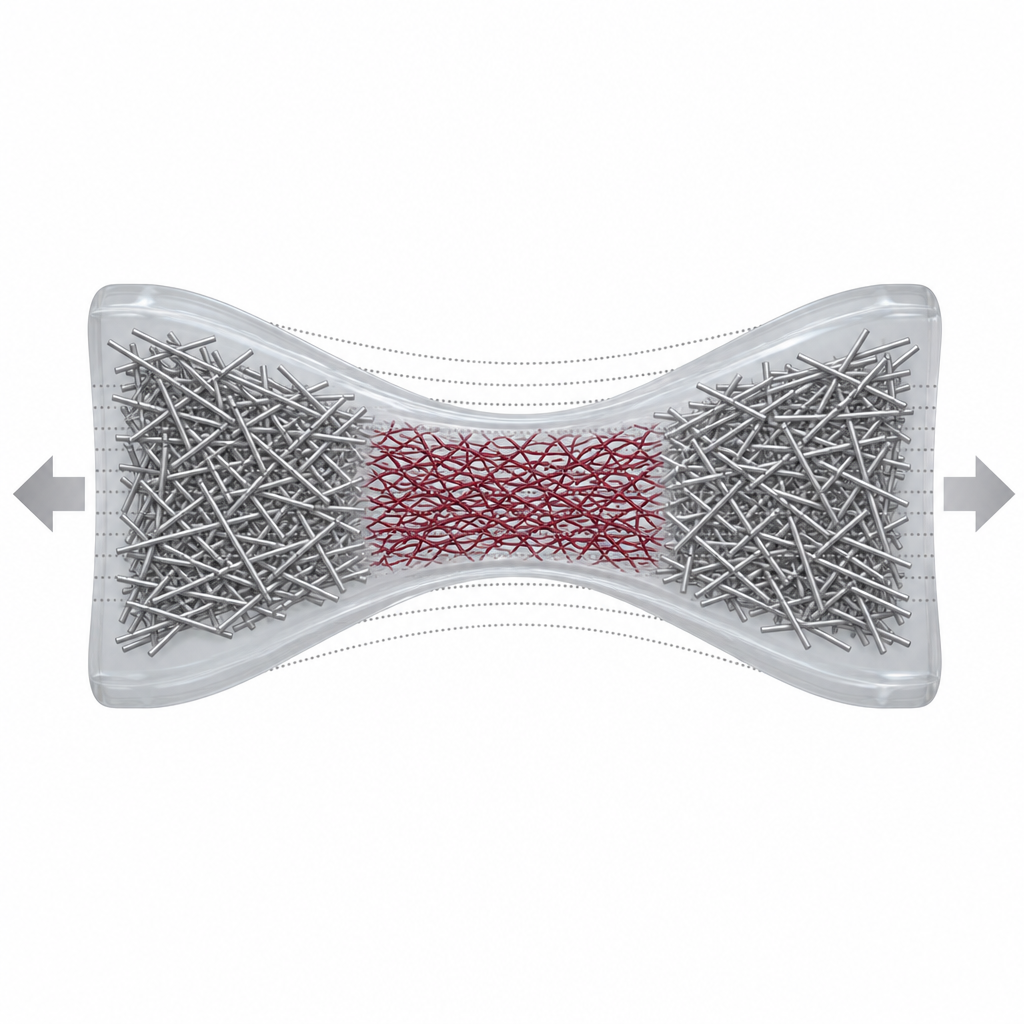
The ACS Material silver nanowires were supplied as a 20 mg/mL aqueous dispersion, with ~99.5% purity, nanowire length around 20 µm, and diameter near 120 nm. To form the stretchable conductor, the AgNW solution was drop-cast through a Kapton shadow mask onto a pre-cleaned glass slide, dried at 60 °C, and then heated on a hot plate at 200 °C for 30 minutes to enhance electrical conductivity at the nanowire junctions. A PDMS prepolymer/curing-agent mixture (10:1 w/w) was spin-coated over the patterned AgNW network and cured at 60 °C for six hours, after which the 250 µm-thick AgNW/PDMS film was peeled from the glass to yield the stretchable conductor composite. These AgNW/PDMS lines served as source and drain interconnects on either side of a 50 µm-wide channel of P3HT-NF/PDMS semiconductor nanocomposite, completing the strain sensor architecture.
The optimized AgNW/PDMS interconnects exhibited a low sheet resistance that rose only modestly from about 2 Ω/□ to 8 Ω/□ when stretched uniaxially up to 100% strain, ensuring that the device’s overall resistance change is dominated by the piezoresistive P3HT-NF/PDMS semiconductor rather than the electrodes. Among the four P3HT weight loadings tested (10, 15, 20, and 25 wt%), the 10 wt% device (S10) gave the best performance: its resistance rose from 0.3 GΩ to 10.7 GΩ between 0 and 100% strain, yielding a maximum gauge factor of 32, compared with 26, 15, and 12 for the S15, S20, and S25 devices, respectively. The response was highly linear (R² > 0.996) and the degree of hysteresis stayed between 2% and 12% across stretch-release cycles at 1 Hz from 20% to 100% strain, decreasing further at lower cycling rates. Analytical modeling based on 3D percolation theory reproduced both the resistance trend and gauge factor, supporting the interpretation that strain straightens and partially disconnects the percolated P3HT-NF network while AgNW/PDMS contacts remain stable. The authors further built a 3 × 3 sensor array that mapped local strain on inflated balloons and human elbows, and a rubbery glove integrating 17 sensors that distinguished individual finger-joint bending, wrist motion, and clenched-fist gestures with response and recovery times of 0.6 s and 1.0 s.
Applications enabled by this platform include wearable health monitors, electronic skins, soft robotic feedback systems, prosthetic devices, and human-machine interfaces that require large, repeatable, and linear strain readouts. The smart glove demonstration is directly relevant to sign-language interpretation, gesture-controlled robotics, and rehabilitation monitoring. Because both the AgNW/PDMS conductor and the P3HT-NF/PDMS semiconductor are solution-processed from commercially available precursors, the authors emphasize that the approach is scalable, and they outline extensions to fully rubbery transistors, integrated circuits, active-matrix backplanes, and pressure or temperature sensors.
For researchers developing stretchable electronics, the study highlights how the quality and geometry of the metal-nanowire conductor strongly influence the achievable sensor performance: stable, low-resistance AgNW networks let the rubbery semiconductor’s intrinsic piezoresistive response dominate the device signal. ACS Material supplies the silver nanowires (20 µm length, 120 nm diameter) used here, along with related copper nanowires and other 1D nanostructures suitable for transparent conductors, stretchable interconnects, and percolation-based composites in flexible electronic devices.How ACS Material products were used
- Silver Nanowires (AgNWs) aqueous dispersion, 20 mg/mL (Nanowire Series) — “Silver nanowires (AgNWs, ~99.5%, 20 mg/mL) dispersed in water (Length and diameter of an AgNW are 20 µm and 120 nm, respectively) was from ACS materials.”
Product Performance in this Study
The AgNWs were patterned and embedded in PDMS to form the stretchable conductive interconnects of the rubbery strain sensor. The AgNW/PDMS conductor maintained low sheet resistance (2–8 Ω/□) under uniaxial strain up to 100%, contributing negligibly to the overall resistance change so that the piezoresistive response could be attributed cleanly to the P3HT-NF/PDMS semiconductor.
Related product categories
Frequently asked questions
How do silver nanowires enable stretchable interconnects in a strain sensor?
Silver nanowires form a percolated conductive network inside an elastomer such as PDMS. When the composite is stretched, the long, high-aspect-ratio nanowires slide and reorient while maintaining electrical contact at their junctions. In this study, AgNW/PDMS interconnects retained low sheet resistance (2 to 8 Ω/□) under up to 100% uniaxial strain, ensuring that resistance changes of the overall device originated from the piezoresistive semiconductor channel rather than the electrodes.
Why is a high gauge factor important for wearable strain sensors?
Gauge factor (GF) measures how strongly a sensor’s resistance changes per unit strain, directly determining the signal-to-noise ratio when detecting small body motions. Metal foil gauges typically have GF below 5, which is inadequate for subtle physiological signals. The rubbery sensor reported here reaches GF = 32 while still tolerating 100% strain, making it sensitive enough to resolve individual finger-joint bending and wrist motion on a wearable glove.
What role does P3HT nanofibril content play in the rubbery semiconductor?
P3HT nanofibril loading sets the percolation behavior of the semiconductor composite. The percolation threshold occurs around 3 wt% P3HT-NF in PDMS, but the highest gauge factor (32) was obtained at 10 wt%, where stretching partially disconnects the nanofibril network and induces a large resistance increase. Higher loadings (15 to 25 wt%) yielded denser networks, smaller relative resistance changes, and gauge factors that dropped to 26, 15, and 12.