-
Silver Nanowire Top Electrodes for Semitransparent OPVs - NC State, 2020
Jun 01, 2026 | ACS MATERIAL LLCXiong, Y. et al. (2020). Novel Bimodal Silver Nanowire Network as Top Electrodes for Reproducible and High‐Efficiency Semitransparent Organic Photovoltaics. *Solar Rrl*. https://doi.org/10.1002/solr.202000328
Solar Rrl · 2020
NC State researchers used ACS Material long, thin silver nanowires to build bimodal AgNW top electrodes for semitransparent organic solar cells reaching 9.79% PCE.
About this research
North Carolina State University researchers developed a bimodal silver nanowire (AgNW) top electrode for semitransparent organic photovoltaics (ST-OPVs) using high-aspect-ratio silver nanowires (diameter 30 nm, length 100–200 μm) supplied by ACS Material, LLC, achieving a champion power conversion efficiency of 9.79% with 23% average visible transmittance in PM6:Y6 devices. By blending these long, thin nanowires with shorter, thicker AgNWs in a 1:1 mixture, the team produced a fully solution-processed transparent top electrode that simultaneously lowers sheet resistance and increases visible-light transmittance. The work, published in Solar RRL by Xiong, Ye, Ade and co-workers at NC State, demonstrates a practical replacement for vacuum-evaporated thin metal top contacts in printable organic solar cells.
Semitransparent organic photovoltaics are attractive for building-integrated applications such as smart windows, greenhouses, and skylights because the absorber spectrum can be tuned to harvest near-infrared light while passing visible photons. However, most high-efficiency ST-OPVs still rely on energy-intensive thermal evaporation of thin Ag, Au, or Al films as the top electrode, which is incompatible with low-cost roll-to-roll manufacturing. Pure solution-processed top electrodes face a difficult trade-off: silver nanowire networks generally require high-temperature annealing or composite hosts to reduce contact resistance, and the underlying photoactive layer must survive solvent contact. Designing AgNW networks that achieve both high transparency and low sheet resistance without thermal post-treatment is therefore a critical materials challenge for fully printable ST-OPVs.
The high-aspect-ratio AgNWs (AgNW-HR, L/D ≈ 3333–6666) supplied by ACS Material as an isopropanol ink were the central building block of the new electrode. The authors note in the Experimental section that 'the high aspect ratio AgNW ink (D: 30 nm, L: 100–200 μm) that dissolved in isopropanol was provided by ACS Material, LLC.' These wires were diluted to 10 mg mL⁻¹ and mixed at 1:1 volume ratio with shorter AgNW-LR (D 60 nm, L 20–30 μm) to form the bimodal (AgNW-BM) dispersion. The mixture was vortex-shaken to prevent agglomeration and spin-coated at 4000 rpm directly onto a 30 nm CLEVIOS HTL Solar PEDOT:PSS hole-transport layer covering the bulk heterojunction. A mild 70 °C drying step in ambient air replaced the high-temperature anneal typically needed for AgNW films. The long, thin ACS Material wires established a sparse percolating backbone that minimized optical scattering, while the shorter wires bridged junctions to suppress contact resistance and counteracted the entanglement-induced aggregation typical of pure long-nanowire dispersions.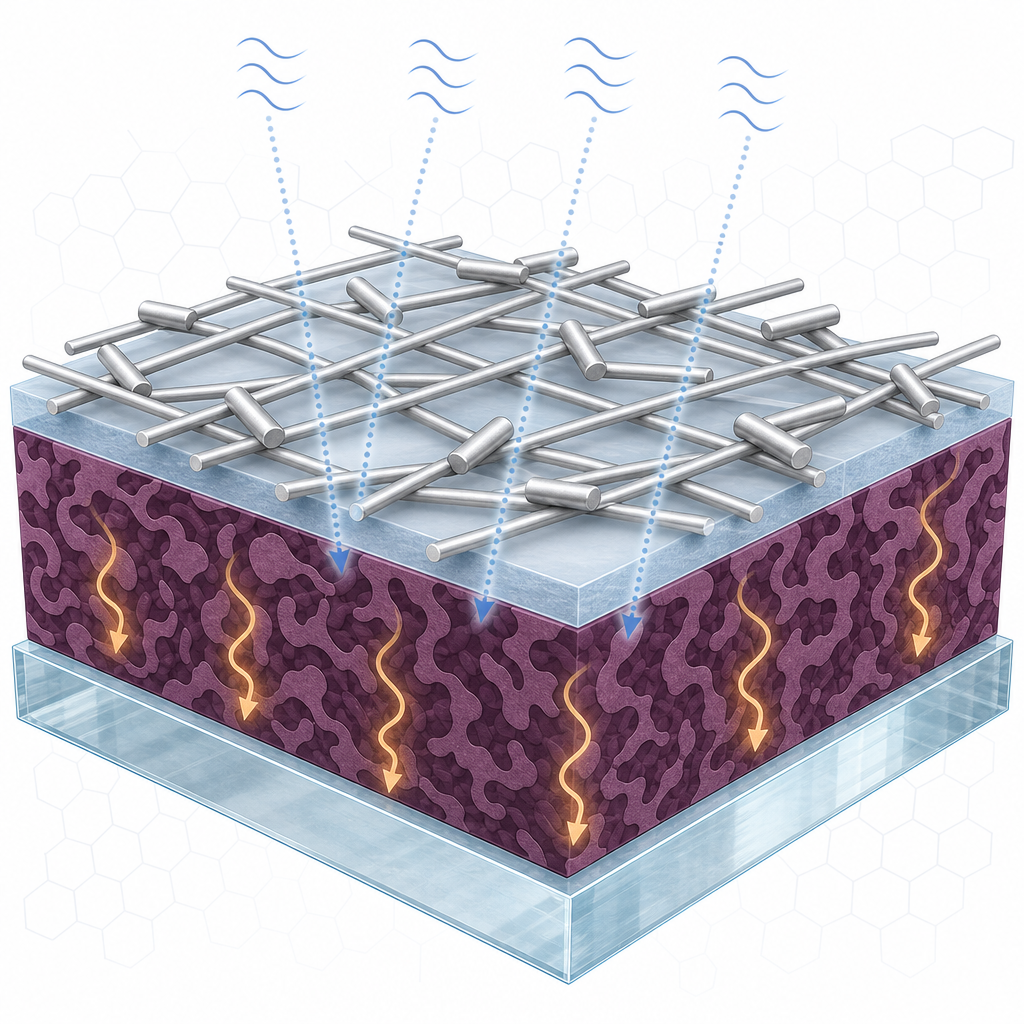 The optoelectronic data quantify the advantage of the bimodal design. Scanning electron microscopy and visible light microscopy confirmed that AgNW-HR films alone formed dense microscale aggregates, whereas AgNW-BM films showed uniform coverage. Across a series of film thicknesses, the PEDOT:PSS/AgNW-BM stack delivered the highest visible transmittance at any given sheet resistance: a mean optical transmission near 80% across 400–700 nm with sheet resistance below 10 Ω/sq. For comparison, AgNW-LR films required six deposition cycles to reach 4.6 Ω/sq, but transmittance fell to 54%. Semitransparent PTB7-Th:IEICO-4F devices fabricated with the AgNW-BM electrode achieved a champion PCE of 7.49% with Jsc of 17.78 mA cm⁻², Voc of 658 mV, FF of 61%, and a 33% average visible transmittance, outperforming both AgNW-LR (6.26% PCE, 22% AVT) and AgNW-HR (6.54% PCE, 27% AVT) controls. Statistics over 90 devices showed a much narrower PCE distribution for AgNW-BM cells, evidencing improved reproducibility. The same electrode was then applied to PM6:Y6 ST-OPVs, reaching 9.79% PCE with 23% AVT, an average Jsc of 20.84 mA cm⁻², Voc of 0.72 V, and FF of 61.26%. Color-rendering indices reached 90 (PTB7-Th:IEICO-4F) and 96 (PM6:Y6), indicating near-neutral transmitted light.
The demonstrated electrode is directly relevant to building-integrated photovoltaics, agrivoltaics, smart windows, semitransparent greenhouse roofing, and tandem or perovskite stacks that require a printable transparent contact. Because the AgNW-BM film does not need high-temperature annealing, it is compatible with heat-sensitive nonfullerene acceptors and could be transferred to roll-to-roll slot-die or spray-coating production lines. The authors highlight that this is the highest reported efficiency for ST-OPVs based on a fully solution-processed AgNW top electrode, and the approach generalizes across both PTB7-Th:IEICO-4F and PM6:Y6 photoactive systems. Future work suggested by the paper includes further tuning of nanowire ratios, integration with low-conductivity PEDOT:PSS variants on other emerging photoactive blends, and scaling the deposition to large-area flexible substrates.
For researchers developing transparent electrodes, flexible optoelectronics, or printable solar cells, the high-aspect-ratio silver nanowire inks available from ACS Material under the Nanowire Series provide a starting point for replicating bimodal electrode architectures. The work confirms that wire geometry, rather than post-processing, can be used to balance conductivity, transparency, and morphological uniformity. Groups working on ST-OPVs, perovskite top contacts, transparent heaters, or stretchable conductors can adopt the bimodal mixing strategy with commercially available AgNW dispersions to obtain solution-cast electrodes that meet practical performance targets.How ACS Material products were used
- High Aspect Ratio Silver Nanowire Ink (D: 30 nm, L: 100–200 μm) in isopropanol (Nanowire Series) — “The high aspect ratio AgNW ink (D: 30 nm, L: 100–200 μm) that dissolved in isopropanol was provided by ACS Material, LLC.”
Product Performance in this StudyThe high aspect ratio AgNWs supplied by ACS Material were combined with shorter, thicker AgNWs to form a bimodal network top electrode. The bimodal electrode delivered the lowest sheet resistance (<10 Ω/sq at 80% transmittance) and the highest semitransparent device efficiency reported for fully solution-processed AgNW top electrodes, with PCE up to 9.79% in PM6:Y6 cells.
Related product categories
Frequently asked questionsWhy does mixing high and low aspect ratio silver nanowires improve transparent electrode performance?
Long, thin nanowires lower the percolation threshold and reduce optical scattering, but they tend to entangle and aggregate in solvent, increasing contact resistance. Shorter, thicker nanowires interpenetrate the long-wire network, bridge junctions, and disperse the aggregates. The resulting bimodal film simultaneously reaches lower sheet resistance and higher visible transmittance than either monodisperse network, with mean transmission near 80% at under 10 Ω/sq.
What efficiency can silver nanowire top electrodes achieve in semitransparent organic solar cells?
Using a bimodal AgNW top electrode, NC State researchers reached 7.49% power conversion efficiency with 33% average visible transmittance in PTB7-Th:IEICO-4F devices and 9.79% efficiency with 23% AVT in PM6:Y6 devices. Color rendering indices of 90 and 96 were achieved, indicating that transmitted light remains close to neutral white, which is essential for window and greenhouse applications.
Can silver nanowire films replace evaporated metal top electrodes without high-temperature annealing?
Yes. The bimodal silver nanowire electrode in this study was spin-coated from isopropanol onto a PEDOT:PSS hole-transport layer and dried at only 70 °C for 10 minutes in air. No high-temperature sintering, mechanical pressing, or composite host was required. The resulting fully solution-processed top electrode is compatible with heat-sensitive nonfullerene acceptors and roll-to-roll printing workflows.