-
Silver Nanowire Transparent Conductive Films - University of Central Florida, 2021
Jun 24, 2026 | ACS MATERIAL LLCFox, D. W. et al. (2021). Uniform deposition of silver nanowires and graphene oxide by superhydrophilicity for transparent conductive films. *ACS Applied Nano Materials*. https://doi.org/10.1021/acsanm.1c00654
University of Central Florida · ACS Applied Nano Materials · 2021
University of Central Florida researchers use ACS Material silver nanowires and graphene oxide on superhydrophilic surfaces to build high-performance transparent conductive films.
About this research
Researchers at the University of Central Florida used silver nanowires (AgNWs) obtained from ACS Material to demonstrate that superhydrophilic, antireflective glass substrates enable uniform drop-cast deposition of 1D and 2D nanomaterials for high-performance transparent conductive films (TCFs). By eliminating the coffee-ring effect that normally plagues solution processing, the team produced AgNW networks with a sheet resistance (Rs) of 250 Ω sq⁻¹ at 97.7% transmittance, and after epitaxial Au shelling, films of 92.0% transmittance at just 39.8 Ω sq⁻¹. The work was published in ACS Applied Nano Materials in 2021.
Transparent conductive films are essential to displays, touchscreens, solar cells, and flexible optoelectronics, where indium tin oxide (ITO) remains dominant despite its brittleness and high cost. Solution-processed nanomaterial networks—silver nanowires, carbon nanotubes, and graphene derivatives—are the most credible ITO alternatives, but their performance hinges on uniform deposition. Spin-coating wastes material, while drop-casting suffers from the coffee-ring effect, in which capillary flow during evaporation concentrates particles at the contact line. Eliminating that defect without surfactant additives or complex environmental control has been a persistent challenge. The Zhai group addressed it through substrate engineering: a nanoporous superhydrophilic film that imbibes liquid faster than capillary flow can redistribute solute, immobilizing the nanowires almost on contact.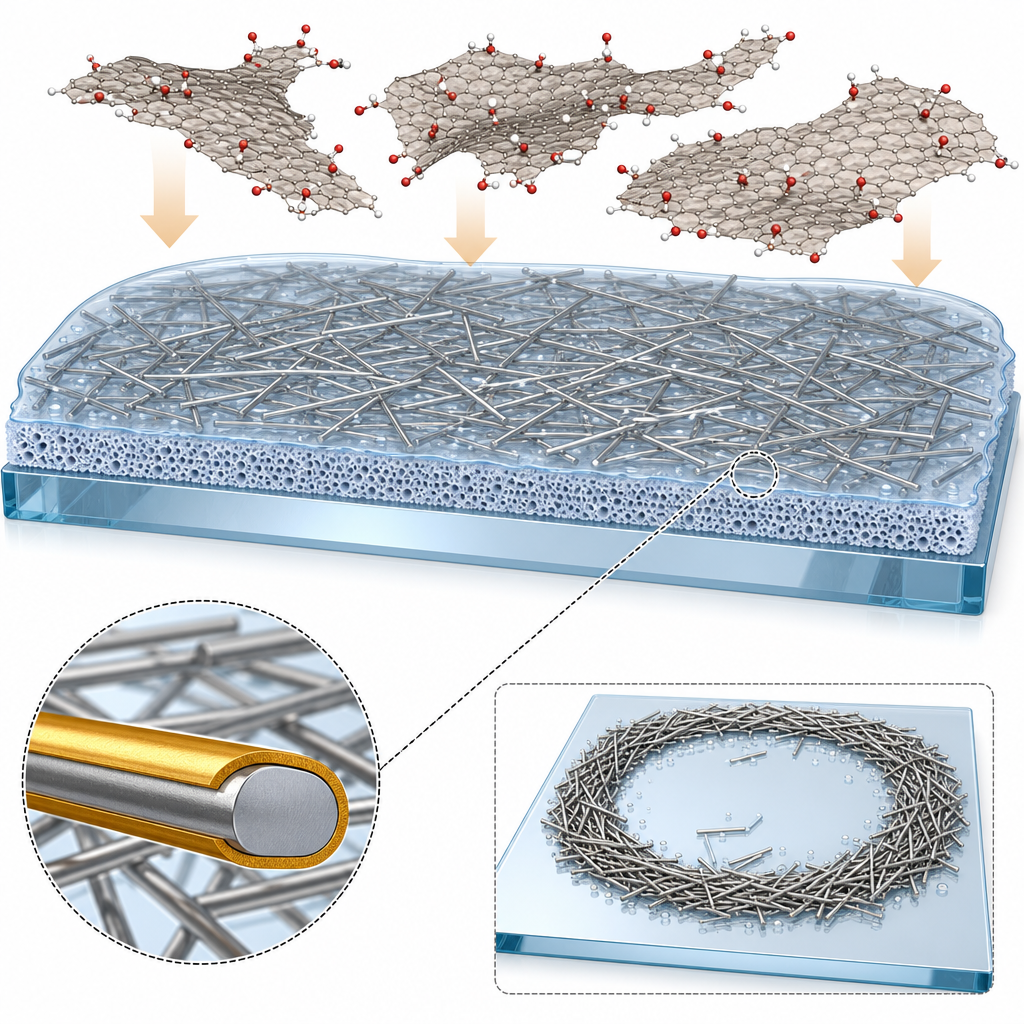
The AgNWs used in the study were obtained from ACS Material (Pasadena, CA) and selected for their length of 100–200 µm, which lowers the percolation threshold critical density and minimizes the effect of further length variation on sheet resistance. The nanowires were diluted in ethanol to concentrations between 0.1 and 2 mg mL⁻¹ for drop-casting and spin-coating onto glass and superhydrophilic substrates. The superhydrophilic antireflective coating itself was built layer-by-layer from PAH and SiO₂ nanoparticles, with 18 bilayers calcined at 400 °C to give a porous silica film with ~99% transmittance. On this surface, a 5 µL droplet of AgNW suspension spread to ~10 mm radius, forming a liquid sheet about 15 µm thick that locked the AgNWs into a uniform percolative network. Conformal gold growth (using HAuCl₄, Na₂SO₃, ascorbic acid, PVP, and NaOH) was applied to selected films to form Ag@Au core–shell nanowires that resisted oxidation and survived subsequent aqueous processing. Graphene oxide was then deposited by spin-coating or spray-coating to flatten the surface.
SEM and XPS line scans confirmed that AgNWs deposited on pristine glass collected at droplet edges in clear coffee rings, while AgNWs deposited on superhydrophilic substrates produced uniform Ag 3d signal across the entire deposition area. Optical performance was outstanding: a TCF with Rs of 250 Ω sq⁻¹ exhibited a transmittance at 550 nm of 97.7%, exceeding bare glass thanks to the antireflective coating; a Rs of 24.7 Ω sq⁻¹ sample retained higher transmittance than pristine glass. Drop-casting on superhydrophilic substrates matched or exceeded spin-coating performance while wasting essentially no nanowire material. After epitaxial Au growth on AgNWs, the best Ag@Au core–shell TCF reached 92.0% transmittance with Rs = 39.8 Ω sq⁻¹, giving a Haacke figure of merit of 1.1 × 10⁻², surpassing previously reported core–shell and alloy nanowire TCFs. Conformal spray-coating of graphene oxide reduced the areal root-mean-square roughness from 28.4 nm to 15.7 nm, with localized regions between nanowires smoothed to 7–10 nm, although GO had limited effect on conductivity in already well-percolated networks. The combined optical, electrical, and mechanical results validate the superhydrophilic-substrate approach as a route to scalable AgNW TCFs.
The demonstrated film architecture is directly applicable to flexible displays, OLED electrodes, touchscreen panels, smart windows, transparent heaters, and solar cell front contacts where ITO replacement matters. The Au-shelled AgNW networks are particularly attractive for devices that require chemical and electrochemical stability, including bio-integrated electronics and outdoor optoelectronics. The drop-casting protocol on superhydrophilic coatings is also compatible with other 1D and 2D nanomaterials—carbon nanotubes, MXenes, transition metal dichalcogenides—pointing toward a general manufacturing strategy for solution-processed nanomaterial films. Future work suggested by the authors includes integration with stretchable substrates, scaling to roll-to-roll fabrication, and pairing with patterned superhydrophilic regions for direct electrode printing.
For researchers working on transparent electrodes, percolation networks, or coating uniformity, the silver nanowires used in this study are available from ACS Material's nanowire product line. The same long-aspect-ratio AgNW grade can be applied to flexible TCFs, electromagnetic shielding, and wearable electronics. ACS Material's nanowire and graphene oxide catalogs support the broader workflow demonstrated here, providing well-characterized starting materials for laboratories building next-generation ITO-free optoelectronic devices.How ACS Material products were used
- Silver Nanowires (AgNWs) (Nanowire Series) — “Silver nanowires were obtained from ACS Materials (Pasadena, CA).”
Product Performance in this StudyThe ACS Material silver nanowires served as the 1D conductive building block for the transparent conductive films. Drop-cast onto superhydrophilic antireflective coatings, they formed uniform percolative networks delivering 97.7% transmittance at 250 Ω sq⁻¹ and, after Au coating, 92.0% transmittance at 39.8 Ω sq⁻¹.
Related product categories
Frequently asked questionsHow do silver nanowires improve transparent conductive films compared to ITO?
Silver nanowires form a sparse percolative network that allows light to pass between wires while providing metallic conduction along them. Unlike ITO, AgNW films are flexible, solution-processable at low cost, and can be deposited on plastic. In this study, AgNW networks reached 97.7% transmittance at 250 Ω sq⁻¹, and after Au shelling, 92.0% transmittance at 39.8 Ω sq⁻¹, outperforming many commercial ITO samples while remaining mechanically robust.
Why does a superhydrophilic substrate suppress the coffee-ring effect during drop-casting?
A nanoporous superhydrophilic surface imbibes liquid through capillary forces within the film, causing the droplet to spread into a very thin sheet (about 15 µm) almost instantly. This outward spreading dominates over the inward capillary flow that normally drives particles to the contact line. Suspended silver nanowires become immobilized in the thinning liquid before they can migrate, producing uniform deposition rather than ring-shaped accumulation.
What is the role of graphene oxide on silver nanowire transparent electrodes?
Graphene oxide acts mainly as a smoothing 2D overcoat on AgNW networks. Spray-coated GO produced a conformal film that reduced areal root-mean-square roughness from 28.4 nm to 15.7 nm, with localized regions down to 7–10 nm between nanowires. This smoother surface helps prevent short circuits in thin-film optoelectronic devices. GO can also bridge gaps in low-density nanowire networks but offers limited conductivity benefit when junctions are already well connected.