-
Silver Nanowire Transparent Electrodes for BIPV OPVs - Bangor University, 2016
Jun 18, 2026 | ACS MATERIAL LLCDing, Z. et al. (2016). Spray coated silver nanowires as transparent electrodes in OPVs for Building Integrated Photovoltaics applications. *Solar Energy Materials and Solar Cells*. https://doi.org/10.1016/j.solmat.2016.05.053
Solar Energy Materials and Solar Cells · 2016
Bangor University researchers used ACS Material L-50 silver nanowires to spray-coat transparent OPV electrodes reaching 30 Ω/sq at 90% transparency for BIPV.
About this research
Researchers at Bangor University, working with collaborators at National Tsing-Hua University and Cardiff University, used L-50 silver nanowires purchased from ACS Material to spray-coat hybrid transparent top electrodes that achieved a sheet resistance of 30 Ω/sq at 90% transparency on P3HT:PCBM organic photovoltaic (OPV) devices. The hybrid AgNW/PH1000 PEDOT:PSS electrode was applied both to semi-transparent OPVs for solar glazing and to top-illuminated OPVs fabricated on opaque DC01 low-carbon steel substrates, demonstrating a versatile route to Building Integrated Photovoltaics (BIPV).
BIPV technologies aim to embed solar generation directly into building envelopes such as windows, façades, and roof cladding rather than mounting modules on top of existing structures. Organic photovoltaics are attractive for BIPV because their colour, transparency and form factor can be tuned, raw-material costs are modest, and energy payback times are short. However, two long-standing challenges have held back the field: replacing brittle, vacuum-deposited transparent conductive oxides such as ITO with solution-processable transparent electrodes, and depositing high-quality OPV stacks on rough, opaque construction materials like steel. This paper addresses both challenges, targeting solar glazing for greenhouses and bus shelters as well as roof- and facade-integrated cells on low-cost steel.
The ACS Material L-50 silver nanowires were supplied at and dispersed at 0.5 mg/mL in ethanol, sonicated for 10 minutes, and spray-coated through a shadow mask using an air brush in a fume hood. They were deposited directly onto a ~70 nm PH1000 PEDOT:PSS layer (modified with 10 vol% DMSO for conductivity enhancement) that itself sat on a Clevios HTL PEDOT:PSS hole-transport layer above the P3HT:PCBM active film. The PH1000 underlayer was essential: when AgNWs were applied directly onto the thin (<20 nm) HTL layer, solvent dewetting detached the PEDOT and produced S-shaped J–V curves. With the thicker PH1000 underlayer, the AgNW network formed a continuous, highly interconnected conductive mesh on the device surface, visible in SEM cross-section and plan-view images. The amount of AgNW deposited was tuned to balance optical transmission against electrode connectivity.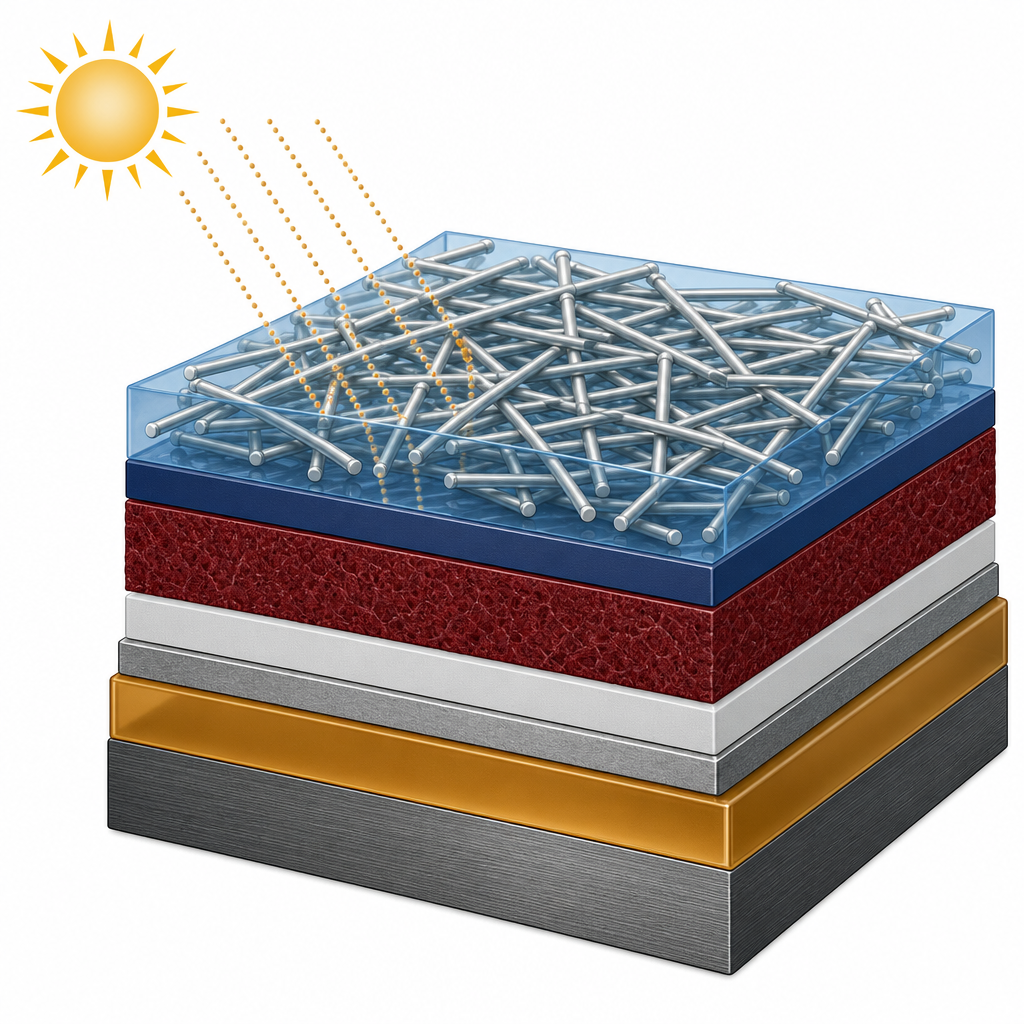
The optimised spray-coated AgNW/PH1000 electrode delivered a sheet resistance of 30 Ω/sq at 90% transparency, comparable to ITO on glass and dramatically better than PH1000 alone (which only reached 300 Ω/sq at 80% transparency at best). For semi-transparent OPVs on ITO-glass with the AgNW top electrode, power conversion efficiency reached 1.5% when illuminated through the AgNW side and 2.1% when illuminated through the ITO side, with Jsc up to 8.3 mA/cm² and Voc of 0.52–0.53 V on 1 cm² devices. Overall device transparency between 350–800 nm was 51%. For the steel-substrate configuration, the team planarised DC01 low-carbon steel using an SU-8 epoxy intermediate layer, reducing RA from 0.10 µm to just 10 nm—one of the lowest reported values for a steel-based PV substrate. After optimising thermally evaporated Al/Cr bottom contacts (which gave 100% diode yield versus 27.7% for bare Ag), the steel/SU8/Al/Cr/ZnO/P3HT:PCBM/HTL/PH1000/AgNW stack reached 2.3% PCE, with Jsc of 8.2 mA/cm², Voc of 0.53 V and FF of 0.53 over a 1 cm² area—only 23% below the rigid ITO-glass control (3.0% PCE). Initial ISOS-T-2 thermal cycling showed a 19% relative PCE drop after 100 cycles.
This work points the way to OPV modules embedded directly into roofs, facades, slate, ceramic tiles and metal cladding using low-cost steel rather than stainless steel, with the authors estimating a substrate cost of about €29/m² including SU-8 planarisation. Solar glazing for greenhouses, bus shelters, and architectural windows is another immediate application, since the semi-transparent device retains 51% visible transmission. The spray-coated AgNW/PEDOT:PSS electrode is fully solution-processable in ambient using ethanol and water, making it compatible with roll-to-roll manufacturing on flexible or large-area substrates. Follow-on work suggested by the paper includes thinning the PH1000 underlayer to recover 10–15% in Jsc and extended environmental stability testing to address CTE mismatch between P3HT:PCBM and steel.
For researchers developing transparent electrodes, flexible OPVs, perovskite top contacts, or transparent heaters and EMI shields, ACS Material offers silver nanowires in a range of diameters and lengths suitable for spray, slot-die and spin coating. The L-50 grade used in this study is part of the broader Nanowire Series and supports work on ITO replacement, BIPV modules and printable optoelectronics where balancing sheet resistance against optical transmission is critical.How ACS Material products were used
- Silver Nanowire (L-50) (Nanowire Series) — “0.5 mg/mL silver nanowire (Ag NW) (L-50, purchased from ACS Materials) in ethanol”
Product Performance in this StudyThe ACS Material L-50 silver nanowires formed the conductive component of a spray-coated transparent top electrode that, in combination with PH1000 PEDOT:PSS, achieved 30 Ω/sq sheet resistance at 90% transparency, enabling functional semi-transparent OPVs and steel-substrate OPVs.
Related product categories
Frequently asked questionsHow do silver nanowires replace ITO in organic solar cells?
Spray-coated silver nanowires form a percolating conductive mesh that, when combined with a PEDOT:PSS underlayer, provides sheet resistance comparable to ITO while remaining highly transparent. In this study a hybrid AgNW/PH1000 PEDOT:PSS electrode reached 30 Ω/sq at 90% transmission. Unlike ITO, AgNW electrodes are solution-processable in ambient conditions using ethanol or water, are mechanically flexible, and avoid vacuum sputtering, making them suitable for large-area, roll-to-roll OPV manufacturing.
What sheet resistance and transparency can spray-coated silver nanowire electrodes achieve?
The optimised spray-coated AgNW/PH1000 PEDOT:PSS top electrode in this study achieved a sheet resistance of 30 Ω/sq at 90% optical transparency on glass, closely matching the performance of commercial ITO on glass. By tuning the amount of nanowire deposited, the trade-off between conductivity and transmittance can be controlled: more nanowires improve mesh interconnectivity and reduce sheet resistance, but increase optical reflection and absorption losses.
Why is silver nanowire ink important for Building Integrated Photovoltaics?
Building Integrated Photovoltaics require transparent electrodes that can be deposited on rough, opaque, or temperature-sensitive substrates such as steel, plastic, or planarised concrete. Silver nanowire inks can be spray-coated at low temperatures in ambient air using benign solvents, avoiding the vacuum sputtering, UV plasma exposure, and high temperatures needed for ITO. This enables direct integration of organic photovoltaics into roof cladding, façades, and solar glazing without damaging underlying polymer or epoxy layers.