-
Silver Nanowire Transparent Electrodes for OPVs - Hanyang University, 2018
Jun 29, 2026 | ACS MATERIAL LLCCamic, B. T. et al. (2018). Solution-Processable transparent conducting electrodes via the self-Assembly of silver nanowires for organic photovoltaic devices. *Journal of Colloid and Interface Science*. https://doi.org/10.1016/j.jcis.2017.09.112
Journal of Colloid and Interface Science · 2018
Hanyang University researchers self-assemble ACS Material silver nanowires into transparent conducting electrodes for P3HT:PCBM organic photovoltaic devices.
About this research
Researchers at Hanyang University, working with collaborators at Yıldız Technical University, developed solution-processable transparent conducting electrodes (TCEs) by self-assembling ACS Material silver nanowires (Ag NWs, 50 nm diameter, 5-10 µm length, 20 mg/mL in IPA) onto silanized glass substrates, and integrated the resulting electrodes as the anode of P3HT:PCBM organic photovoltaic (OPV) devices. Reported in the Journal of Colloid and Interface Science (2018), the work demonstrates that controlled electrostatic self-assembly produces uniform AgNW networks with tunable density, good substrate adhesion, and competitive optoelectronic performance compared to indium tin oxide (ITO). The approach addresses both uniformity and material-waste challenges that limit conventional AgNW deposition methods.
Transparent conducting electrodes underpin organic photovoltaics, flexible displays, and touch panels, where ITO has long been the standard. ITO's brittleness, indium scarcity, and high vacuum-deposition cost have driven the search for solution-processable alternatives. Silver nanowire networks combine high transmittance with low sheet resistance, but common deposition routes — spin coating, spray coating, brush painting, Meyer-rod coating, drop casting, and dry transfer — either struggle with large-area uniformity or generate substantial nanowire waste. Self-assembled coatings, in which functional groups on the substrate selectively capture nanowires from solution, offer a route to uniform films with tunable porosity and minimal material loss, which is exactly the gap this study targets for OPV electrode manufacturing.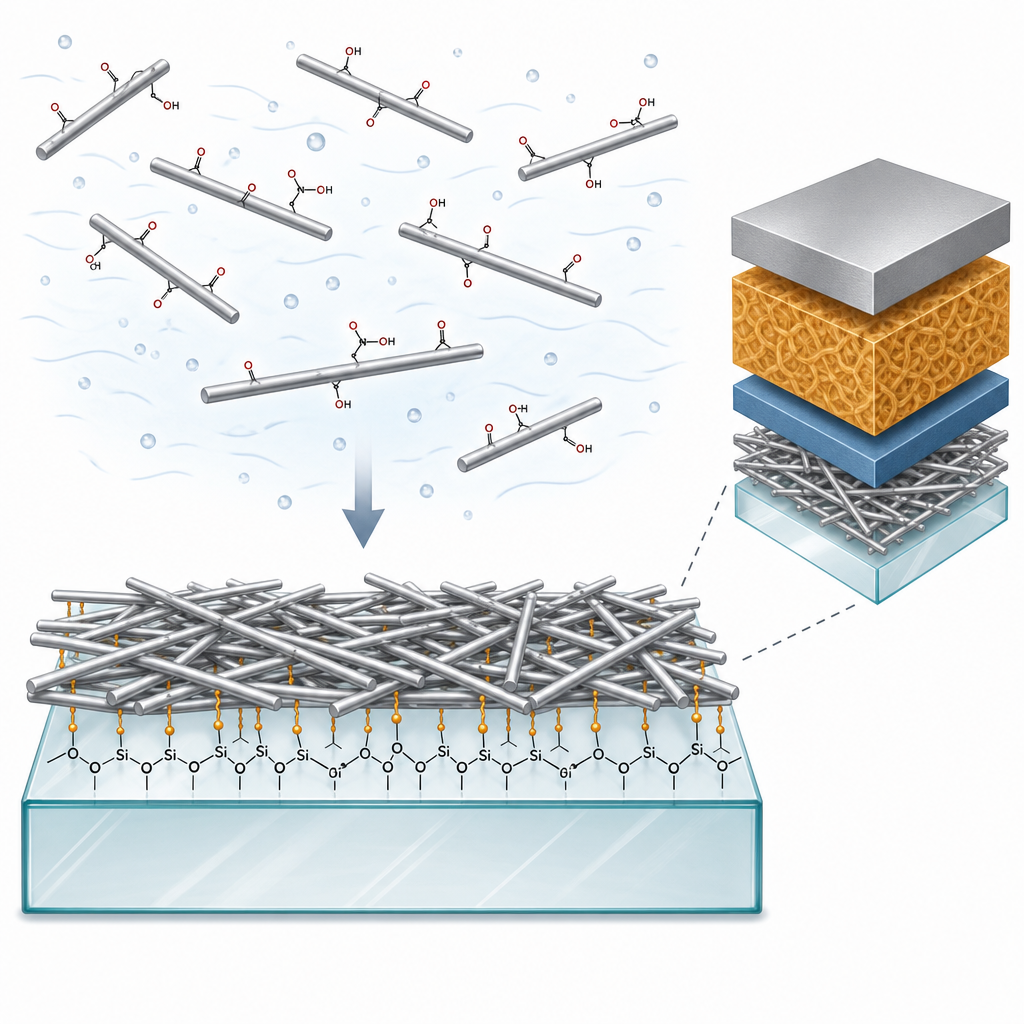
The ACS Material silver nanowires (50 nm × 5-10 µm, IPA dispersion) were used directly as supplied and also after surface modification. To produce negatively charged Ag NWs (COOH), the nanowires were centrifuged out of IPA, redispersed in DMF, and reacted with 3-mercaptopropionic acid (MPA, 30 mg per 10 mg AgNWs) for 24 h at room temperature; thiol-Ag bonding installed carboxyl groups, confirmed by XPS peaks at 162.2, 163.2, and 164.6 eV corresponding to S-Ag, S-H, and S-C bonds. Glass slides were cleaned with piranha solution and silanized with either APTES (amine-terminated) or MPTES (thiol-terminated). APTES-modified substrates were dipped in Ag NW (PVP) or Ag NW (COOH) solutions (0.5 mg/mL) and MPTES-modified substrates in AgNW (PVP) solutions, for immersion times between 1.5 and 24 h. After IPA/water rinsing and drying, films were annealed at 230 °C for 15 min in air to weld nanowire junctions and lower contact resistance. The pristine ACS Material AgNWs served both as the starting nanowire stock and as the conductive network in the final electrodes.
Zeta-potential measurements gave -30.2 mV for Ag NWs (PVP) in IPA and -31.3 mV for Ag NWs (COOH) in DI water, both above the |30| mV threshold associated with electrostatic dispersion stability, confirming that the carboxyl-functionalized nanowires remained well dispersed prior to assembly. XPS validated the MPA functionalization chemistry. The self-assembled AgNW networks were characterized by UV-Vis spectrometry, optical microscopy, FE-SEM, four-point probe sheet-resistance measurement, and AFM roughness analysis. Nanowire surface coverage and density scaled with immersion time, giving direct control over the trade-off between optical transmittance and sheet resistance. The annealed films exhibited the low sheet resistance and high transmittance typical of fused AgNW percolation networks, and were uniform over the 15 × 15 mm² glass area used. The TCEs were integrated into OPV devices with the architecture AgNW/V2O5 (spin-cast HTL)/P3HT:PCBM (1:0.8 wt, dichlorobenzene:diphenylether 97:3)/Al (100 nm), measured under 1 sun (100 mW cm⁻²) AM1.5 illumination in a N2 glove box without encapsulation, demonstrating functional device operation with the self-assembled AgNW anode.
The self-assembly route is attractive for any application area where uniform, large-area, low-waste transparent electrodes are needed: flexible OPVs and perovskite solar cells, OLED lighting, transparent heaters, electrochromic windows, and capacitive touch sensors. Because the immersion-time variable controls nanowire density, the same chemistry can be tuned to favor either high transparency (sparse networks for windows and displays) or low sheet resistance (denser networks for current-collecting electrodes). The authors point toward follow-up work using flexible substrates and alternative photoactive layers, where the strong silane-mediated adhesion is expected to improve mechanical durability under bending compared with simple drop-cast films.
For researchers building their own AgNW electrodes, the practical takeaway is that commercially supplied silver nanowires with consistent 50 nm × 5-10 µm geometry — like those used here from ACS Material — are well suited to MPA functionalization and silane-mediated self-assembly. The Nanowire Series and related transparent conductive film products from ACS Material are available to research and prototyping groups working on ITO-free electrodes, organic and perovskite photovoltaics, and flexible optoelectronics.How ACS Material products were used
- Silver Nanowires (dispersed in IPA, 20 mg/mL, avg. diameter 50 nm, length 5-10 µm) (Nanowire Series) — “Silver nanowire (Ag NW) dispersed in IPA (20 mg/ml) with an average diameter of 50 nm and length of 5-10 µm was obtained from ACS Materials.”
Product Performance in this StudyThe ACS Material silver nanowires were the core building block of the transparent conducting electrode. After MPA functionalization and self-assembly onto silanized glass, they formed uniform, well-adhered networks that served as the anode in P3HT:PCBM organic photovoltaic devices.
Related product categories
Frequently asked questionsHow are silver nanowires self-assembled into transparent conducting electrodes?
Glass substrates are first silanized with APTES or MPTES so that amine or thiol groups face outward. Silver nanowires, either as-received PVP-stabilized or carboxyl-functionalized with 3-mercaptopropionic acid, are then captured from solution by electrostatic interaction during a controlled immersion (1.5-24 h). After rinsing and 230 °C annealing, the welded AgNW network forms a uniform transparent electrode with strong substrate adhesion.
Why are silver nanowire electrodes considered a good alternative to ITO?
Silver nanowire networks deliver sheet resistance and optical transmittance comparable to indium tin oxide while being solution-processable at low cost. Unlike ITO, AgNW films tolerate mechanical bending, avoid indium scarcity, and do not require vacuum deposition. This makes them attractive for flexible OPV cells, perovskite solar cells, OLED lighting, transparent heaters, and capacitive touch panels manufactured by roll-to-roll printing.
What silver nanowire dimensions work best for organic photovoltaic anodes?
This study used silver nanowires averaging 50 nm in diameter and 5-10 µm in length. That aspect ratio is high enough to form a percolating conductive network at sparse coverage, preserving optical transmittance, while the 50 nm diameter keeps scattering low. Geometric consistency is critical, so researchers typically source pre-characterized commercial AgNWs rather than synthesizing batches in-house.