-
Silver Nanowires for IR Transparent Electrodes - NYU, 2025
Jun 18, 2026 | ACS MATERIAL LLCPaul, S. J. et al. (2025). Plenty of room at the top: exploiting nanowire–polymer synergies in transparent electrodes for infrared imagers. *Journal of Materials Chemistry C*. https://doi.org/10.1039/d5tc00581g
New York University · Journal of Materials Chemistry C · 2025
NYU researchers used ACS Material silver nanowires in a PVA composite top electrode achieving >70% IR transmittance and ~11 Ω/sq for HgTe quantum dot photodetectors.
About this research
Researchers at New York University demonstrated that silver nanowires (Ag-NWs) purchased from ACS Material LLC, dispersed in isopropyl alcohol and embedded in polyvinyl alcohol (PVA), form a transparent conductive top electrode that delivers over 70% optical transmittance across the near-, short- and mid-wave infrared while maintaining a low sheet resistance of roughly 11 Ω sq⁻¹. Integrating this Ag-NW–PVA composite as a top contact in a HgTe colloidal quantum dot (cQD) photodiode produced detectivities near 2.9×10¹¹ Jones at 1800 nm, comparable to conventional bottom-illuminated infrared cQD detectors. The work shows that a solution-processable, room-temperature-cured composite can replace fragile or absorbing transparent electrodes in vertical infrared photodetectors.
Infrared photodetection is expanding from military and space niches into machine vision, agriculture, medicine and consumer electronics. Colloidal quantum dots offer a solution-processable, wavelength-tunable alternative to costly or toxic bulk materials like mercury cadmium telluride and InGaAs. However, scaling cQD detectors into fully integrated imagers, particularly in the mid-wave infrared, is held back by the scarcity of top electrodes that combine high IR transparency with low sheet resistance and gentle, low-temperature processing. Transparent conductive oxides such as ITO degrade in the extended-SWIR and MWIR and risk sputtering damage; CVD graphene needs specialized equipment; graphene oxide suffers contact uniformity issues; and thin gold films can form discontinuous layers on rough cQD surfaces. A solution-processable electrode that works from the visible into the MWIR addresses a genuine bottleneck for affordable infrared imaging.
The ACS Material silver nanowires were supplied in IPA at 20 mg mL⁻¹ with a length range of 10–30 µm and a diameter of 120 nm. A roughly 5 wt% PVA stock solution was prepared in deionized water, and the Ag-NW stock was added at ratios giving 10, 20 and 30 wt% theoretical Ag-NW content. Mixing was performed gently by tilting or low-speed vortexing because vigorous sonication risks breaking the fragile nanowires. The composite solutions were spin-coated (4000 rpm, 60 s) onto glass, silicon, sapphire and device substrates, then annealed on a hot plate at 40–44 °C for one minute and vacuum dried overnight. This low-temperature route is compatible with temperature-sensitive HgTe cQDs. The nanowires were also used alone as a bare mesh and in a sequential deposition control to isolate the benefit of embedding them in the polymer. In the final device, a 20 wt% Ag-NW–PVA composite was spin-coated as the top contact over a HgTe cQD stack with TiO2 or SnO2 electron transport and MoO3 or Ag2Te hole transport layers.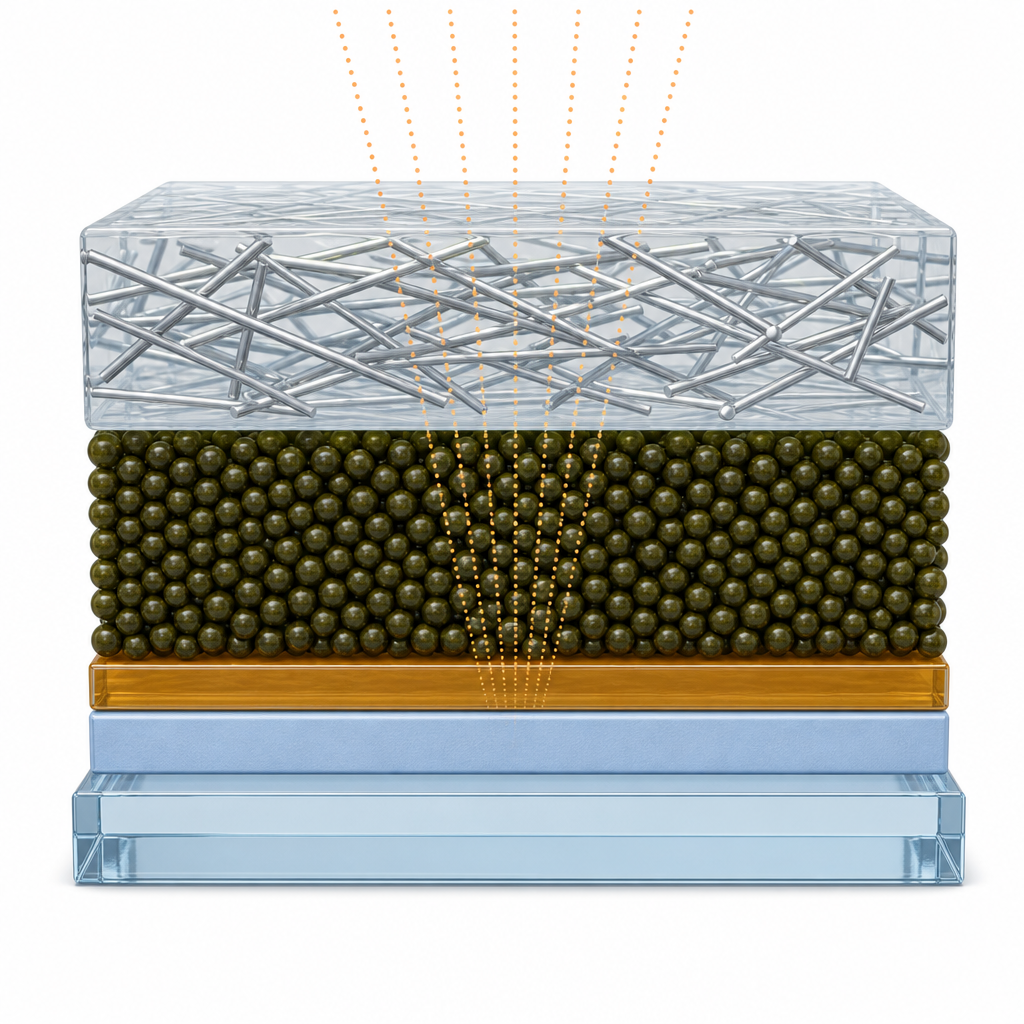
Thermogravimetric analysis indicated the true nanowire content was higher than the nominal value, with 20 wt% mixed solution yielding films near 50 wt% Ag-NWs. SEM showed conductive pathways forming even at 10% loading, with interconnectivity rising at higher loading while more than half the area remained nanowire-free, preserving transparency. The composite films achieved over 70% transmittance through the NIR and SWIR and above 60% into the MWIR (3–5 µm), exceeding ITO and FTO, which fall below 50% beyond 3 µm. Average film thicknesses were 349, 144 and 57 nm for 10, 20 and 30% loading. Sheet resistance decreased with loading and stabilized near 11 Ω sq⁻¹ above 15% Ag-NW, indicating a stable junction network. Kelvin probe force microscopy gave a work function of about 4.6 eV, close to silver and ITO (~4.7 eV), supporting integration into cQD photodiode stacks. Devices with the composite top contact showed nearly identical responsivity under top versus bottom illumination, unlike opaque 100 nm silver contacts. The mixed-deposition composite outperformed a bare Ag-NW mesh by about two orders of magnitude in responsivity and roughly doubled the response versus sequential deposition. The optimized FTO/SnO2/HgTe/Ag2Te/Ag-NW–PVA diode achieved peak detectivity ~2.9×10¹¹ Jones and responsivity ~36.5 mA W⁻¹ at 1800 nm, with rise and fall times of 10 ms and 23 ms.
The Ag-NW–PVA composite enables vertical, top-illuminated infrared photodetector architectures without sacrificing the transparency of the top contact, which is valuable for focal plane arrays and IR imagers. Because the composite is solution-processable and cured at room temperature, it is compatible with temperature-sensitive cQDs such as HgTe and with flexible substrates, opening paths toward affordable, scalable SWIR and MWIR detectors. The authors note their approach can be readily translated to other emerging infrared cQD systems and device geometries as those syntheses improve. The MWIR transparency is especially relevant given the limited availability of compatible transparent electrodes in that band, suggesting potential impact in machine vision, search-and-rescue and wearable optoelectronics.
For researchers pursuing transparent electrodes, infrared photodetectors or flexible optoelectronics, this study illustrates how commercially available silver nanowires can be processed into high-performance composite contacts. The silver nanowire dispersions used here are available from ACS Material's Nanowire Series, supporting groups working on similar transparent-conductor and quantum-dot device challenges. The reported transmittance, sheet resistance and detectivity figures reflect the composite system as a whole and provide a practical, evidence-based reference point for selecting nanowire feedstock for IR electrode development.How ACS Material products were used
- Silver Nanowires in IPA (20 mg/mL, length 10-30 µm, diameter 120 nm) (Nanowire Series) — “Silver nanowires in isopropyl alcohol (Ag-NWs in IPA, 20 mg mL1) were purchased from ACS Material LLC. The nanowires have a length range of 10–30 mm and a diameter of 120 nm.”
Product Performance in this StudyThe ACS Material silver nanowires, embedded in PVA, formed a transparent conductive composite top electrode delivering >70% IR transmittance and ~11 Ω sq⁻¹ sheet resistance, enabling top-illuminated HgTe cQD photodiodes with detectivity ~2.9×10¹¹ Jones.
Related product categories
Frequently asked questionsHow do silver nanowires improve transparent electrodes for infrared photodetectors?
Silver nanowire networks combine high conductivity with high optical transparency. When embedded in PVA, the resulting composite in this study delivered over 70% transmittance across the NIR and SWIR and above 60% into the MWIR, with a sheet resistance near 11 Ω/sq. Because more than half the film area remains nanowire-free, infrared light passes through while the connected wires carry current.
Why is embedding silver nanowires in PVA better than using a bare nanowire mesh?
Bare silver nanowire films suffer from poor substrate adhesion, weak wire-to-wire bonding, high optical haze and Joule heating degradation. Embedding the nanowires in PVA improves adhesion and mechanical and electrical stability. In this work, devices with a mixed Ag-NW–PVA composite top contact showed about two orders of magnitude higher responsivity than identical devices using a bare nanowire mesh.
What grade of silver nanowires is suitable for infrared transparent electrodes?
This study used silver nanowires dispersed in isopropyl alcohol at 20 mg/mL with a length range of 10–30 µm and a diameter of 120 nm. These dimensions formed an interconnected conductive network at 15–20 wt% loading while leaving enough open area for high infrared transmittance, making such nanowire dispersions appropriate feedstock for transparent infrared electrode fabrication.