-
Silver Nanowires for Nucleate Boiling Heat Transfer - HBKU, 2022
Jul 08, 2026 | ACS MATERIAL LLCSezer, N. et al. (2022). Enhanced nucleate boiling heat transfer on bubble-induced assembly of 3D porous interconnected graphene oxide/silver nanowire hybrid network. *Case Studies in Thermal Engineering*. https://doi.org/10.1016/j.csite.2022.102334
Case Studies in Thermal Engineering · 2022
ACS Material silver nanowires formed a 3D porous GO/AgNW film that boosted nucleate boiling heat transfer coefficient by 196.6% and critical heat flux by 182.4%.
About this research
Researchers at Hamad Bin Khalifa University demonstrated that high-purity silver nanowires supplied by ACS Material, combined with graphene oxide nanosheets, can form a 3D porous interconnected hybrid film that boosts the nucleate boiling heat transfer coefficient by 196.6% and delays critical heat flux by 182.4%. The hybrid network was created in a single, low-cost step by bubble-induced self-assembly during pool boiling of colloidal dispersions on a flat copper heating surface. Among three GO:AgNW weight ratios (0:1, 1:1, 1:5), the silver-nanowire-rich 1:5 formulation gave the best combined improvement in heat transfer coefficient and critical heat flux, attributed to greater surface area, denser bubble nucleation sites, improved lateral heat conduction and stronger capillarity.
This research matters because the heat load on electronic devices keeps rising as components shrink and integrate more functions, demanding more efficient cooling. Nucleate boiling is considered the most efficient phase-change heat transfer mode, yet its two key metrics—heat transfer coefficient (efficiency) and critical heat flux (capacity)—still have substantial room for improvement. Engineering the heating surface with micro- and nanostructures is a leading route to enhanced boiling. Self-assembled 3D porous graphene oxide surfaces are already known to help, and hybridizing graphene with metals or carbon nanotubes pushes performance further. However, graphene/metal nanowire hybrids had not previously been studied in boiling research. By introducing silver nanowires—well dispersed within porous graphene oxide—the authors targeted better interfacial contact, faster liquid replenishment and localized heat dissipation, addressing a clear gap relevant to thermal management of high-power electronics and concentrated photovoltaics.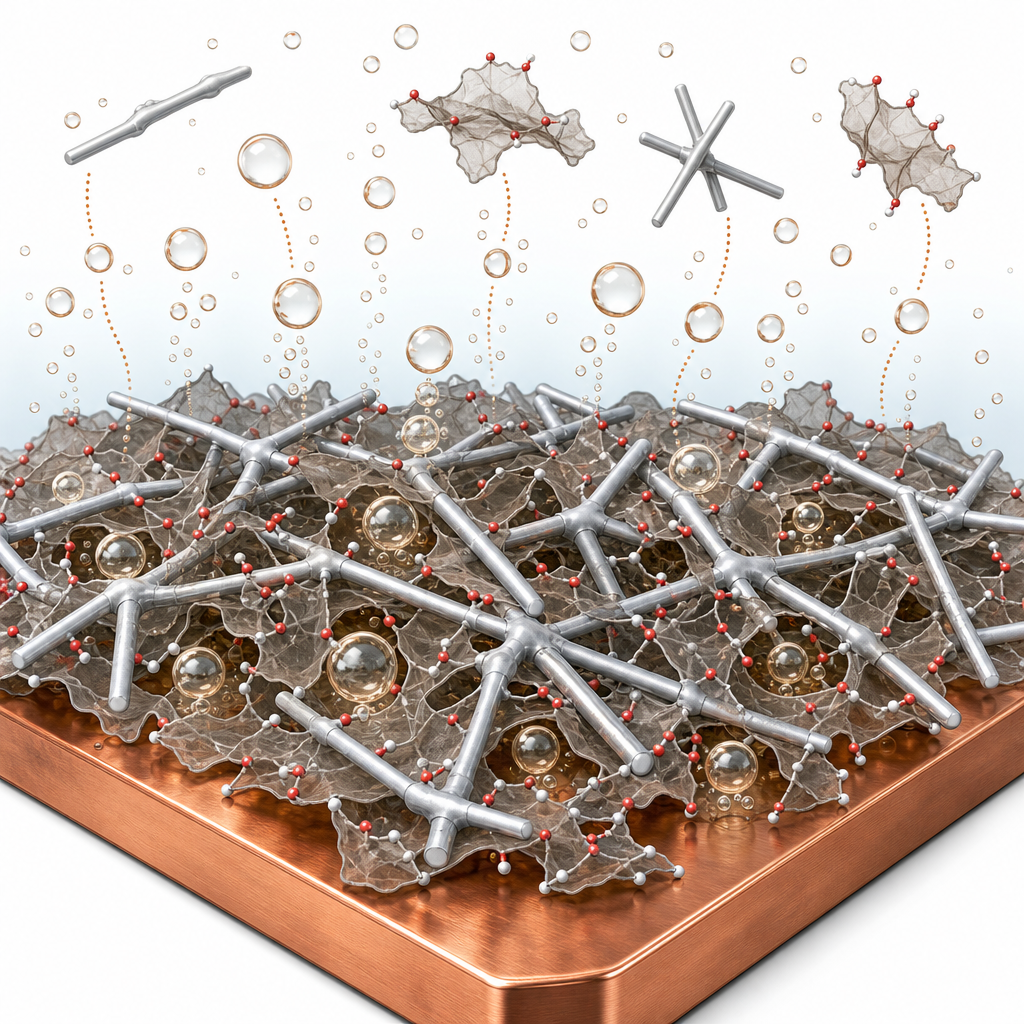
The ACS Material silver nanowires were specified as ~99.5% purity, 20–30 μm in length and ~60 nm in diameter. They were dispersed in deionized water together with chemically oxidized graphite (graphene oxide) at a total solid loading of 0.005 wt%, with no surfactant added so that only the intrinsic effect of the colloids on boiling was probed. Three AgNW:GO weight ratios were prepared by sonication. The dispersions were then boiled (250 mL batches) under atmospheric pressure on a custom apparatus with a 20 mm × 20 mm copper heating surface, where bubble dynamics drove simultaneous deposition of graphene oxide nanosheets and silver nanowires into a uniform 3D porous film. Transmission electron microscopy (Talos F200X) confirmed the pristine nanowires were defect- and impurity-free with constant diameter along their length. The deposited hybrid layers were characterized by Field Emission Scanning Electron Microscopy (Versa 3D, FEI), Energy Dispersive X-Ray Spectroscopy, contact angle analysis (KRÜSS Drop Shape Analyzer) and stylus profilometry (KLA Tencor P-17). The silver nanowires sat within the graphene oxide framework, and EDS elemental mapping confirmed their identity.
Key results quantify the benefit clearly. Critical heat flux for plain water was around 850 kW·m⁻², rising to roughly 2400 kW·m⁻² for the 1:5 GO:AgNW hybrid dispersion. The maximum heat transfer coefficient increased from 59.7 kW·m⁻²·K⁻¹ for the GO-only (1:0) surface to 68.5 kW·m⁻²·K⁻¹ at 1:1 and 82.7 kW·m⁻²·K⁻¹ at 1:5. Average heat transfer coefficient enhancement was 112.4% (1:0), 147.4% (1:1) and 196.6% (1:5), while critical heat flux delay reached 135.3%, 147.1% and 182.4% respectively. Surface roughness (Ra) rose from 0.13 μm for bare copper to 0.52–0.71 μm for the coated surfaces—an approximately five-fold increase in roughness that provided more effective surface area and nucleation cavities. Film thicknesses were ~10 μm (GO-only), ~3 μm (1:1) and ~2 μm (1:5). All deposition layers were hydrophobic with contact angles exceeding 90°, with the hybrid surfaces slightly more hydrophobic than GO-only. SEM revealed some silver nanowires sintered together during boiling, reducing contact resistance and enhancing heat conduction, while thermal stress deformed others. The measurement uncertainties were ±5.0% for heat flux and ±5.4% for heat transfer coefficient.
The findings enable improved passive thermal management for high-power-density electronics, concentrated photovoltaics and other phase-change cooling systems. The bubble-induced self-assembly route is attractive because it is facile, one-step and low-cost compared with chemical vapor deposition, freeze drying or solvothermal methods. The authors recommend follow-up work exploring additional GO:AgNW concentrations, graphene oxide hybrids with different nanowire types, and the influence of heat flux and boiling time on silver nanowire sintering and deformation to optimize durability. They also note the importance of studying film aging for broader environmental and energy applications, where long-term stability of the porous hybrid coating would determine practical viability.
For researchers pursuing similar enhanced-boiling or nanostructured-surface studies, the silver nanowires used here are available from ACS Material in comparable dimensions and purity. Their consistent diameter and high purity contributed to forming a well-defined interconnected network within the graphene oxide film, which is essential for reproducible boiling enhancement. This paper grounds the product in concrete, quantified performance gains rather than promotional claims, making it a useful reference point for thermal engineers and materials scientists evaluating metal nanowire and 2D-material hybrids for heat transfer applications.How ACS Material products were used
- Silver Nanowire (~99.5% purity, 20–30 μm length, ~60 nm diameter) (Nanowire Series) — “High purity (∼99.5%) silver nanowires of 20–30 μm length and ∼60 nm diameter was supplied by Advanced Chemicals Supplier (ACS) Material, USA.”
Product Performance in this StudyThe ACS Material silver nanowires were a key constituent of the GO/AgNW hybrid film; at a 1:5 GO:AgNW ratio they increased nucleation site density, lateral heat conduction and capillarity, raising the heat transfer coefficient enhancement to 196.6% and critical heat flux delay to 182.4%.
Related product categories
Frequently asked questionsHow do silver nanowires improve nucleate boiling heat transfer?
Silver nanowires dispersed within a porous graphene oxide film increase the density of bubble nucleation sites, enlarge effective surface area and improve lateral heat conduction. During boiling some nanowires sinter together, lowering contact resistance. In this study, adding silver nanowires at a 1:5 GO:AgNW ratio raised the heat transfer coefficient enhancement to 196.6% and delayed critical heat flux by 182.4% versus water.
What GO:AgNW ratio gives the best boiling performance?
Among the tested weight ratios of 0:1, 1:1 and 1:5, the silver-nanowire-rich 1:5 GO:AgNW ratio delivered the best results. It produced a maximum heat transfer coefficient of 82.7 kW·m⁻²·K⁻¹, a 196.6% average enhancement and a critical heat flux of about 2400 kW·m⁻². No further improvement occurred at higher ratios, and little benefit was seen below 1:1.
What is bubble-induced self-assembly of graphene oxide and silver nanowires?
It is a one-step, low-cost method in which a colloidal dispersion of graphene oxide nanosheets and silver nanowires is boiled on a heating surface. Bubble dynamics during nucleate boiling drive the simultaneous deposition of both components into a uniform 3D porous interconnected hybrid film, avoiding the multi-step processes of CVD, freeze drying or solvothermal synthesis.