-
Silver Nanowires for On-Skin Strain Sensors - University of Tokyo, 2020
Jun 01, 2026 | ACS MATERIAL LLCWang, Y. et al. (2020). A durable nanomesh on-skin strain gauge for natural skin motion monitoring with minimum mechanical constraints. *Science Advances*. https://doi.org/10.1126/sciadv.abb7043
The University of Tokyo · Science Advances · 2020
Researchers at The University of Tokyo used ACS Material silver nanowires to build contact pads for an ultrathin nanomesh on-skin strain gauge.
About this research
Researchers at The University of Tokyo, led by Prof. Takao Someya, developed an ultrathin and durable nanomesh on-skin strain gauge that uses silver nanowires (30 nm diameter, 100-200 µm length) supplied by ACS Material as the conductive contact pads bridging the sensing region to external wiring. Published in Science Advances (2020), the device weighs only 0.12 mg/cm² and is just 430 ± 18 nm thick, yet sustains 5000 stretching/releasing cycles at 60% strain with a resistance drift (ΔR/R₀) of only 0.03. The work demonstrates that breathable nanomesh electronics can monitor full-range human body motion without disturbing the natural mechanics of the underlying skin.
Continuous, long-term skin motion monitoring is increasingly relevant for human-machine interfaces, prosthetics, rehabilitation, endurance sports, and personal health diagnostics. Conventional stretchable strain gauges typically rely on thick polymer substrates (>100 µm) to achieve mechanical durability, but these films either suppress the underlying skin movement, slip during dynamic motion, or fail under repeated large strains. Ultrathin film-based devices often delaminate or crack under cyclic stretching above 50% strain. The open challenge addressed by this paper is to combine sub-micrometer thickness, gas permeability, large linear strain range, and long-term durability in a single conformal sensor that records the actual mechanics of soft tissue rather than constraining it.
In the device architecture, electrospun polyurethane (PU) nanofibers (~198 nm diameter) form a porous backbone that is encased in a thin polydimethylsiloxane (PDMS) sheath by dip-coating in diluted PDMS/hexane solution. A 100 nm gold layer is then thermally evaporated on both sides to make the mesh conductive. The mesh is patterned through a polyimide window frame, allowing arbitrary device geometries. To form the sensor patch used for facial strain mapping, ACS Material silver nanowires (30 nm × 100-200 µm) are dip-coated onto the two ends of the Au/PU-PDMS nanomesh. This creates highly conductive, strain-insensitive contact pads (~1.5 × 3 mm²) that interface the sensing region with anisotropic conductive film connectors and multimeter wiring. The AgNW pads remain mechanically compliant with the nanomesh, which is essential because rigid metal pads would otherwise re-introduce the very mechanical constraints the nanomesh design aims to avoid.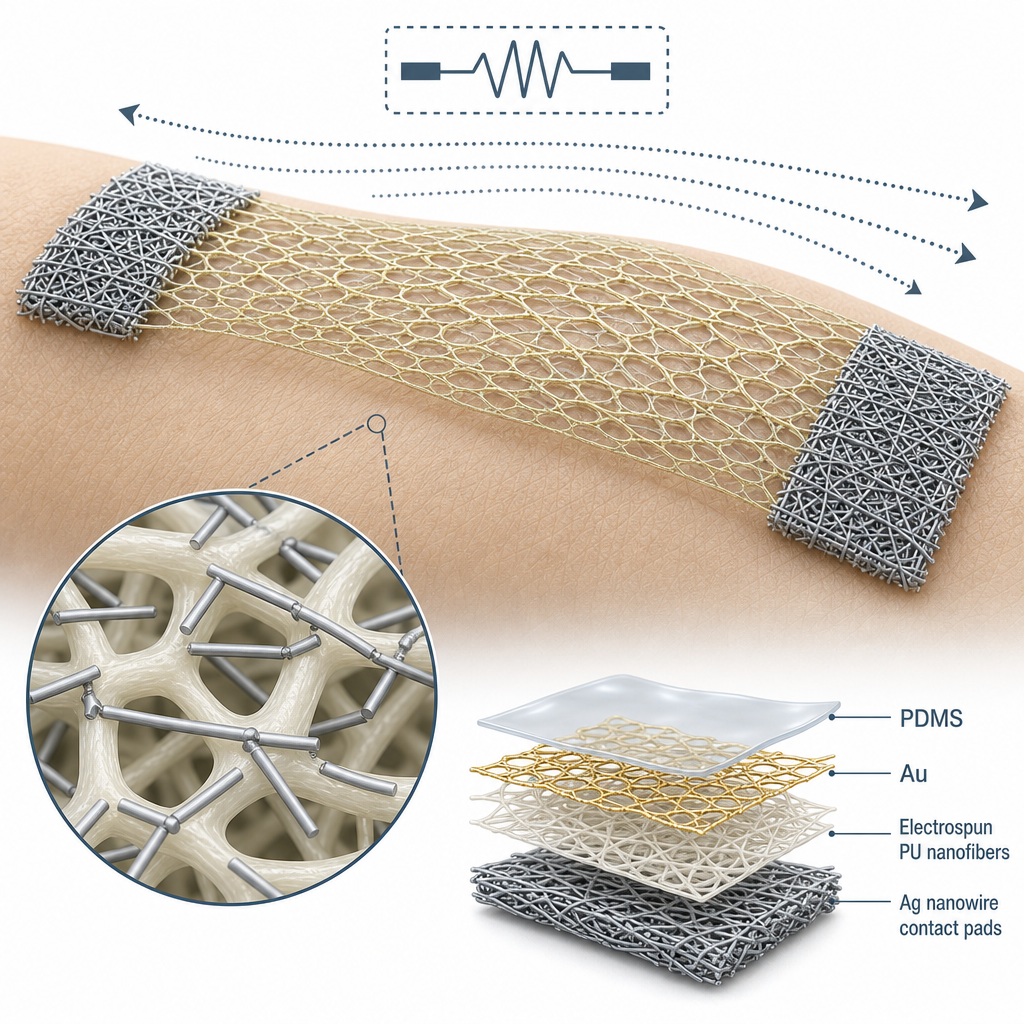 Electromechanical characterization shows that by tuning the PDMS/hexane ratio (1/40, 1/80, 1/160), the linear strain range can be programmed from 16% up to 60%, with gauge factors from 46.3 down to 7.26. The sheet resistance of the PU-PDMS conductor is 1.2 ± 0.36 Ω/□, lower than bare PU nanomesh conductors (2.03 ± 0.62 Ω/□) due to better electrical junctions. Hysteresis at 16% strain, 1 Hz is only 6.1%. Under a sustained 40% strain for 12 hours, resistance drift is below 5.3% and fully recovers on release. The sheet resistance is stable over 100 days under ambient conditions. Most strikingly, the 60% strain, 5000-cycle endurance with ΔR/R₀ = 0.03 is roughly 30,000× lower than a reported CNT/PDMS film strain gauge and 3× lower than an AgNW/PU nanomesh sensor. Water-vapor permeability is essentially equal to an uncovered glass bottle. On the face, the nanomesh sensor records skin strains of 18.3%, 23.6%, and 21.7% during phonations of "a," "u," and "o," matching reference black-marker strains, whereas a 200-µm PDMS film suppresses these strains to 1.3-3.8%. Wrist-bending tests show calculated strains of 11.2%, 22.1%, and 33.6% for 30°, 60°, and 90° flexion, matching measured skin strains. The device survives 10,000 wrist flexion cycles and 3.5 hours of continuous facial wear.
These results enable a new class of imperceptible wearable sensors for speech recognition, remote health monitoring, arterial pulse waveform analysis (the team extracted radial augmentation index AIr = 0.68 from wrist pulse signals), prosthetic feedback, and sports performance tracking. Because the device measures rather than restricts the underlying mechanics, it is especially well-suited to facial expression decoding, vocal training, dermatological studies of skin biomechanics, and long-term ambulatory monitoring where comfort and breathability matter. The authors also suggest that direct coating with conductive nanomaterials or in-situ polymerization on the electrospun scaffold could replace gold evaporation for scalable manufacture, in which AgNW dispersions would play an enabling role.
For researchers building similar conformal bioelectronics, the silver nanowires used in this study are available in the ACS Material Nanowire Series catalog, with diameters and lengths suited to forming low-impedance contact pads, transparent electrodes, and stretchable interconnects on nanomesh and elastomer substrates. The Someya group's success demonstrates that AgNW geometry (30 nm × 100-200 µm) provides the percolation network density needed for reliable contact pads on sub-micrometer scaffolds without compromising compliance.How ACS Material products were used
- Silver Nanowires (30 nm diameter, 100-200 µm length) (Nanowire Series) — “AgNWs were from ACS Material, Japan, with a diameter of 30 nm and a length of 100 to 200 μm.”
Product Performance in this StudySilver nanowires from ACS Material were dip-coated at the two ends of Au/PU-PDMS nanomeshes to form low-resistance, strain-insensitive contact pads for the facial strain-mapping sensor patch. They enabled reliable electrical interfacing between the strain-sensing nanomesh region and external wiring.
Related product categories
Frequently asked questionsWhy use silver nanowires as contact pads in nanomesh on-skin sensors?
Silver nanowires (AgNWs) form a percolating, mechanically compliant conductive network that adheres well to ultrathin nanomesh substrates. In this work, AgNWs of 30 nm diameter and 100-200 µm length were dip-coated onto the ends of an Au/PU-PDMS nanomesh to create low-resistance, strain-insensitive contact pads. This avoids the rigid metal connectors that would otherwise constrain skin motion and re-introduce mechanical mismatch at the device interface.
How durable is the PU-PDMS nanomesh strain gauge?
The reinforced PU-PDMS core-sheath nanomesh sustains 5000 stretching/releasing cycles at 60% strain with a resistance degradation ΔR/R₀ of only 0.03, roughly 30,000 times lower than a reported CNT/PDMS film strain gauge. It also survived 10,000 wrist flexion cycles and 3.5 hours of continuous facial wear, with sheet resistance stable for over 100 days under ambient conditions thanks to gold inertness.
What makes this strain gauge suitable for natural facial motion monitoring?
The device is only 430 nm thick and weighs 0.12 mg/cm², so its mechanical stiffness is negligible compared to facial skin. During speech of "a," "u," and "o," the nanomesh-attached side of the face exhibited skin strains of 18.3%, 23.6% and 21.7%, matching reference markers, whereas a 200 µm PDMS film suppressed strains to 1.3-3.8%. The nanomesh therefore measures rather than restricts facial skin deformation.