-
Silver Nanowires for Si-Quantum-Dot Solar Cells - Kyung Hee University, 2019
Jun 23, 2026 | ACS MATERIAL LLCShin, D. H. et al. (2019). Remarkable enhancement of stability in high-efficiency Si-quantum-dot heterojunction solar cells by employing bis (trifluoromethanesulfonyl)-amide as a dopant for graphene transparent conductive electrodes. *Journal of Alloys and Compounds*. https://doi.org/10.1016/j.jallcom.2018.09.289
Journal of Alloys and Compounds · 2019
Kyung Hee University researchers benchmark TFSA-doped graphene transparent electrodes against ACS Material silver nanowires in 16.6% Si-QD heterojunction solar cells.
About this research
Researchers at Kyung Hee University evaluated silver nanowires purchased from ACS Material as a benchmark dopant for graphene transparent conductive electrodes (TCEs) in silicon-quantum-dot (SQD) heterojunction solar cells, and demonstrated that an alternative bis(trifluoromethanesulfonyl)-amide (TFSA) doping route achieved 16.61% power conversion efficiency with markedly enhanced long-term stability. Published in the Journal of Alloys and Compounds (2019), the study fabricated TFSA-GR/p-SQDs:SiO2/n-Si devices and directly compared them to Ag-nanowire-doped graphene controls, showing that chemical molecular doping of graphene outperforms nanowire-decorated graphene for this device architecture.
Silicon-quantum-dot solar cells are attractive because the SQD bandgap can be tuned by dot size, opening a route to multi-junction or tandem photovoltaics built on industrially established silicon platforms. A persistent obstacle has been the front transparent electrode: indium tin oxide is brittle and supply-limited, while pristine CVD graphene has sheet resistance too high for efficient carrier collection. Researchers have therefore turned to chemical p-type doping or to hybridizing graphene with metal nanowires. Both approaches improve conductivity, but each must be evaluated for optical loss, work-function tuning, and—critically for commercial deployment—operational stability under continuous illumination. This paper addresses that gap by directly benchmarking a molecular dopant (TFSA) against a nanowire decorator (AgNWs) on otherwise identical SQD photovoltaic stacks.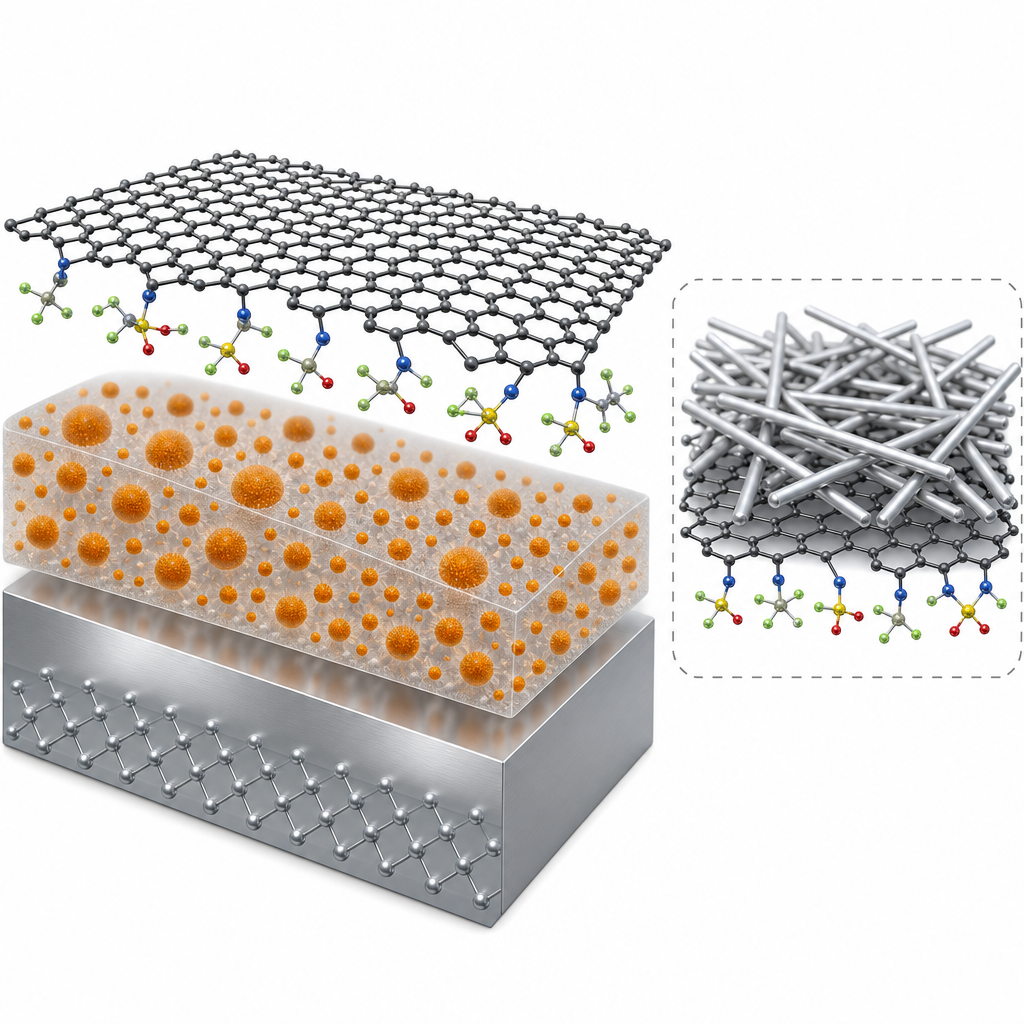
The ACS Material silver nanowires used in this work were specified at 30 nm average diameter with 99.5% purity. The authors describe in the Experimental section that "Ag NWs with an average diameter of 30 nm and a purity of 99.5% were purchased from ACS material." The nanowire powder was dispersed in isopropyl alcohol at 0.1 wt%, spin-coated onto CVD graphene transferred from copper foil at 1500 rpm for one minute, and dried at 100 °C for two minutes. This produced the AgNW-doped graphene control electrode used to contextualize the TFSA-doped graphene devices. The graphene itself was grown by CVD on copper using a CH4/H2 mixture at 1000 °C and transferred onto 120 nm p-SQDs:SiO2 on n-type silicon. Aluminum and InGa served as the top and bottom contacts, respectively, while doping concentration of TFSA (nD) was varied from 5 to 30 mM.
The key electrode metrics shifted substantially with TFSA doping. The graphene work function moved from −4.52 ± 0.047 eV to −4.92 ± 0.026 eV with increasing nD, confirming p-type behavior. Sheet resistance dropped from 1250 ± 47 Ω/sq for pristine graphene to 191 ± 14 Ω/sq at 30 mM TFSA, while optical transmission lost only ~1% at the highest doping level. The ratio of DC to optical conductivity, σDC/σop, reached a maximum of ~62 at 20 mM, well above the industry threshold of 35 for transparent-conducting-oxide replacements. Raman blue-shifts of the G and 2D bands and a rising I(G/2D) ratio confirmed charge transfer from TFSA to graphene. Device-level performance followed the same trend: at nD = 0 mM the cell delivered Voc = 0.517 V, Jsc = 37.36 mA/cm², FF = 68.81%, and PCE = 13.29%; at nD = 20 mM these rose to Voc = 0.547 V, Jsc = 38.13 mA/cm², FF = 79.63%, and PCE = 16.61%. The TFSA-graphene electrode also outperformed the AgNW/graphene control in long-term stability under continuous 1-Sun illumination, which the authors highlight as the central advance.
These results matter for groups pursuing silicon-based tandem photovoltaics, transparent-electrode replacements for ITO, and stable graphene-based optoelectronics. The demonstrated combination of low sheet resistance, minimal transmittance loss, and tunable work function makes molecularly doped CVD graphene a credible candidate for SQD, perovskite/Si tandem, and flexible photovoltaic devices. The benchmarking against AgNWs also clarifies when nanowire decoration is preferable (mechanically flexible, larger-area coverage) versus when molecular doping wins (stability and uniform work-function control). Follow-up work suggested by the paper includes extending illumination durability tests, exploring alternative anion dopants, and integrating the TFSA-graphene electrode into larger-area module prototypes.
For researchers working on transparent electrodes, photovoltaics, and 2D-material/nanowire hybrids, the silver nanowires used as the control in this study—30 nm diameter, high-purity AgNWs—are available from ACS Material's Nanowire Series. Reliable, well-characterized nanowire reagents are essential when the experimental design depends on a fair comparison between competing electrode chemistries, and the authors' use of a commercially specified AgNW source makes their stability comparison reproducible by other groups working on Si-QD or related heterojunction architectures.How ACS Material products were used
- Silver Nanowires (30 nm diameter, 99.5% purity) (Nanowire Series) — “Ag NWs with an average diameter of 30 nm and a purity of 99.5% were purchased from ACS material.”
Product Performance in this StudyAg NWs from ACS Material were used to prepare a control TCE (Ag NWs-doped graphene) against which the authors benchmarked the TFSA-doped graphene electrode. The Ag NWs dispersion produced a viable comparison electrode that helped establish the superior stability of the TFSA-doped graphene system reported in the paper.
Related product categories
Frequently asked questionsWhy are silver nanowires used as a comparison electrode in silicon-quantum-dot solar cells?
Silver nanowires (AgNWs) decorate the surface of CVD graphene to lower its sheet resistance while preserving optical transparency, creating a hybrid transparent conductive electrode. They serve as a well-established benchmark against new doping strategies. In this Kyung Hee University study, 30 nm diameter AgNWs from ACS Material provided the control electrode against which TFSA-doped graphene was compared, allowing fair evaluation of efficiency and operational stability under 1-Sun illumination.
How does TFSA doping improve graphene transparent electrodes for solar cells?
TFSA donates charge to graphene, shifting its work function from −4.52 eV to −4.92 eV and producing p-type behavior aligned with the SQD/Si heterojunction. Sheet resistance dropped from 1250 to 191 Ω/sq with only ~1% transmittance loss, giving a σDC/σop of about 62—well above the industry standard of 35 for ITO replacements. This combination enabled a Si-quantum-dot solar cell power conversion efficiency of 16.61%.
What diameter and purity of silver nanowires are suitable for graphene-based transparent electrodes?
The study used silver nanowires with an average diameter of 30 nm and purity of 99.5%, dispersed in isopropyl alcohol at 0.1 wt% and spin-coated at 1500 rpm onto CVD graphene. Thin, high-purity nanowires minimize light scattering while providing percolation pathways that lower sheet resistance. Researchers replicating Si-quantum-dot or perovskite/Si tandem electrode work should match these specifications closely for reproducible comparison to literature benchmarks.