-
Silver Nanowires for Stretchable Photodetectors - Sookmyung Women's University, 2022
Jun 24, 2026 | ACS MATERIAL LLCKim, H. et al. (2022). Stretchable photodetectors based on electrospun polymer/perovskite composite nanofibers. *ACS Applied Nano Materials*. https://doi.org/10.1021/acsanm.1c03875
Gyeongsang National University · ACS Applied Nano Materials · 2022
Sookmyung Women's University used ACS Material silver nanowires to build stretchable PVP/MAPbI3 perovskite nanofiber photodetectors with 51.2 mA/W responsivity.
About this research
Researchers at Sookmyung Women's University demonstrated stretchable perovskite photodetectors built around ACS Material silver nanowires (diameter 70 nm, length 100–200 μm) used as the conductive backbone of a stretchable electrode, achieving a responsivity of 51.2 mA W⁻¹ and detectivity of 2.23 × 10¹¹ Jones at 550 nm under 15% strain. The work combined electrospun poly(vinylpyrrolidone)/methylammonium lead iodide (PVP/MAPbI3) composite nanofibers with an Ag–Au alloy nanowire electrode embedded in PDMS. The resulting thin, conformal device retained its performance through mechanical deformation and was applied as a wearable image sensor that selectively mapped red and green light. The study links nanofiber morphology, mechanical orientation, and photodetection behavior in a single integrated platform.
This research addresses a central problem in wearable optoelectronics: organic–inorganic hybrid perovskites are flexible but not intrinsically stretchable because cracks readily form along grain boundaries under low tensile strains below 5%. While polymer/perovskite composites can release applied stress and improve durability, composite nanofibers made with presynthesized nanoparticles rarely contain enough crystals to achieve full percolation, limiting their use to color filters and luminescent mats. The authors target this gap with a mixed polymer/precursor electrospinning route that produces densely percolated MAPbI3 nanocrystals inside thin nanofibers. The application space spans wearable image sensors, optical sensing textiles, and solar-energy conversion fabrics—areas where researchers increasingly search for stretchable, durable, and humidity-stable photoactive materials that survive repeated mechanical cycling.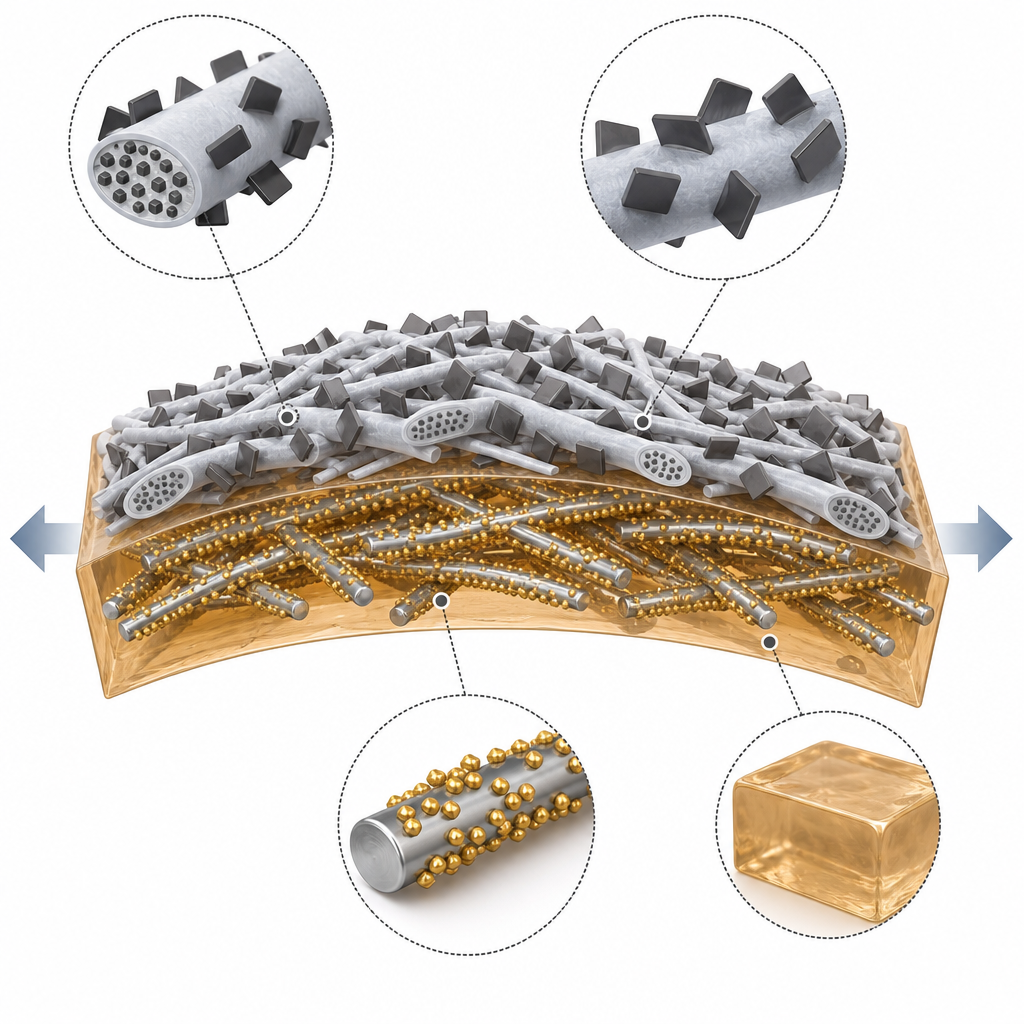
The ACS Material silver nanowires were the foundation of the stretchable electrode. The supplied dispersion (2 mg mL⁻¹ in 2-propanol) was dropped onto a polyimide stencil mask, dried, and annealed at 150 °C for 3 minutes to improve inter-nanowire adhesion. A PDMS prepolymer/curing agent mixture was spin-coated over the nanowire network and cured, embedding the wires within the rubbery substrate. Because iodide anions react with bare Ag to form AgI during MAPbI3 crystallization, the team performed a selective galvanic replacement reaction by dropping 5 mM HAuCl4 onto the exposed nanowire surfaces, decorating them with gold nanocrystals. This protected the wires while raising their work function from 4.25 to 4.67 eV for better band alignment with the perovskite. The partially embedded geometry meant only the top surfaces reacted, leaving the conductive nanowire network intact. The PVP/MAPbI3 precursor solution was then electrospun directly onto the patterned electrode at a 10 μL min⁻¹ feed rate and 16.0 kV, followed by annealing and PDMS encapsulation.
The device delivered strong, reproducible photodetection metrics. The electrode retained conductivity of 6753 S cm⁻¹ even after embedding and showed no electrical failure after 1000 stretching cycles at 50% strain. Uniform nanofibers (average diameter 430 nm) carried protruding MAPbI3 nanoplates (15 nm thick) on the surface and percolated nanoparticles (under 15 nm) within the core, producing double photoluminescence emission at 710.5 and 745.3 nm and a short PL lifetime of about 1.46 ns. At λ = 550 nm, the photodetector achieved an on/off current ratio of 458.5 at 0% strain and 393.8 at 15% strain, with responsivity falling from 61.1 to 51.2 mA W⁻¹ and detectivity from 2.66 to 2.23 × 10¹¹ Jones. At λ = 700 nm, the on/off ratio was 207.8 (0% strain) and 170.3 (15% strain), with responsivity of 22.9 mA W⁻¹ and detectivity of 1.01 × 10¹¹ Jones at 15% strain. Rise and fall times were 5 ms. The device retained 94.7% of its initial 550 nm values after 500 stretching cycles, 97.3% after 1000 twisting cycles, and 95.5% after continuous green light illumination for 720 hours at 35% relative humidity. Finite element analysis confirmed that fiber orientation governs stress, with the maximum von Mises stress reaching 16.3 MPa at a 60° orientation angle under 20% strain.
This platform enables wearable image sensors capable of selective red and green light mapping, demonstrated by reconstructing the letters "P" and "E" from photocurrent maps. The combination of electrospun nanofiber morphology control, percolated perovskite nanocrystals, and a chemically robust stretchable nanowire electrode points toward perovskite-based textile devices, solar-energy conversion fabrics, and conformal skin-mounted optical sensors. The authors highlight the importance of fiber orientation in determining mechanical durability, suggesting that aligned or randomly oriented nanofiber networks can be engineered to maximize stretchability. The humidity and cycling stability data indicate practical paths toward durable, encapsulated wearable optoelectronics where the metal nanowire network must survive corrosive halide chemistry and repeated deformation.
For researchers pursuing stretchable electronics, flexible photodetectors, or perovskite composite devices, the silver nanowires used here are available from ACS Material's Nanowire Series. The paper shows the nanowires perform reliably as a stretchable electrode backbone when chemically protected against halide corrosion, retaining conductivity through thousands of mechanical cycles. This makes them a credible starting point for teams developing transparent conductors, wearable sensors, and elastomer-embedded electrode networks, where consistent nanowire dimensions and dispersion quality directly influence percolation and device stability.How ACS Material products were used
- Silver Nanowire (diameter = 70 nm, length = 100–200 μm, 2 mg/mL in 2-propanol) (Nanowire Series) — “Ag nanowire solutions (diameter = 70 nm, length = 100−200 μm, concentration = 2 mg mL−1 in 2-propanol) were purchased from ACS Material.”
Product Performance in this StudyThe ACS Material silver nanowires formed the conductive backbone of the stretchable Ag–Au alloy nanowire electrode, which retained high conductivity (6753 S cm⁻¹) and survived 1000 stretching cycles at 50% strain, enabling stable photodetector operation.
Related product categories
Frequently asked questionsWhy are silver nanowires used as electrodes in stretchable photodetectors?
Silver nanowires form a percolated network that maintains electrical pathways during mechanical stretching, retaining conductivity even at high strain. In this work the Ag nanowire network embedded in PDMS preserved about 6753 S cm⁻¹ conductivity and survived 1000 stretching cycles at 50% strain, making it suitable for stable operation of wearable, deformable optoelectronic devices.
How does galvanic replacement protect silver nanowires in perovskite devices?
Iodide anions react with bare silver to form insulating AgI, degrading conductivity. By dropping a 5 mM HAuCl4 solution onto the exposed nanowire surfaces, the authors coated them with gold nanocrystals through galvanic replacement. This suppressed the silver–iodide reaction and raised the work function from 4.25 to 4.67 eV, improving carrier injection from the MAPbI3 perovskite.
What performance can electrospun perovskite nanofiber photodetectors achieve under strain?
At 15% strain, the device achieved a responsivity of 51.2 mA W⁻¹ and detectivity of 2.23 × 10¹¹ Jones at 550 nm, with 5 ms rise and fall times. It retained 94.7% of its initial values after 500 stretching cycles and 95.5% after 720 hours of continuous green light at 35% relative humidity, demonstrating strong mechanical and environmental stability.