-
Silver Nanowires for Stretchable Synaptic Transistors - Pennsylvania State University, 2022
May 26, 2026 | ACS MATERIAL LLCShim, H. et al. (2022). An elastic and reconfigurable synaptic transistor based on a stretchable bilayer semiconductor. *Nature Electronics*. https://doi.org/10.1038/s41928-022-00836-5
Nature Electronics · 2022
Researchers at Penn State used ACS Material silver nanowires to build elastic reconfigurable synaptic transistors achieving over 90% MNIST accuracy at 50% strain.
About this research
Researchers at Pennsylvania State University, working with collaborators at the University of Houston, Southeast University, Northwestern University, and Flexterra, used silver nanowires supplied by ACS Material (Agnw-120) to fabricate the stretchable source and drain electrodes of an elastic, reconfigurable synaptic transistor that achieves more than 90% MNIST handwritten-digit recognition accuracy even under 50% uniaxial strain. Published in Nature Electronics in 2022, the work demonstrates a top-gated transistor built from a stretchable bilayer semiconductor—an N2200 polymer film on a semiconducting single-walled carbon nanotube (s-CNT) network—with a polyurethane (PU) elastomer gate dielectric. The device emulates the bilingual excitatory/inhibitory behavior of ventral tegmental area neurons in a single soft component.
Mechanically compliant synaptic devices are a key building block for soft robotics, wearable health monitors, neural interfaces, and abiotic prosthetics. Most reported stretchable synaptic transistors rely on p-type organic semiconductors with ion-gel dielectrics, which support only monosynaptic (excitatory-only) behavior and suffer from electrochemical doping that degrades the channel over time. Achieving both excitatory postsynaptic currents (EPSCs) and inhibitory postsynaptic currents (IPSCs) in a single elastomeric device—without ion-gel-related instability—has remained an open challenge. Solving it enables more compact neuromorphic circuits, lower transistor counts, and direct interfacing with biological neurons in deformable electronic skins and human–machine interfaces.
The ACS Material silver nanowires played a central role in the device stack. According to the Methods section, "the AgNWs were patterned onto a glass substrate by drop casting the AgNWs solution (Agnw-120, ACS Material) through a shadow mask" prepared by a programmable cutting machine, then baked at 95 °C for 10 minutes. A PDMS precursor was spin-coated over the patterned nanowire network at 300 rpm and cured at 95 °C for 2 hours, after which the AgNWs/PDMS composite was peeled off the glass, producing intrinsically stretchable composite electrodes. These electrodes served as the source and drain contacts for the single-layer N2200 transistor, the single-layer s-CNT transistor, the bilayer reconfigurable synaptic transistor, and the 5×5 stretchable transistor array. The same AgNWs/PDMS approach was used in the crossbar array to form data and source lines, with eutectic gallium–indium liquid metal forming the top gate through via holes. The stretchability of the silver nanowire network was essential to the device retaining function under 10%, 30%, and 50% strain.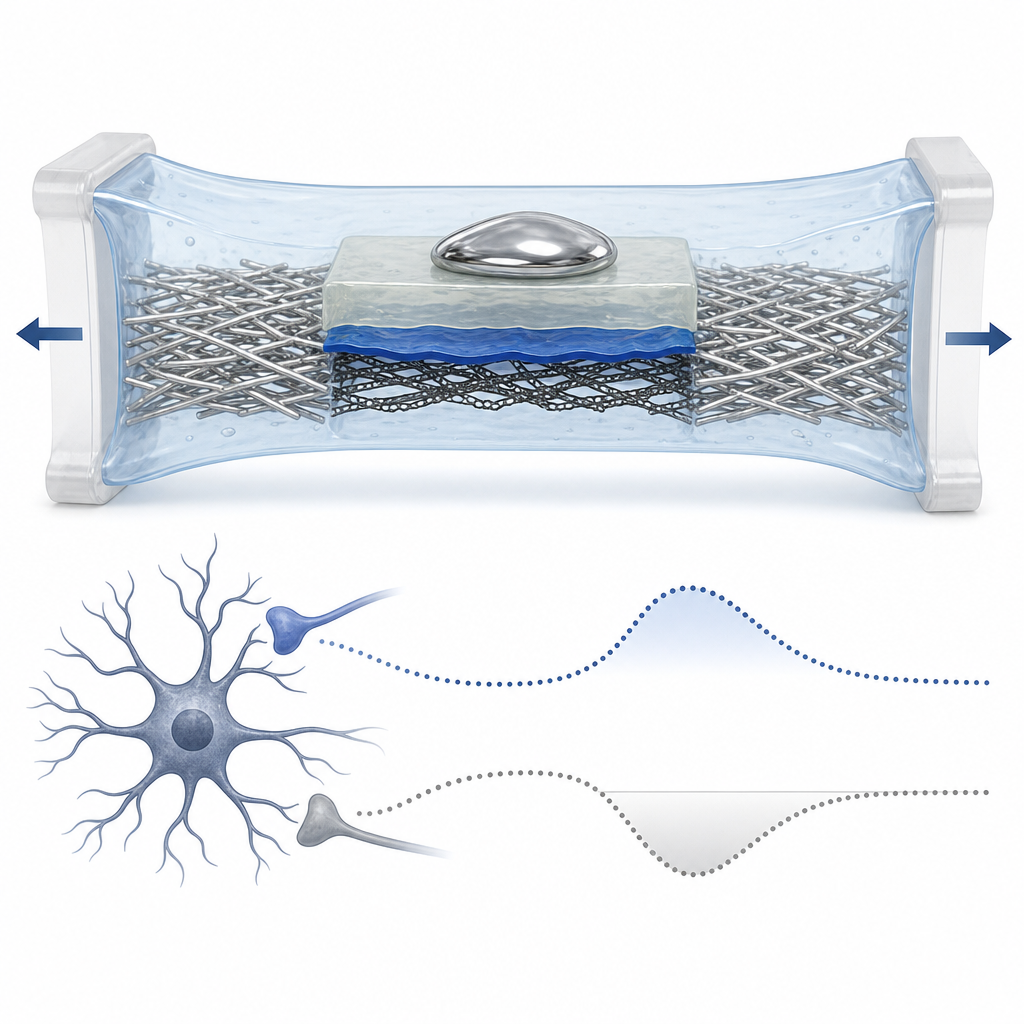
Quantitatively, the bilayer device exhibits both EPSCs and IPSCs across four operational regimes defined by drain and gate polarity, and it preserves synaptic behavior at 50% uniaxial strain. The PU gate dielectric had a specific capacitance of 0.662 nF cm⁻² at 20 Hz. Field-effect mobility of the N2200 channel decreased modestly from 0.18 to 0.07 cm² V⁻¹ s⁻¹ at 50% strain. The paired-pulse facilitation index ran from 177% at 50 ms pulse interval to 116% at 2,000 ms, and was retained after stretching. EPSC gain (A10/A1) increased from 1.30 to 6.18 between 1 and 20 Hz, showing high-pass filtering behavior. The device produced measurable synaptic responses from presynaptic pulses as small as 80 mV, with the lowest specific energy consumption reported among comparable organic synaptic transistors at 0.11 pJ per 10⁻⁹ m². EPSC stability was maintained over 90 days in ambient air, retaining roughly 70% of initial amplitude. Backpropagation simulations on MNIST 8×8 and 28×28 images and the Sandia file classification dataset gave 96.26%, 94.81%, and 93.00% accuracies for p-type operation, and 93.59%, 95.00%, and 91.00% for n-type operation, with similar accuracy at 50% strain. Device-to-device variation across 25 transistors was under 7%.
Applications targeted by the authors include soft neuromorphic computing, wearable electronics, soft robotics, neural interfaces, and human–machine interfaces. The bilingual synaptic functionality enables dual-directional learning in a single device, which can reduce transistor count compared to CMOS implementations of equivalent function. The low operating voltage (down to ±1 V drain bias and 80 mV presynaptic pulses) makes the device compatible in principle with direct biological neuron interfacing, opening paths toward biohybrid synapses and adaptive edge computing for body-worn electronics. The 50%-strain image-recognition accuracy suggests practical use in epidermal sensor arrays and prosthetic skins where mechanical deformation is unavoidable.
For researchers building stretchable neuromorphic devices, conformal sensors, or transparent flexible electrodes, the silver nanowires used in this study are available through ACS Material's nanowire series. Their compatibility with PDMS encapsulation, drop-casting through shadow masks, and reliable conduction at large strain are properties documented across multiple device variants in this paper.How ACS Material products were used
- Silver Nanowire (Agnw-120) (Nanowire Series) — “The AgNWs were patterned onto a glass substrate by drop casting the AgNWs solution (Agnw-120, ACS Material) through a shadow mask”
Product Performance in this StudySilver nanowires from ACS Material were used to form stretchable AgNWs/PDMS composite source/drain electrodes for all device variants. The electrodes maintained conductivity and mechanical integrity under up to 50% uniaxial strain, supporting reliable synaptic transistor operation and array-level device-to-device uniformity below 7%.
Related product categories
Frequently asked questionsHow were silver nanowires used to make stretchable electrodes in this synaptic transistor?
Silver nanowires from ACS Material (Agnw-120) were drop-cast through a shadow mask onto a glass substrate and baked at 95 °C. A PDMS precursor was then spin-coated at 300 rpm and cured at 95 °C for two hours. The composite was peeled off the glass, producing an AgNWs/PDMS electrode in which nanowires are embedded near the PDMS surface. This electrode stretched to 50% strain while maintaining electrical conductivity, serving as the source and drain in all device variants.
Why does the device use a bilayer N2200 plus carbon nanotube semiconductor?
The N2200 polymer is n-type and the semiconducting single-walled carbon nanotube network is p-type. Stacking them creates a single channel that can operate as either polarity depending on drain and gate bias, enabling four operational regimes that produce excitatory or inhibitory postsynaptic currents. This bilayer architecture lets one device emulate the bilingual synapses of the ventral tegmental area, which would otherwise require separate n- and p-type transistors.
What recognition accuracy did the synaptic transistor achieve under mechanical strain?
An artificial neural network simulation using the experimentally measured potentiation and depression of the device achieved 96.26% accuracy on small MNIST images, 94.81% on standard 28×28 MNIST images, and 93.00% on the Sandia file classification dataset in p-type operation. Under 50% uniaxial strain, the n-type configuration still produced over 90% accuracy across the same datasets, with device-to-device variation below 7% across 25 transistors.