-
Silver Nanowires for Transient TENG Devices - Georgia Tech, 2019
Jun 29, 2026 | ACS MATERIAL LLCWu, C. et al. (2019). Sunlight‐Triggerable Transient Energy Harvester and Sensors Based on Triboelectric Nanogenerator Using Acid‐Sensitive Poly (phthalaldehyde). *Advanced Electronic Materials*. https://doi.org/10.1002/aelm.201900725
School of Materials Science and Engineering Georgia Institute of Technology Atlanta GA 30332 USA · Advanced Electronic Materials · 2019
Georgia Tech researchers built sunlight-degradable triboelectric nanogenerators using ACS Material silver nanowires on poly(phthalaldehyde) films.
About this research
Researchers at the School of Materials Science and Engineering Georgia Institute of Technology Atlanta GA 30332 USA developed a sunlight-triggerable transient triboelectric nanogenerator (TENG) by embedding silver nanowires from ACS Material (Agnw-L70) into films of acid-sensitive cyclic poly(phthalaldehyde) (PPHA). The device harvested mechanical energy, powered six series-connected LEDs, served as a touch sensor for alarm triggering, and functioned as an acoustic microphone, then liquefied to leave minimal residue within roughly 10 minutes under winter sunlight in Atlanta. The work demonstrates that transient power sources need not rely on aqueous dissolution and can operate in non-biological field environments where stealth or simple disposability is required.
Transient electronics are devices designed to vanish on demand after performing their task, with applications in resorbable medical implants, environmental monitors, disposable consumer electronics, and security/anti-reverse-engineering hardware. Until now most transient energy harvesters required immersion in aqueous solution to dissolve bioresorbable polymers such as silk or polylactide-glycolide, which limits their use outside the body. Triboelectric nanogenerators are attractive for transient power because they can be built from a wide range of polymer pairs and convert ambient mechanical motion directly into electricity. The open challenge addressed in this paper is to combine a metastable, photo-depolymerizable substrate with a durable yet degradable electrode, so the entire device disappears under a natural trigger such as sunlight rather than a liquid bath.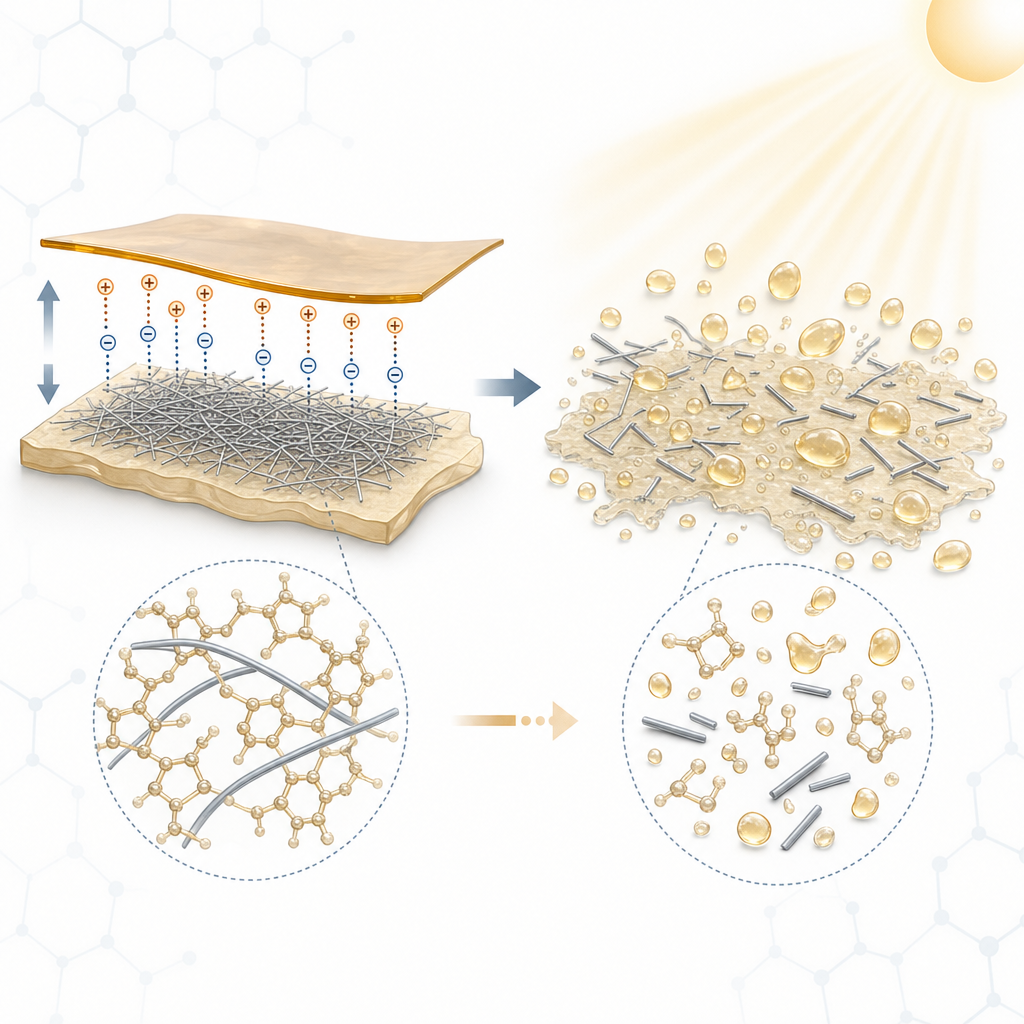
The ACS Material silver nanowire dispersion (Agnw-L70) served as the conductive electrode for both the energy-harvesting and sensing TENGs. The dispersion was diluted with isopropanol at a 1:5 volume ratio and pipetted onto clean glass substrates, then left overnight on an optical table for the IPA to evaporate and the nanowires to form a uniform percolating network. A nylon fence defined a casting area into which a tetrahydrofuran solution of cyclic PPHA, the photoacid generator Rhodorsil FABA, anthracene as photosensitizer, and BMP TFSI ionic liquid plasticizer was poured to a controlled 100 µm thickness. After drying in a pressurized nitrogen chamber and a 24-hour ambient dark cure, the PPHA-Ag composite was released by a short water bath and peeled from the glass, yielding a freestanding film in which the Ag nanowires are embedded at the film surface and act as the back electrode of a single-electrode TENG.
The PPHA-Ag film delivered an open-circuit voltage around 30 V in contact-separation tests against a copper-coated Kapton counter electrode. In a triboelectric series experiment against polyurethane, nylon, polyethylene, polyester, Kapton, and FEP, PPHA was placed between polyurethane and nylon. A Kapton-PPHA TENG produced a maximum areal power density of 28.4 µW cm⁻² at a matched load of 88 MΩ. Coating with the ACS Material silver nanowires raised the PPHA film's yield stress from 3.09 to 6.75 MPa and its modulus of resilience from 0.01 to 0.05 J m⁻³ while keeping Young's modulus near 460 MPa. Thermogravimetric analysis showed thermal stability up to 113 °C. Under 365 nm UV at 4 mW cm⁻², ATR-IR confirmed complete PPHA depolymerization to ortho-phthalaldehyde monomer within 90 s, and the device output decayed from 30 V to 0 V over the same interval. In real outdoor tests under Atlanta winter sunlight the entire TENG liquefied and was absorbed into soil or paper within about 10 minutes. The same architecture was demonstrated as a hand-tap energy harvester powering six LEDs, as a touch sensor driving an alarm bell, and as an acoustic sensor recording music with usable frequency response between 100 and 5000 Hz.
Applications of this platform include disposable environmental sensors, single-use medical monitors, security-sensitive devices that must not be recoverable after a mission, and disposable consumer electronics where end-of-life waste is a concern. The PPHA-Ag concept could be extended to other transient self-powered systems such as soil-deployed wireless monitors, anti-counterfeiting tags, and stealth acoustic recorders. The authors note that surface modification of the PPHA could further raise triboelectric output, and that the degradation rate is tunable through the loading of photoacid generator and photosensitizer or by adding weakly basic additives, opening the door to programmable device lifetimes.
For researchers building flexible electrodes, transparent conductors, transient electronics, or printed TENGs, the silver nanowire dispersion used in this study is available from ACS Material in the Nanowire Series. Its compatibility with simple solution casting on glass and with subsequent polymer overcoating, demonstrated here for PPHA, makes it a practical starting material for groups that need a conductive network embedded in an otherwise non-metallic, degradable substrate.How ACS Material products were used
- Silver Nanowire Dispersion (Agnw-L70) (Nanowire Series) — “Ag NWs dispersion (Agnw-L70) was purchased from ACS Material.”
Product Performance in this StudyThe silver nanowires served as the transparent, flexible electrode embedded on the PPHA film. They enabled charge collection in the triboelectric nanogenerator, enhanced the mechanical strength of the substrate (yield stress rose from 3.09 to 6.75 MPa), and ensured the device remained fully degradable since only minimal Ag residue is left after PPHA depolymerization.
Related product categories
Frequently asked questionsHow do silver nanowires enable a fully degradable triboelectric nanogenerator?
Silver nanowires form a percolating conductive network embedded in the surface of a degradable poly(phthalaldehyde) film, acting as the back electrode of a single-electrode TENG. When sunlight depolymerizes the polymer, the polymer turns to liquid byproducts absorbed by soil or paper and the remaining nanowire residue is so small it is unnoticeable after light stirring, enabling near-complete device disappearance.
What output performance was achieved by the silver nanowire-PPHA triboelectric nanogenerator?
The PPHA-Ag film delivered an open-circuit voltage of about 30 V against a copper-Kapton counter electrode in contact-separation mode. A Kapton-PPHA TENG produced a maximum areal power density of 28.4 µW cm⁻² at a matched load resistance of 88 MΩ, sufficient to power six series-connected LEDs by hand tapping and to drive a touch-triggered alarm and an acoustic microphone.
Why are silver nanowires preferred over metal films for transient electronics?
Metallic thin films leave continuous, visible residues after polymer degradation and can stiffen flexible substrates. Silver nanowires instead form a sparse, mechanically compliant mesh that strengthens the polymer film (yield stress rose from 3.09 to 6.75 MPa) while maintaining flexibility, and the residual nanowire mass after PPHA depolymerization is minimal, supporting the stealth and disposability goals of transient electronic devices.