-
Single-Layer GO Dispersion for CO2 Sorption - Imperial College London, 2017
Jun 02, 2026 | ACS MATERIAL LLCMarco, M. D. et al. (2017). Hybrid effects in graphene oxide/Carbon nanotube-Supported layered double hydroxides: enhancing the CO2 sorption properties. *Carbon*. https://doi.org/10.1016/j.carbon.2017.07.094
Carbon · 2017
Imperial College London researchers used ACS Material single-layer graphene oxide dispersion to build GO/MWCNT-supported LDH adsorbents retaining 96% CO2 capacity over 20 cycles.
About this research
Researchers at Imperial College London, working with collaborators at King Abdulaziz University, used single-layer graphene oxide (GO) aqueous dispersion supplied by ACS Material to engineer a hybrid GO/multi-walled carbon nanotube (MWCNT) scaffold for Mg/Al layered double hydroxide (LDH) CO2 sorbents, demonstrating 96% retention of CO2 sorption capacity over 20 temperature-swing cycles. The work, published in Carbon (2017) by De Marco, Menzel, Shaffer and co-workers, identifies a true 'hybrid effect': the mixed 1:1 GO:MWCNT support outperforms either nanocarbon alone, simultaneously maximizing surface area and long-term stability of the supported sorbent. Potassium promotion (5 wt%) further standardizes the absolute performance.
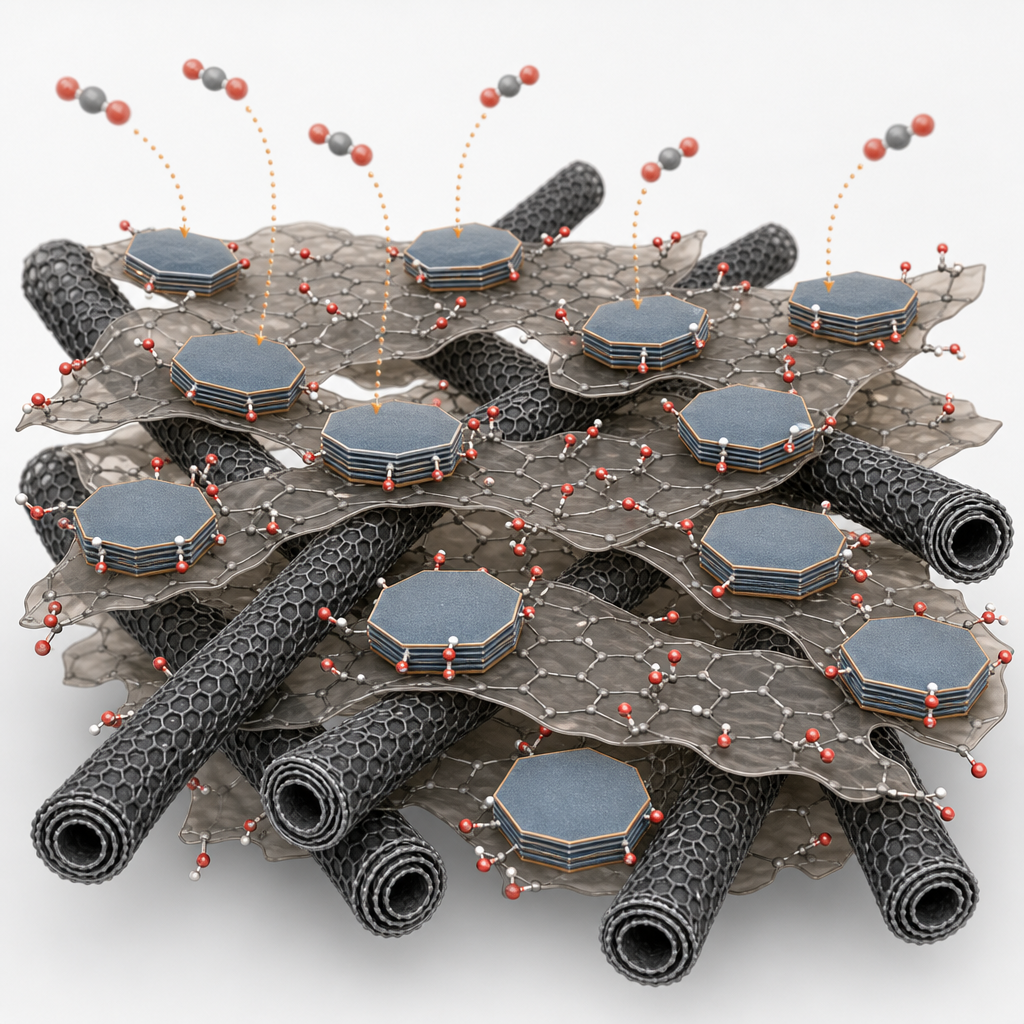
Carbon capture by solid sorbents remains a central problem for pre-combustion CO2 separation and sorption-enhanced water gas shift reactions. Mg/Al LDHs operate well in the 200-400 °C window with fast kinetics and low regeneration energy, but their intrinsic capacity is modest and they sinter on repeated thermal cycling. Earlier reports showed that nanocarbon supports - carbon nanofibers, oxidized MWCNTs, and graphene oxide - each enhance LDH dispersion and basic site availability. However, GO alone restacks during drying, while MWCNT networks lack the 2D geometric compatibility needed to template LDH platelets. The open question this paper addresses is whether a rationally combined GO/MWCNT scaffold can deliver both the surface area of exfoliated GO and the network robustness of nanotubes.
The ACS Material single-layer graphene oxide was supplied as a 10 mg/mL aqueous dispersion with flake lateral size 0.5-2.0 μm and thickness 0.6-1.2 nm. This already-exfoliated, well-characterized starting material was critical because the hybrid effect depends on initial colloidal-state mixing with oxidized MWCNTs before LDH deposition. The authors mixed the GO dispersion with oxidized MWCNT suspensions at GO:MWCNT ratios from 10:1 down to 1:5, filtered to a wet carbon paste, and then co-precipitated Mg(NO3)2 and Al(NO3)3 in NaOH/Na2CO3 onto the paste at 60 °C for 12 hours. Subsequent K2CO3 incipient-wetness doping (5 wt%) and 400 °C calcination under N2 activated the mixed-metal-oxide sorbent. XRD analysis showed that hybridization with MWCNTs reduced the average GO stack from ~33 layers (pure dried GO) to only 3-4 layers at the 1:1 ratio, retained even in the dried state.
BET surface area of the carbon support peaked at 127 m2/g for the GO/MWCNT (1:1) blend, versus 23 m2/g for pure dried GO and 90 m2/g for pure MWCNTs. On these hybrid supports the LDH crystallite thickness (c-direction) decreased from 22 nm (unsupported) to 5.7-15 nm, indicating finer dispersion of LDH platelets and more accessible basic sites. The optimized GO/MWCNT(1:1)20-LDH composition (20 wt% total carbon) delivered an intrinsic adsorption capacity of 0.58 mol CO2 per kg LDH, or 0.46 mol CO2 per kg total adsorbent, at 300 °C under 20% CO2/N2. Adsorption kinetics were rapid, with 80% of equilibrium uptake achieved within 10 minutes. Most strikingly, after 20 cycles of adsorption at 300 °C and desorption at 400 °C under dry feed, capacity retention reached 96%, compared with only 50% for unsupported LDH and 60-85% for previously reported supported LDH systems. SEM and Raman analysis showed minimal periclase sintering and well-preserved graphitic structure in the hybrid, confirming the protective synergistic role of the two nanocarbons.
This sorbent design is directly relevant to medium-temperature pre-combustion CO2 capture, sorption-enhanced steam methane reforming, and sorption-enhanced water gas shift. The principle of using a 1D/2D hybrid nanocarbon scaffold also extends to other supported active phases that suffer from cycling-induced sintering: heterogeneous base catalysts (aldol, epoxidation, isomerization), adsorbents for fuel desulfurization, and pseudocapacitor electrodes. The authors note that the optimum carbon loading drops to 10-20 wt% (compared to ~50 wt% previously), which improves the volumetric metrics that matter for industrial implementation. Other 1D/2D nanomaterial combinations beyond graphene and nanotubes may follow the same strategy.
For researchers working on supported LDH catalysts, CO2 sorbents, or 2D/1D nanocarbon hybrid electrodes, this study underscores the importance of starting from a genuinely single-layer GO dispersion rather than restacked GO powders. The GO grade used here - a 10 mg/mL single-layer aqueous dispersion - is available from ACS Material along with related graphene oxide and MWCNT products in the Graphene Series and Carbon Series catalogs, supporting reproducible synthesis of hybrid nanocarbon scaffolds for adsorption, catalysis, and energy storage research.How ACS Material products were used
- Single Layer Graphene Oxide Dispersion (Graphene Series) — “Graphene oxide (GO) was purchased as single layer water dispersion of 10 mg mL-1 (flake size 0.5 - 2.0 µm and size 0.6 - 1.2 nm) from ACS Materials.”
Product Performance in this Study
The single-layer GO aqueous dispersion served as the foundational two-dimensional support phase for layered double hydroxide platelets. Combined with MWCNTs at a 1:1 ratio, the GO exfoliated to only 3-4 layers and contributed decisively to the synergistic surface area increase (up to 127 m2/g) and the 96% CO2 sorption capacity retention over 20 cycles.
Related product categories
Frequently asked questions
How does a GO/MWCNT hybrid support improve LDH CO2 adsorption performance?
Single-layer graphene oxide and multi-walled carbon nanotubes act synergistically as a 1D/2D scaffold. MWCNTs prevent GO restacking, keeping the GO exfoliated to 3-4 layers and raising the support surface area from 23 m2/g (pure GO) to 127 m2/g at a 1:1 ratio. The accessible high-surface scaffold templates smaller LDH platelets and resists thermal sintering, raising CO2 capacity retention from about 50% to 96% over 20 cycles.
What grade of graphene oxide is suitable for synthesizing nanocarbon-supported LDH adsorbents?
A truly exfoliated, single-layer GO aqueous dispersion is required. The Imperial College London study used a 10 mg/mL aqueous dispersion with flake size 0.5-2.0 μm and thickness 0.6-1.2 nm sourced from ACS Material. Starting from a single-layer dispersion rather than restacked GO powder enables the colloidal-state hybridization with MWCNTs that ultimately governs surface area, LDH platelet thinning, and long-term cycling stability.
Why is the 1:1 GO to MWCNT ratio optimal for CO2 sorbents?
At 1:1 mass ratio, MWCNTs act as spacers between GO sheets while GO provides a high-area 2D anionic template for nucleating positively charged LDH platelets. This ratio simultaneously yields the lowest GO stack number (about 3-4 layers), the highest support BET surface area (127 m2/g), the thinnest LDH crystallites, and the highest CO2 uptake per mass of LDH at every carbon loading tested, indicating a balanced contribution from both nanocarbons.