-
Single Layer Graphene for Fe5C2 Fischer-Tropsch Catalysts - Korea Institute of Energy Research, 2019
May 29, 2026 | ACS MATERIAL LLCLee, H. et al. (2019). Extremely productive iron-carbide nanoparticles on graphene flakes for CO hydrogenation reactions under harsh conditions. *Journal of Catalysis*. https://doi.org/10.1016/j.jcat.2019.09.004
Journal of Catalysis · 2019
Researchers at KIER used ACS Material single layer graphene to support 35 wt% Fe5C2 nanoparticles, achieving record C5+ productivity in CO hydrogenation.
About this research
Researchers at the Korea Institute of Energy Research (KIER) used single layer graphene powder supplied by ACS Material to engineer a highly productive Fe5C2/graphene (Fe5C2/G) catalyst that achieves a C5+ hydrocarbon productivity of 4.41 gC5+HC gcat⁻¹ h⁻¹, CO conversion of 91.8%, and an iron time yield of 6.5×10⁻⁴ molCO gFe⁻¹ s⁻¹ in high-temperature Fischer-Tropsch synthesis (HT-FTS). Published in Journal of Catalysis (2019), the work demonstrates that defect-rich graphene flakes can anchor an unusually high 35 wt% iron load as ~14 nm Hägg carbide (Fe5C2) nanoparticles, outperforming conventional wetness-impregnated catalysts on graphene or activated carbon under harsh reaction conditions.
High-temperature Fischer-Tropsch synthesis is a key route to gasoline-range hydrocarbons (C5–C12) and lower olefins from syngas, and is industrially carried out with iron-based catalysts at 300–350 °C. Productivity per unit mass of catalyst is the dominant economic driver, which makes high active-metal loading attractive — but iron nanoparticles tend to agglomerate at loadings above 10–20 wt%, eroding active surface area. Strategies based on metal–organic framework pyrolysis can push loadings above 30 wt% but are complex and costly. Simpler scalable approaches with comparable dispersion are still needed, particularly for compact reactors that operate under aggressive space velocities where insufficient catalytic activity normally collapses CO conversion. This paper addresses that gap by combining melt-infiltration of an iron salt with a defect-rich graphene host.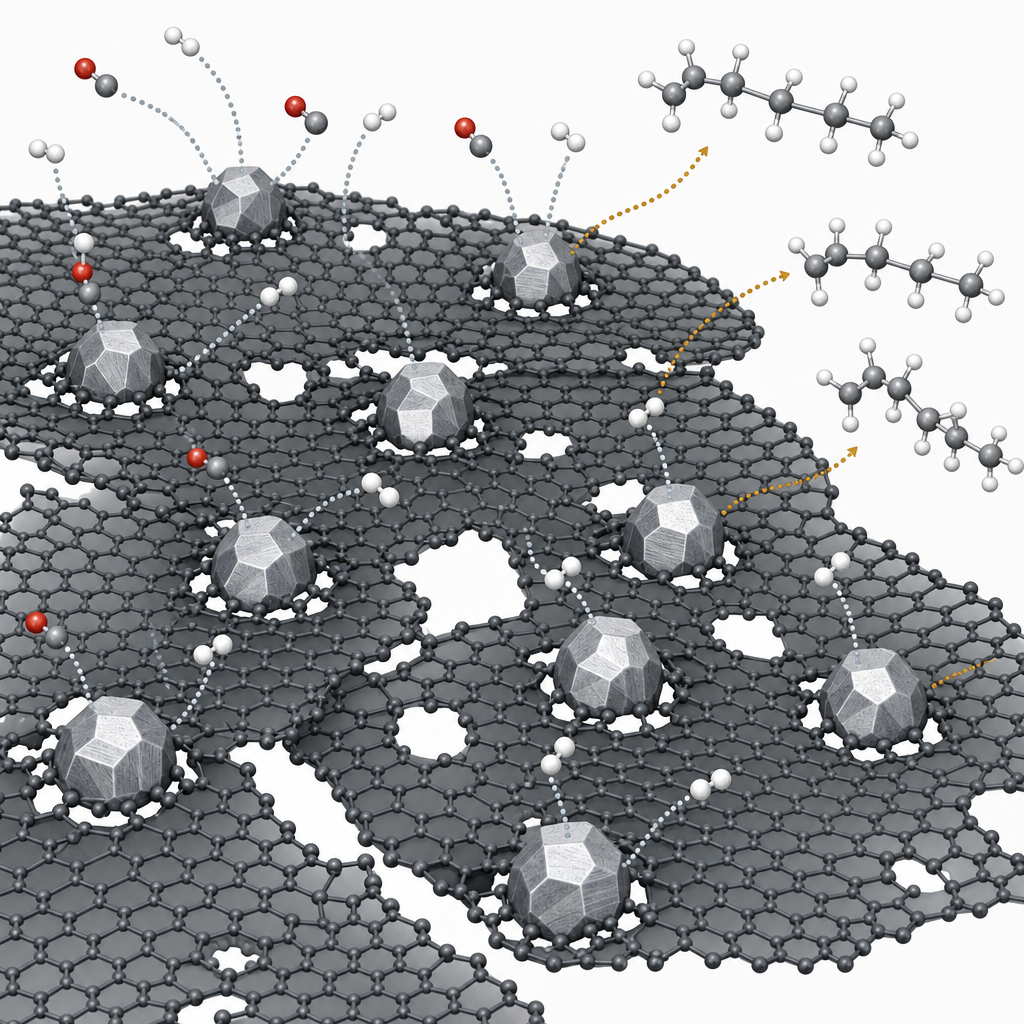
The ACS Material single layer graphene powder was mixed with Fe(NO3)3·9H2O at a giron salt/gsupport ratio of 3.9 using a SPEX 8000M high-energy ball mill, then aged at 50 °C in a tumbling oven for 24 h, allowing the hydrated iron salt to melt and infiltrate the mesopores and defect sites of the graphene flakes. Differential scanning calorimetry confirmed that nearly all the iron salt was confined to graphene-defect mesopores (ΔH = 53.8 J g⁻¹ at ~45 °C). Raman spectroscopy showed a strong D-band near 1350 cm⁻¹, consistent with abundant defect sites that act as both nucleation and anchoring points. The infiltrated material was then thermally treated at 350 °C under flowing CO (200 mL min⁻¹) for 4 h to simultaneously decompose the nitrate and carburize the iron to Hägg carbide. HAADF-STEM, HRTEM, and XRD confirmed monoclinic Fe5C2 nanoparticles (JCPDS# 51-0997) with a mean size of 13.9 ± 5.9 nm, distributed uniformly across the graphene flakes, and ICP-OES verified an Fe content of 34.2 wt%.
Under HT-FTS conditions (340 °C, 1.5 MPa, H2/CO = 1) the Fe5C2/G catalyst achieved 95.1% CO conversion at 48 h time-on-stream at GHSV = 42 NL gcat⁻¹ h⁻¹, with CH4 selectivity of only 7.4% and C5+ selectivity of 34.1%. A control prepared by wetness impregnation on the same graphene (w-Fe5C2/G) gave much larger 24.2 nm particles and substantially lower performance, as did Fe5C2 on activated carbon (w-Fe5C2/AC, 65.5% CO conversion). Pushing the gas hourly space velocity to 60 and 72 NL gcat⁻¹ h⁻¹ — conditions that normally collapse activity — still kept CO conversion above 90%. At GHSV = 72 NL gcat⁻¹ h⁻¹ the catalyst reached its peak metrics: C5+ syncrude productivity of 4.41 gC5+HC gcat⁻¹ h⁻¹, total hydrocarbon yield of 9.78 gHC gcat⁻¹ h⁻¹, iron time yield of 6.5×10⁻⁴ molCO gFe⁻¹ s⁻¹, and a chain-growth probability α of 0.832, well matched to gasoline-range products. The authors state these are the highest values reported among Fe-based FTS catalysts under comparable conditions. Post-reaction TEM and XRD showed the Fe5C2 nanoparticles remained well dispersed (~15 nm spacing) with limited oxidation to Fe3O4.
The demonstrated combination of high iron loading, fine particle size, and thermal stability addresses a key constraint in compact gas-to-liquid (GTL) systems and modular Fischer-Tropsch reactors, where catalyst mass and reactor volume must be minimized. The same defect-anchoring strategy on graphene could extend to cobalt, ruthenium, or bimetallic FTS catalysts, as well as CO2 hydrogenation systems targeting light olefins. Because the synthesis relies on conventional ball-milling and tube-furnace processing rather than MOF precursors or templated mesoporous supports, scale-up to kilogram batches appears feasible. Researchers exploring lower-olefin selectivity, supported single-atom Fe sites, or graphene-confined iron carbide for CO2-to-fuels chemistry can build directly on this synthesis protocol.
The single layer graphene powder used as the support is available from ACS Material, along with other graphene grades (reduced graphene oxide, graphene oxide, nitrogen-doped graphene) suitable for catalyst development, energy storage, and composite research. Groups working on high-loading metal catalysts, Fischer-Tropsch synthesis, or defect-engineered 2D carbon supports may find this graphene grade a useful starting point. The paper provides clear benchmark data for evaluating new supports against a graphene-based reference for HT-FTS work.How ACS Material products were used
- Single Layer Graphene (Graphene Series) — “1.0 g of single layer graphene powder (ACS Material) were physically mixed using a high-energy ball mill”
Product Performance in this Study
The ACS Material single layer graphene powder served as the support for Fe5C2 nanoparticles via melt-infiltration. Its defect-rich porous structure enabled exceptionally high Fe loading (35 wt%) with well-dispersed 14 nm iron-carbide nanoparticles, directly enabling record-high CO conversion and C5+ productivity in Fischer-Tropsch synthesis.
Related product categories
Frequently asked questions
How does graphene improve iron-carbide Fischer-Tropsch catalysts?
Defect-rich graphene flakes provide both nucleation and anchoring sites for iron species, enabling unusually high Fe loadings (35 wt%) while keeping Fe5C2 nanoparticles small (~14 nm) and well dispersed. This combination delivers more accessible active sites per gram of catalyst, which translates directly into higher CO conversion and C5+ productivity even under high gas hourly space velocities where conventional supported catalysts lose activity.
What is melt-infiltration and why is it preferred over wetness impregnation for high-loading catalysts?
Melt-infiltration mixes a hydrated metal salt with a porous support and heats it just above the salt's hydrate melting point, drawing the molten salt into pores and defect sites. Compared with wetness impregnation, it avoids bulk solvent evaporation that drags metal salts to particle exteriors, so the resulting catalysts in this paper showed 14 nm Fe5C2 particles versus 24 nm for the impregnated control.
What CO conversion and productivity can graphene-supported Fe5C2 catalysts achieve in Fischer-Tropsch synthesis?
The Fe5C2/graphene catalyst reported here reached 91.8% CO conversion, 4.41 gC5+HC gcat⁻¹ h⁻¹ C5+ productivity, total hydrocarbon yield of 9.78 gHC gcat⁻¹ h⁻¹, and an iron time yield of 6.5×10⁻⁴ molCO gFe⁻¹ s⁻¹ at 340 °C, 1.5 MPa, H2/CO = 1 and GHSV = 72 NL gcat⁻¹ h⁻¹. The authors report these as the highest values among comparable Fe-based FTS catalysts.