-
Single Layer Graphene for Iodine-Doped PEMFC Electrodes - ICIT Rm. Valcea, 2017
Jun 22, 2026 | ACS MATERIAL LLCMarinoiu, A. et al. (2017). Low cost iodine intercalated graphene for fuel cells electrodes. *Applied Surface Science*.
Applied Surface Science · 2017
Researchers used ACS Material single layer graphene (750 m²/g) to synthesize iodine-intercalated graphene as a low-cost metal-free ORR support for PEM fuel cells.
About this research
Researchers at the National R&D Institute for Cryogenics and Isotopic Technologies (ICIT) in Rm. Valcea, Romania, working with the University Politehnica of Bucharest, used ACS Material single layer graphene powder (specific surface area 750 m²/g) as the starting material for synthesizing iodine-intercalated graphene (sample GrI4) for proton exchange membrane fuel cell (PEMFC) electrodes. Published in Applied Surface Science in 2017, the study reports that adding iodine-doped graphene as a microporous layer alongside a 0.2 mg cm⁻² Pt/C cathode raised the electrochemical surface area from roughly 30 to 82–90 m² g⁻¹ Pt and improved PEMFC power density by about 18% relative to a Pt-only cathode at the same loading.
The oxygen reduction reaction (ORR) at the PEMFC cathode is one of the most stubborn bottlenecks holding back fuel cell commercialization. Platinum-based catalysts are still the benchmark, but their cost, CO sensitivity, and limited durability make Pt-only electrodes economically unattractive at scale. Heteroatom-doped carbons - including N-, B-, S-, P-, and halogen-doped graphenes - have emerged as candidates for metal-free or Pt-lean ORR systems because electronegativity differences between dopant and carbon polarize neighboring carbon atoms and create active sites. Iodine doping is particularly interesting because charge-transfer complexes such as I₃⁻ and I₅⁻ can tune the graphene work function. However, the practical translation of iodine-doped graphene into PEMFC electrodes - including how surface area, defect density, and iodine speciation affect device-level performance - had not been systematically studied.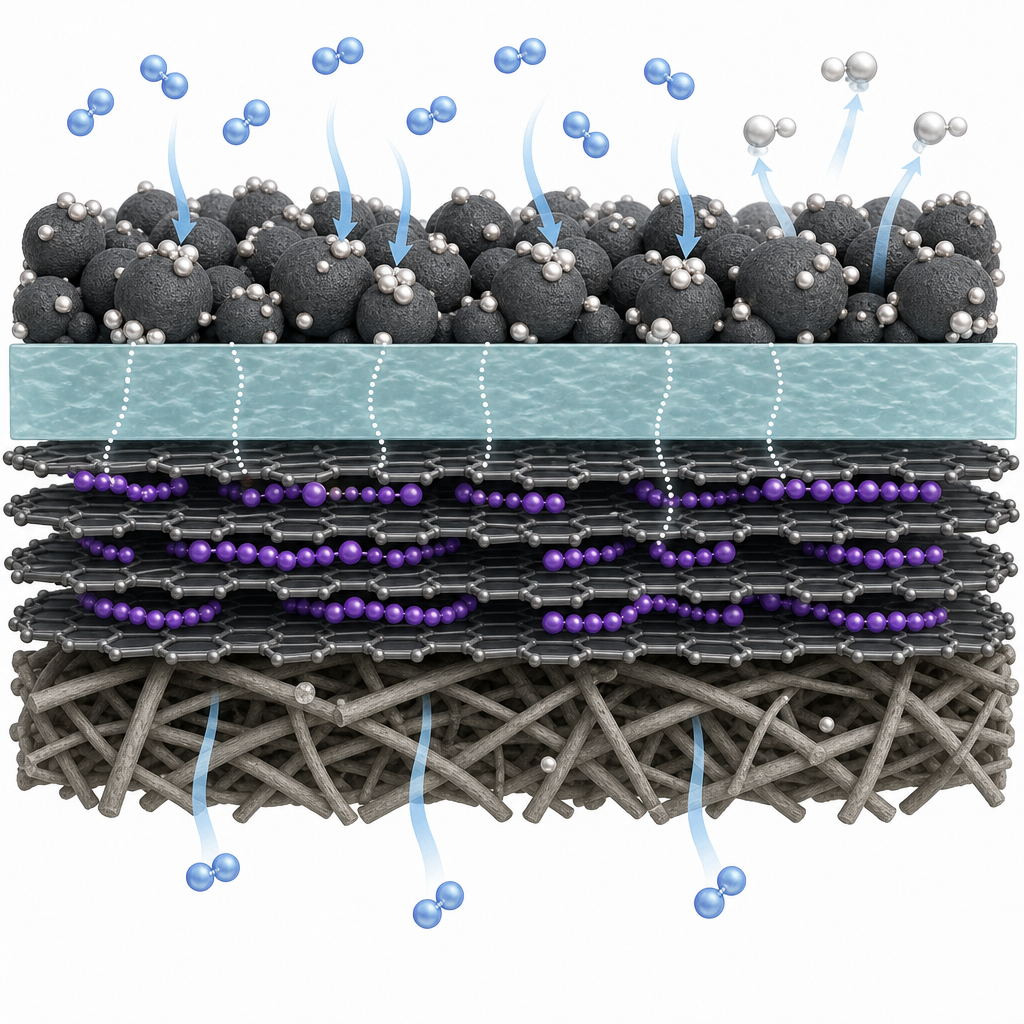
The ACS Material single layer graphene was used as the raw carbon framework for one of four iodinated graphene samples (GrI4), produced by electrophilic substitution using a KI/NaIO₄ system in concentrated H₂SO₄ at a 1:1 I⁺/graphene molar ratio. After 24 h of reaction at 30–35 °C, the product was washed free of sulfate, dried under vacuum at 50 °C, and Soxhlet-extracted with acetone to remove unbound elemental iodine. The resulting iodinated graphene was formulated into a catalyst ink with isopropanol and 5 wt% Nafion ionomer, ultrasonicated, and sprayed onto either the Nafion membrane or the gas diffusion layer (GDL) of a 5 cm² single-cell PEMFC. The team compared four cathode configurations: 0.4 mg cm⁻² Pt only, 0.2 mg cm⁻² Pt only, 0.2 mg cm⁻² iodine-doped graphene only, and a hybrid of 0.2 mg cm⁻² Pt on membrane plus 0.2 mg cm⁻² iodine-doped graphene on the GDL acting as a microporous layer.
XPS confirmed iodine incorporation, with I 3d signals at 620 eV and iodine contents ranging from 1.1 to 5.8 wt%. Raman spectra revealed I₃⁻ (104 cm⁻¹) and I₅⁻ (163 cm⁻¹) peaks and a D′ defect band near 1608 cm⁻¹ indicative of sp³ C–I bonding. BET surface areas were 380 m² g⁻¹ for GrI1, 420 m² g⁻¹ for GrI2, 47 m² g⁻¹ for GrI3, and 375 m² g⁻¹ for GrI4 - notably, the ACS Material-derived GrI4 retained high surface area after doping. The N₂ isotherms were type IV with hierarchical micro/mesoporosity favorable for ORR mass transport. In single-cell tests at 60 °C and 1 bar with H₂/air at 100/300 mL min⁻¹, peak power density reached 0.574 W cm⁻² at 1 A cm⁻² for both 0.4 and 0.2 mg cm⁻² Pt-only cathodes, and 0.549 W cm⁻² for the Pt/iodine hybrid, but the iodine microporous layer cut ohmic and concentration losses and pushed the electrochemical surface area to 82 m² g⁻¹ Pt at 60 °C and 90 m² g⁻¹ Pt at 80 °C - roughly three times higher than the equivalent Pt/C-only electrode. The iodine-doped layer improved water management, oxygen transport to catalytic sites, and Pt utilization.
The work points to iodine-intercalated graphene as a practical, low-cost microporous layer additive for reducing Pt loading in PEMFC cathodes without sacrificing power density. The synthesis routes - nucleophilic substitution of graphene oxide with HI and electrophilic substitution of pristine graphene with KI/NaIO₄ - are scalable and avoid expensive precursors or rare metals. Downstream applications include automotive PEMFC stacks, stationary distributed power, and portable fuel cells, where any reduction in platinum group metal content directly improves commercial viability. The authors also flag multi-element doped graphenes (I/N, I/B) as a natural extension, leveraging the same intercalation chemistry demonstrated here.
For researchers working on ORR catalysts, fuel cell electrodes, or halogen-functionalized 2D carbons, the high-surface-area single layer graphene used in this study is available from ACS Material's Graphene Series catalog. The 750 m² g⁻¹ specific surface area makes it well suited as a precursor for chemical functionalization workflows where preserving porosity through wet-chemistry doping is critical to the final electrocatalyst performance.How ACS Material products were used
- Single Layer Graphene (Graphene Series) — “The same protocol was followed for GrI4 synthesis except that the starting raw material was single layer graphene powder (specific surface area 750 m2 g−1, ACS Material, USA).”
Product Performance in this StudyThe high-surface-area (750 m²/g) single-layer graphene powder from ACS Material served as the raw carbon scaffold for the GrI4 iodine-intercalated sample, prepared by electrophilic substitution. While GrI3 (from a lower-surface-area commercial graphene) ultimately showed the best crystallinity and highest iodine loading, the ACS Material-based GrI4 retained a high BET surface area (375 m²/g) after doping and demonstrated the viability of high-surface-area single-layer graphene as a precursor for halogen-doped ORR supports.
Related product categories
Frequently asked questionsHow does iodine-doped graphene improve PEM fuel cell performance?
Iodine doping creates I3- and I5- charge-transfer complexes that polarize adjacent carbon atoms and increase the graphene work function, weakening the O-O bond of adsorbed O2 and accelerating the oxygen reduction reaction. When used as a microporous layer with Pt/C, iodine-intercalated graphene also improves water management and oxygen transport, raising electrochemical surface area from about 30 to 82-90 m2/g Pt and lifting power density by roughly 18 percent.
Why is high surface area single layer graphene useful as a precursor for doped graphene catalysts?
Heteroatom doping typically introduces stacking and partial agglomeration that reduce surface area. Starting from single layer graphene with a specific surface area of about 750 m2/g preserves more accessible carbon sites after iodine intercalation. In this study the ACS Material-derived sample GrI4 retained a BET surface area of 375 m2/g after doping, providing the hierarchical micro- and mesoporosity needed to expose ORR-active sites and shorten reactant diffusion pathways.
What role does iodine speciation play in halogen-doped graphene electrocatalysts?
Raman peaks at 104 and 163 cm-1 confirm that elemental iodine is trapped between graphene layers as triiodide (I3-) and pentaiodide (I5-) rather than as molecular I2. These polyiodide species form partially ionized C-I+ bonds that enhance charge transfer to adsorbed O2. The D-prime band at 1608 cm-1 indicates sp3 C-I bonding, confirming that iodine is chemically anchored to the lattice and not simply physisorbed.