-
Single-Layer Graphene for Li–O2 Battery Cathodes - AIST, 2014
Jun 15, 2026 | ACS MATERIAL LLCZhang, T., Matsuda, H., & Zhou, H. (2014). Gel-Derived Cation-π Stacking Films of Carbon Nanotube-Graphene Complexes as Oxygen Cathodes. *ChemSusChem*. https://doi.org/10.1002/cssc.201402567
ChemSusChem · 2014
AIST researchers used ACS Material single-layer graphene to build SWNT–graphene cation–π gel films as Li–O2 oxygen cathodes with improved cycling stability.
About this research
Researchers at the National Institute of Advanced Industrial Science and Technology (AIST) in Japan used single-layer graphene supplied by ACS Material to fabricate crosslinked carbon nanotube–graphene complex films that function as oxygen cathodes for lithium–oxygen (Li–O2) batteries. Reporting in ChemSusChem (2014), Zhang, Matsuda, and Zhou demonstrate that imidazolium-based ionic liquids simultaneously disperse entangled single-walled carbon nanotubes and gather dispersible graphene sheets through cation–π stacking interactions, producing a gel that can be extracted in two solvent steps to leave a solid, finely crosslinked SWNT–SLG film. As an O2 cathode in a Li–O2 cell with TEGDME electrolyte, the gel-derived film sustained a capacity of 1000 mAh g⁻¹ for 75 cycles, substantially outperforming films made of SWNTs or SLG alone.
Lithium–oxygen batteries offer one of the highest theoretical specific energies among rechargeable systems, but their practical use is held back by sluggish oxygen electrochemistry, parasitic electrolyte decomposition, and progressive degradation of the carbon support. Carbon nanotubes and graphene are attractive cathode supports thanks to their large surface area, high electronic conductivity, and low-dimensional structure that accommodates Li2O2 deposition. However, both SWNTs and graphene tend to aggregate into bundles or restacked sheets, which limits their effective surface area and undermines cycle life. Designing a processable, well-dispersed carbon network is therefore a central challenge in Li–O2 cathode research, and the cation–π chemistry of ionic liquids provides one of the few routes that can address SWNT and graphene aggregation simultaneously.
The ACS Material single-layer graphene was used directly as the 2D building block of the cathode. In a typical preparation, 10 mg of HiPCO SuperPure SWNTs and 1.36 mg of ACS Material SLG were dispersed in 0.6 mL of 1-ethyl-3-methylimidazolium bis(trifluoromethylsulfonyl)imide ([C2C1im][NTf2]) by ultrasonication, then ground with 2 mg of PTFE emulsion. SEM confirmed that the silky SLG sheets remained largely as individual, dispersible flakes after IL gelation, in contrast to bundled SWNTs which were exfoliated by the cation–π interaction. After roughly 60 minutes of grinding, the paste expanded into a viscous bucky gel containing approximately 1.2 × 10²⁰ IL molecules per milligram of graphene. The ionic liquid was then removed in two stages — first by immersion in N-methylpyrrolidone (NMP) and then in an ethanol/acetonitrile mixture — yielding a solid film in which SWNTs adhered onto the SLG surface without re-aggregating. FTIR confirmed complete IL removal. For catalytic studies, Ru nanoparticles (1.5–2.5 nm) were deposited onto the SWNT–SLG network at a 90:10 carbon:Ru weight ratio.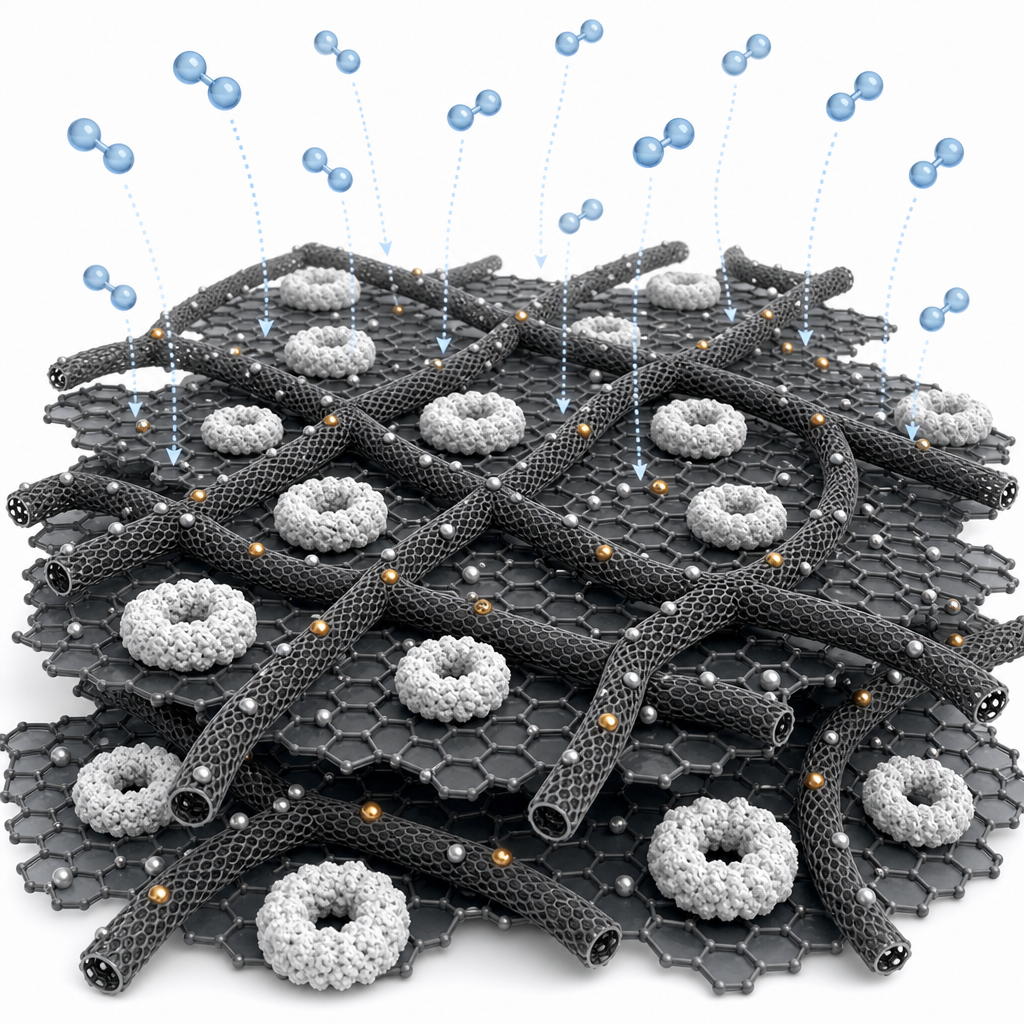
The gel-derived SWNT–SLG cathode delivered a fixed 1000 mAh g⁻¹ capacity for 75 cycles at 250 mA g⁻¹, while SWNT-only and SLG-only cathodes hit the 2.3 V discharge cut-off within 50 and 25 cycles, respectively. Refilling the cell with fresh O2 after the 76th cycle restored cycling stably to 100 cycles, indicating that gas-phase byproduct accumulation, not structural collapse, eventually limits performance. XRD confirmed reversible Li2O2 formation and decomposition during the first cycle, with toroidal Li2O2 particles ~250 nm in size adhering tightly to the SWNT–SLG surface. FTIR after 25 cycles revealed Li2CO3 accumulation, consistent with TEGDME electrolyte decomposition. Adding Ru nanoparticles markedly suppressed this side chemistry: after 30 cycles at 25 °C and 500 mA g⁻¹, the SWNT–SLG–Ru cathode showed only a 1.3× increase in total cell resistance, compared with 2.7× for SWNT–SLG at 25 °C and 27× for SWNT–SLG at 60 °C. The Ru-loaded cathode also retained a much shinier Li metal anode surface, indicating reduced H2O generation from electrolyte breakdown.
The gel-derived processing approach is general and extends well beyond Li–O2 batteries. Because the cation–π network preserves SWNT dispersion and SLG flake integrity in the solid film, it offers a template for SWNT–graphene composites in supercapacitors, electrocatalysis, transparent conductors, sensors, and flexible electrodes. The authors specifically highlight applicability to all-solid-state Li-air systems and to support–catalyst architectures with other metal or oxide nanoparticles. Their identification of the Li metal anode color change as a diagnostic for parasitic H2O formation provides a practical screening method for evaluating new catalysts and electrolytes in metal–air cells, helping to separate genuine catalytic enhancement from artifacts caused by moisture or air leakage.
For researchers building 2D-carbon-based electrodes and catalyst supports, single-layer graphene of the grade used here is available from ACS Material's graphene series, alongside SWCNTs, MXenes, and related 2D nanomaterials. The paper demonstrates that high-quality, dispersible SLG is a practical building block for hybrid carbon architectures whose performance depends on flake integrity and controlled aggregation. The reported cycling improvements derive from morphology control enabled by the SLG itself, providing a credible, citation-supported example for groups exploring graphene-based oxygen cathodes, electrocatalyst supports, or ionic-liquid-processed carbon films.How ACS Material products were used
- Single Layer Graphene (SLG) (Graphene Series) — “SWNTs (10 mg, Hipco SuperPure) and SLG (1.36 mg, ACS Materials) were dispersed in 0.6 mL imidazolium ion-based ionic liquid”
Product Performance in this StudyThe single-layer graphene from ACS Material served as the dispersible 2D component that gathered into a crosslinked gel via cation–π interaction with the ionic liquid, enabling fabrication of SWNT–SLG complex films. As Li–O2 oxygen cathodes, these films sustained 1000 mAh g⁻¹ over 75 cycles, far exceeding SWNT- or SLG-only cathodes.
Related product categories
Frequently asked questionsHow does single-layer graphene improve cycling stability in Li–O2 battery cathodes?
Single-layer graphene provides a high-surface-area 2D scaffold that, when crosslinked with single-walled carbon nanotubes via cation–π stacking in an ionic liquid, prevents both SWNT bundling and SLG restacking. The resulting porous, electronically conductive network supports uniform Li2O2 deposition. In this study the SWNT–SLG film sustained 1000 mAh g⁻¹ for 75 cycles, whereas SWNT- or SLG-only cathodes failed within 25–50 cycles.
What is the role of ionic liquids in carbon nanotube–graphene composite processing?
Imidazolium ionic liquids interact with sp²-carbon surfaces through cation–π stacking, simultaneously dispersing entangled SWNT bundles and gathering dispersible graphene sheets into a crosslinked bucky gel. After grinding, the gel can be shaped, then the ionic liquid is removed by two-step solvent extraction (NMP followed by ethanol/acetonitrile), leaving a solid film in which SWNTs adhere uniformly to graphene without re-aggregating.
Why are Ru nanoparticles used in Li–O2 battery cathodes?
Ru nanoparticles accelerate the kinetics of Li2O2 decomposition during charging, lowering the charge overpotential and thereby reducing electrolyte oxidation. In this work, 1.5–2.5 nm Ru on SWNT–SLG suppressed Li2CO3 accumulation and limited cell impedance growth to only 1.3× after 30 cycles, compared with 2.7× without Ru, while also protecting the Li metal anode from H2O-driven degradation.