-
Single-Layer Graphene Gas Sensors - CSIRO, 2013
Jun 01, 2026 | ACS MATERIAL LLCRandeniya, L. K. et al. (2013). Harnessing the Influence of Reactive Edges and Defects of Graphene Substrates for Achieving Complete Cycle of Room-Temperature Molecular Sensing. *Small*. https://doi.org/10.1002/smll.201300689
Small · 2013
CSIRO researchers used ACS Material single-layer graphene to build chemiresistors that detect ppb-level NO2 and NH3 with rapid room-temperature recovery.
About this research
Researchers at CSIRO Materials Science and Engineering used dispersible single-layer graphene from ACS Material to build room-temperature chemiresistors that detect trace NO2 and NH3 and, more importantly, recover rapidly in ambient air. Published in Small (2013), the work shows that exposing the loaded sensor to water-vapor or ethanol-enriched air displaces strongly bound NO2 and NH3 within minutes, removing the long-standing need for vacuum annealing at 150 °C or 258 nm UV irradiation to regenerate graphene gas sensors. The chemiresistors deliver responses comparable to or better than more elaborate single-layer graphene field-effect devices.
Graphene molecule sensors have attracted intense interest since Schedin and co-workers demonstrated single-molecule sensitivity, but two practical bottlenecks have persisted. First, pristine basal-plane graphene shows modest intrinsic sensitivity to NH3 and NO2 at ppb–ppm levels relevant to air-quality and industrial-safety monitoring. Second, the bound molecules desorb very slowly, so realistic duty cycles require harsh regeneration steps that are incompatible with portable or wearable sensor platforms. The CSIRO team tackles both problems simultaneously by combining edge-rich graphene morphologies with a polar-molecule-assisted desorption mechanism, opening a path toward low-power room-temperature electronic noses.
The ACS Material dispersible single-layer graphene was used without further purification. Ten milligrams of the graphene was sonicated for 1 h in 100 mL deionized water containing 1 g sodium dodecyl sulfate. For pristine (p-type) sensors, the dispersion was diluted 1:20 and vacuum-filtered onto a 55 mm Whatman Anopore mesoporous alumina membrane to produce a semi-transparent film of overlapping single-layer flakes that conform to the rough Al2O3 surface. For nanomesh (n-type) sensors, an aliquot was treated with 1 M HNO3 at 80 °C for 2 h, generating 2–5 nm pores in the flakes (confirmed by TEM) and dramatically increasing the density of reactive edge sites. After thorough water and ethanol washing and air drying, 5 mm × 5 mm pieces were contacted with silver paste on filament posts. Final device resistances were 10–20 MΩ, and XPS confirmed no detectable sulfur residue from the surfactant. Raman (633 nm) and SEM (5 kV) characterized the films.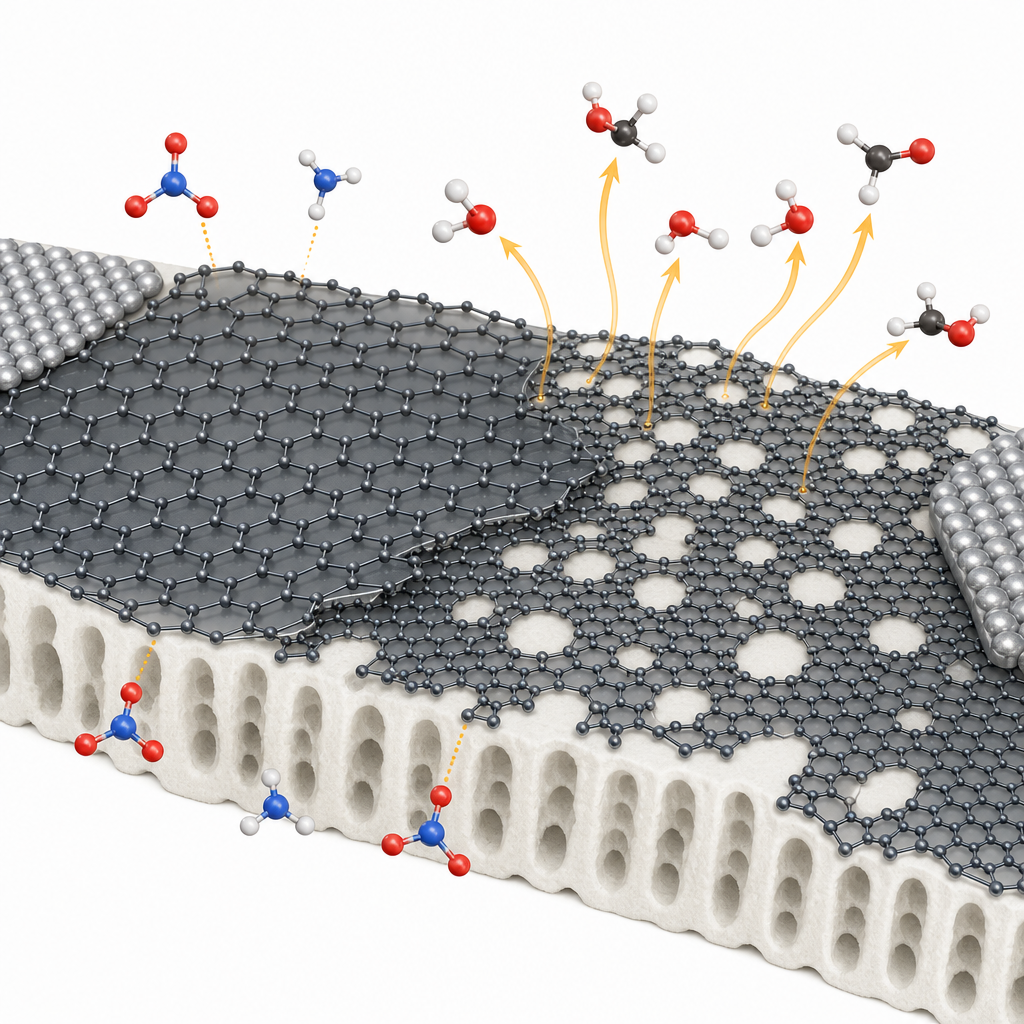 Under 5 ppm NO2 in dry synthetic air, the pristine graphene resistor showed a clear conductance increase consistent with hole doping, confirming p-type behavior; in dry air alone, recovery would have required many hours. When 70% of the buffer gas was diverted through a water bubbler (raising chamber humidity from <1% to 58%), the NO2 desorbed completely in 10–12 min, and the baseline flattened reproducibly across five consecutive 5 min exposures. Switching to HNO3-treated nanomesh chemiresistors flipped the polarity: NO2 caused a conductance decrease (n-type response), and ammonia at 1 ppm and 5 ppm produced clear, reproducible increases in conductance. Just 2% buffer-gas diversion through water (≈12% RH) cleared 1 ppm NH3 in about 5 min, compared with more than 2 h for spontaneous recovery in dry air. Ethanol vapor at roughly 1500 ppm achieved the same effect across five consecutive 5 ppm NH3 cycles, with no deterioration in sensitivity over three months of storage in ambient air. DFTB-SCC calculations combined with ab initio thermodynamics indicate that polar molecules adsorbed at under-coordinated edge and defect sites shift substrate defect states near the Fermi level, decoupling NO2/NH3 orbitals from graphene and triggering desorption electrostatically.
The demonstrated combination of ppb-level sensitivity and minute-scale room-temperature regeneration is directly relevant to portable air-quality monitors, industrial leak detection for ammonia refrigeration and fertilizer plants, automotive NOx sensing, and breath-analysis devices. Because the active material is a simple aqueous graphene dispersion deposited by vacuum filtration, the approach scales to inexpensive disposable sensor strips and is compatible with flexible substrates. The authors point to further work on long-term stability under high-humidity cycling (where slow hydroxylation of edge sites shifts the baseline) and on extending the polar-molecule recovery scheme to other reactive analytes such as H2S, SO2, and volatile organic compounds.
For researchers developing graphene-based chemiresistors, FET sensors, or hybrid 2D/oxide sensing platforms, this paper underscores how much of the device behavior is dictated by edge and defect chemistry rather than basal-plane response. ACS Material supplies the dispersible single-layer graphene used here, along with related single-layer graphene oxide, reduced graphene oxide, and graphene nanoplatelet products that allow similar edge-density engineering through controlled acid or oxygen-plasma treatments. Teams reproducing or extending this sensing strategy can source comparable starting materials directly from the ACS Material graphene catalog.How ACS Material products were used
- Single Layer Graphene (dispersible) (Graphene Series) — “Dispersible single-layer graphene was purchased from ACS Materials and was used without further purification.”
Product Performance in this StudyThe dispersible single-layer graphene from ACS Material formed the active sensing layer of the chemiresistors. After vacuum filtration onto alumina membranes, both the pristine and HNO3-treated (nanomesh) variants delivered reproducible ppb-level NO2 and ppm-level NH3 responses with rapid room-temperature recovery, validating the material as a practical starting point for edge-rich gas sensors.
Related product categories
Frequently asked questionsHow does single-layer graphene detect ppb levels of NO2 and NH3 at room temperature?
Single-layer graphene flakes deposited on mesoporous alumina expose abundant zigzag and armchair edges where flat bands near the Fermi level make adsorption highly sensitive. NO2 acts as an acceptor and NH3 as a donor (or the opposite on nanomesh), shifting carrier density and producing measurable resistance changes. The edge-rich architecture detects ppb concentrations of both gases without requiring transistor gating or elaborate device structures.
Why is rapid sensor recovery important in graphene gas sensors?
NO2 and NH3 bind strongly to graphene, so spontaneous desorption in dry air can take many hours, making repeated measurements impractical. Conventional recovery uses 150 °C annealing or 258 nm UV in vacuum, which adds power, complexity, and incompatibility with portable use. Polar-molecule-assisted recovery in humid or ethanol-enriched air completes desorption in minutes at room temperature, enabling realistic duty cycles for field deployment.
What is graphene nanomesh and how does it change sensor polarity?
Graphene nanomesh is produced here by treating single-layer graphene with 1 M HNO3 at 80 °C, generating 2–5 nm pores and a high density of reactive dangling-bond edge sites. These defect sites alter the band structure so that the chemiresistor behaves as an n-type semiconductor: conductance decreases on NO2 exposure and increases on NH3, opposite to the response of untreated flakes.