-
Single-Layer Graphene Support for Pd Nanocatalysts - KIER, 2024
Jun 04, 2026 | ACS MATERIAL LLCOh, K. H. et al. (2024). Novel solid-state synthesis of surfactant-and solvent-free Pd tetrahedron nanocatalysts. *Journal of Materials Chemistry A*. https://doi.org/10.1039/d3ta06056j
Clean Fuel Laboratory · Journal of Materials Chemistry A · 2024
Korea Institute of Energy Research used ACS Material single-layer graphene to support surfactant-free tetrahedral Pd nanocatalysts, achieving 13.2 kJ/mol activation energy for 4-nitrophenol reduction.
About this research
Researchers at the Korea Institute of Energy Research, together with collaborators at Korea University, Pusan National University, and Hanyang University ERICA, used research-grade single-layer graphene acquired from ACS Material Co., Ltd. as the support for surfactant- and solvent-free tetrahedral palladium nanocatalysts that achieved a very low activation energy of 13.2 kJ/mol for the catalytic reduction of 4-nitrophenol. The work introduces an automated, reproducible solid-state synthesis in which carbon monoxide gas acts as both a reducing agent and a selective capping molecule, controlling the morphology of Pd nanoparticles without polymeric surfactants or harmful organic solvents. The tetrahedral Pd on graphene (T-Pd/G) outperformed spherical Pd on graphene, PVP-stabilized Pd nanocubes on graphene, and commercial Pd/C in catalytic activity.
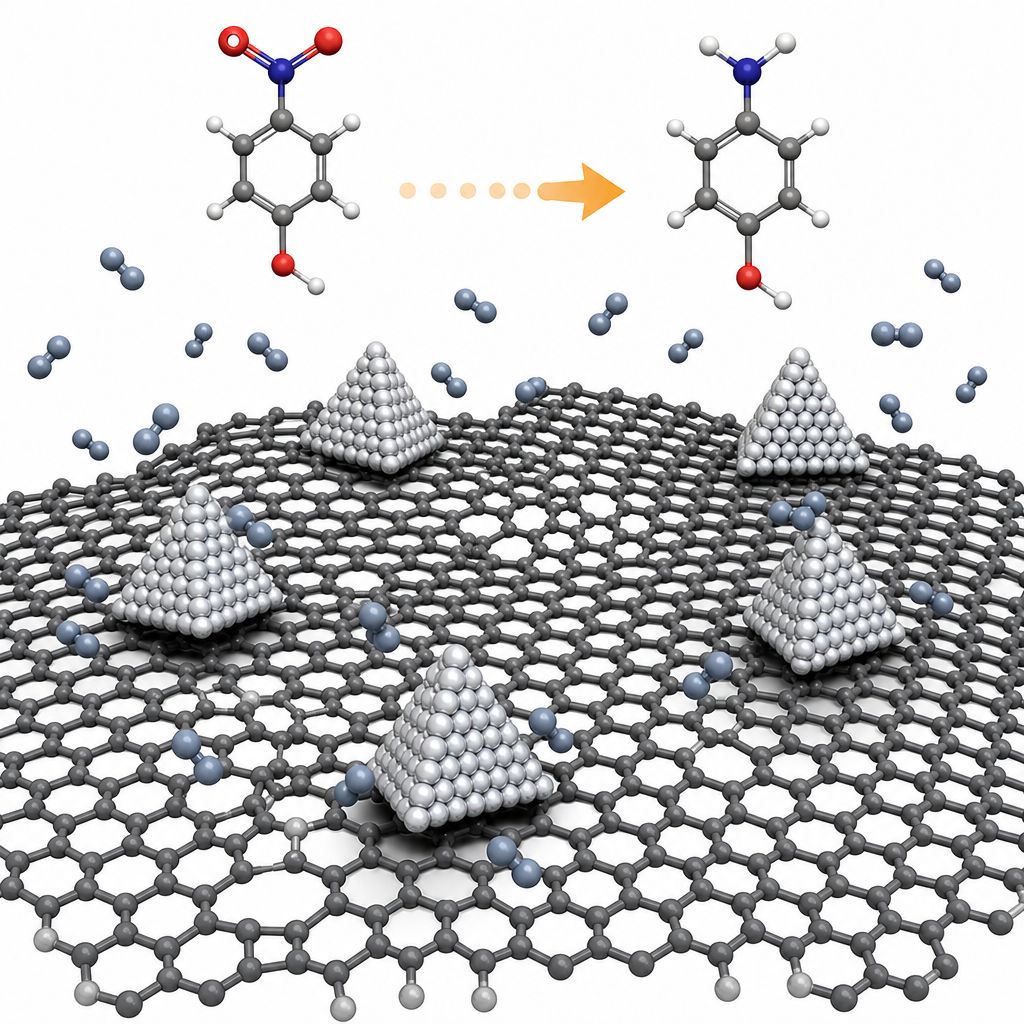
Shape-controlled metal nanoparticles are central to organic, electrochemical, and photocatalytic reactions because the exposed crystal facets dictate reactivity. Conventional solution-phase syntheses rely on polymeric surfactants and polar or non-polar solvents to direct shape and prevent aggregation, but these capping agents bind to metal active sites and physically block catalysis. They also create scale-up difficulties, generate hazardous waste, and contaminate particle surfaces. Palladium nanoparticles in particular show high promise in electrocatalysis, photocatalysis, and organic conversion, yet reproducible, clean-surface, shape-controlled Pd remained an open challenge. The 4-nitrophenol reduction reaction is a widely used model for benchmarking catalysts because nitrophenols are environmental pollutants and the product, 4-aminophenol, is an industrially useful intermediate. A surfactant-free route that yields highly dispersed faceted particles directly addresses both the surface-contamination and the green-chemistry problems facing nanocatalyst manufacturing.
The single-layer graphene from ACS Material was used directly as received, mixed with palladium(II) acetylacetonate at a 0.318 g Pd-salt per g support ratio to give 10 wt% Pd. The powders were homogenized with a methacrylate bead in a high-energy ball mill (SPEX 8000M) at 1725 rpm for 5 min, loaded into a stainless-steel reactor, and processed in an All-In-One (AIO) reactor system under a programmed sequence: heating to 200 °C under 100 mL/min CO flow, a 30 min thermal treatment at 200 °C under CO, slow cooling, and an N2 purge. The thermal reduction under CO produced tetrahedral Pd nanoparticles uniformly anchored on the graphene. The authors note that graphene's excellent electron-transfer properties and intrinsic metal-support interactions promote 4-nitrophenol reduction, and that structural defects in the graphene enhance interactions with anchored nanoparticles. The same support was also used to build a magnetically separable Fe3O4-graphene composite for the bifunctional T-Pd/Fe3O4-G catalyst.
The T-Pd/G catalyst showed tetrahedral Pd nanoparticles with an average edge size of 12.0 ± 2.2 nm; XRD gave a Pd crystallite size of 9.6 nm and confirmed the fcc Pd (111), (200), and (220) reflections. BET surface area of the pristine graphene was 642.1 m2/g, decreasing to 384.4 m2/g after Pd loading, with pore volume falling from 2.2 to 1.41 cm3/g. ICP-OES gave a Pd loading of 10.84 wt%, matching the 10 wt% target. In 4-nitrophenol reduction at 30 °C, T-Pd/G reached a rate constant of 10.1 × 10⁻³ s⁻¹, versus 6.2 × 10⁻³ s⁻¹ for spherical S-Pd/G and 2.9 × 10⁻³ s⁻¹ for commercial Pd/C. Even at 5 °C, T-Pd/G maintained 78.4% conversion compared with 56.3% (S-Pd/G) and 19.6% (Pd/C). Pd activity reached 16.3–20.4 mmol(4-NP)/g(Pd)/s across 5–50 °C, about 1.8 times higher than commercial Pd/C at 30 °C. The activation energy of 13.2 kJ/mol was far below 17.8 kJ/mol (S-Pd/G) and 30.3 kJ/mol (Pd/C). The PVP-stabilized cubic C-Pd/G gave only 30.8% conversion, confirming that surfactant-free clean surfaces and active edge/kink sites drive performance. The bifunctional T-Pd/Fe3O4-G retained over 96% conversion across five magnetic-separation recycle runs, while commercial Pd/C dropped to 20.6% after one run.
This solid-state, surfactant-free approach enables clean, highly dispersed, shape-controlled Pd nanocatalysts suitable for environmental remediation, organic synthesis, and fine-chemical production. The magnetically recoverable T-Pd/Fe3O4-G variant is particularly attractive for continuous or repeated batch operations where catalyst recovery and reuse reduce precious-metal costs. The authors demonstrate the method on graphene, activated charcoal, alumina, and silica, indicating broad applicability across support chemistries. They explicitly point to extending the automated AIO route to other morphology-controlled noble-metal catalysts such as platinum, opening paths toward fuel-cell electrocatalysts and other facet-sensitive reactions where surface cleanliness is decisive.
For researchers pursuing similar facet-controlled metal catalysts, the choice of a high-surface-area, defect-bearing single-layer graphene support proved decisive in stabilizing the tetrahedral Pd morphology and maximizing active-site exposure. The research-grade single-layer graphene used here is available from ACS Material's graphene product line, making this support accessible to groups working on catalytic reduction, electrocatalysis, and magnetically recoverable heterogeneous catalysts. The paper's quantitative benchmarks provide a useful reference point for evaluating graphene-supported Pd systems.How ACS Material products were used
- Single Layer Graphene (research-grade single-layer graphene powder) (Graphene Series) — “Graphene (research-grade single-layer graphene) powder was acquired from ACS Material Co., Ltd.”
Product Performance in this Study
The single-layer graphene served as the primary catalyst support (T-Pd/G), providing high surface area and structural defects that anchored highly dispersed tetrahedral Pd nanoparticles, yielding the best 4-NP reduction performance among all tested supports.
Related product categories
Frequently asked questions
Why is single-layer graphene a good support for palladium nanocatalysts?
Single-layer graphene offers a very high surface area (642 m2/g in this study), excellent electron-transfer properties, and structural defects that anchor metal nanoparticles. These features promote high palladium dispersion and strong metal-support interactions, which enhanced 4-nitrophenol reduction activity. The graphene-supported tetrahedral Pd catalyst reached a rate constant of 10.1 × 10⁻³ s⁻¹, far above commercial Pd/C at 2.9 × 10⁻³ s⁻¹.
How does carbon monoxide control palladium nanoparticle shape during solid-state synthesis?
During thermal treatment under CO flow, CO acts as both a reducing agent and a selective capping molecule. DFT calculations showed Pd atoms preferentially adsorb on (100) and (110) facets under CO, suppressing (111) growth and producing tetrahedral nanoparticles bounded by (111) facets. Under H2 instead, growth selectivity is lost and larger spherical particles form, confirming the capping role of CO.
What makes the magnetic T-Pd/Fe3O4-G catalyst easy to recycle?
Incorporating Fe3O4 nanoparticles into the graphene support makes the catalyst magnetically separable. After 4-nitrophenol reduction, the spent catalyst can be recovered with an external magnet rather than centrifugation. The T-Pd/Fe3O4-G recovered about 82% of catalyst and maintained over 96% conversion across five runs, while commercial Pd/C dropped to 20.6% conversion after a single run.