-
TS-1 Zeolite for Furfural Oxidation — Hokkaido University, 2022
Jun 01, 2026 | ACS MATERIAL LLCPalai, Y., Shrotri, A., & Fukuoka, A. (2022). Selective oxidation of furfural to succinic acid over Lewis acidic Sn-Beta. *ACS catalysis*. https://doi.org/10.1021/acscatal.1c05348
ACS catalysis · 2022
Hokkaido University researchers use ACS Material TS-1 as a benchmark to demonstrate Sn-Beta zeolite selectively oxidizes furfural to bio-succinic acid.
About this research
Researchers at Hokkaido University, led by Atsushi Fukuoka and Abhijit Shrotri with first author Yayati Naresh Palai, used Titanium Silicalite-1 (TS-1) supplied by ACS Material as a benchmark catalyst in a study demonstrating that Sn-Beta zeolite selectively converts furfural to bio-based succinic acid through Baeyer–Villiger oxidation. Published in ACS Catalysis (2022, 12, 3534–3542), the work establishes a new heterogeneous Lewis-acid pathway to a C4 platform chemical that has historically been produced either by petrochemical routes from 1,4-butanediol and ethylene glycol or by costly bacterial fermentation. The TS-1 reference data, obtained without modification of the as-received material, was central to highlighting why Sn-Beta outperforms competing tetravalent-cation zeolites for this transformation.
Succinic acid is one of the U.S. Department of Energy's top platform chemicals, used to make biodegradable polyesters, polyamides, plasticizers, and pharmaceutical intermediates. Producing it from biomass remains challenging because four-carbon sugars such as erythrose are scarce in nature. Furfural, in contrast, is readily obtained by dehydration of pentoses (xylose, arabinose) from hemicellulose, making it an attractive renewable feedstock. Prior catalytic routes to succinic acid from furfural relied on Brønsted-acid materials such as Amberlyst-15 and sulfonated graphene oxide with aqueous H2O2, reaching yields up to 88%. However, these organic-framework catalysts deactivate through humin deposition and cannot be regenerated by calcination, motivating the search for robust inorganic Lewis-acid alternatives.
The ACS Material TS-1 sample played a defined role as a comparison catalyst in the study's experimental section. As stated in the Methods, "TS-1 was purchased from ACS Material and used without modification," while SnO2 powder was sourced separately and the central Sn-Beta catalysts were prepared in-house by dealuminating Zeolyst CP814C in 13 N HNO3 and impregnating with Sn(II) acetate, followed by calcination under N2 then air at 500 °C. The team explored Sn loadings around 2 wt% on the dealuminated beta framework. TS-1 is a well-known tetravalent-cation zeolite (Ti4+ in a silicalite framework) that exhibits pure Lewis acidity and has previously been reported to oxidize furfural to maleic acid in roughly 53% yield. By running TS-1 alongside Sn-Beta under identical aqueous H2O2 conditions (1 mmol furfural, 5 mL water, 50 mg catalyst, 44 mmol H2O2), the authors could attribute the distinctive product selectivity to the Sn site environment rather than to generic Lewis acidity. Product analysis used a Shimadzu HPLC system with a Biorad Aminex HPX-87H column and an RID detector, with characterization by XRD, UV-vis DRS, pyridine-IR, and DRIFTS of furfural adsorption.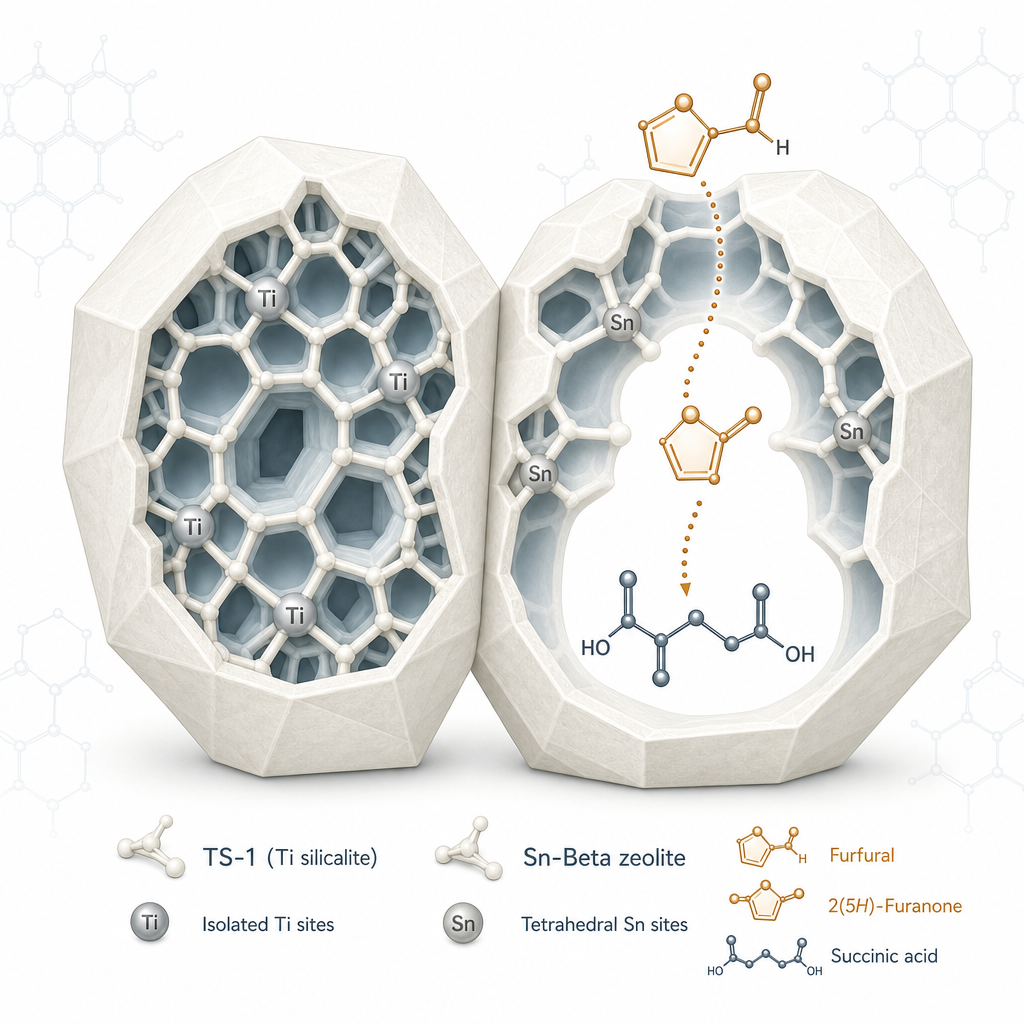 The key result is that Sn-Beta directs the oxidation pathway toward succinic acid via Baeyer–Villiger oxidation of furfural, in clear contrast to TS-1, which favors ring-opening to maleic acid. The Sn-Beta catalyst converted furfural in aqueous H2O2 and produced succinic acid as the dominant C4 product, while losing one carbon as formic acid through oxidative cleavage of the formyl group. The authors identified 2(5H)-furanone (and its tautomer 2(3H)-furanone, calibrated against the commercial 2(5H)-furanone standard) as the key intermediate, supporting a Baeyer–Villiger mechanism in which the furan ring is preserved through migration before subsequent hydrolysis and oxidation steps. Pyridine-IR confirmed Lewis-acidic Sn sites in the beta framework, and DRIFTS showed adsorption modes of furfural consistent with activation at the Sn center. Tuning the Sn loading around 2 wt% balanced active-site density with framework integrity. The work also addresses long-standing concerns about catalyst regenerability: unlike polymeric resins or sulfonated carbons, the Sn-Beta zeolite can in principle be calcined to remove humins and restore activity, an important practical advantage over Amberlyst-15 and sulfonated graphene oxide.
The findings open a heterogeneous, regenerable catalytic route to bio-succinic acid that fits the broader push toward carbon-neutral chemical manufacturing. Bio-succinic acid feeds the synthesis of polybutylene succinate (PBS), succinate plasticizers, 1,4-butanediol, γ-butyrolactone, and tetrahydrofuran, so an improved catalytic option has implications across biodegradable plastics, green solvents, and pharmaceutical intermediates. The mechanistic clarity — separating Baeyer–Villiger oxidation on Sn-Beta from ring-opening on TS-1 — also gives catalyst designers a clear handle for tuning selectivity in furan oxidations, including ongoing work on maleic acid, fumaric acid, and 2,5-furandicarboxylic acid (FDCA) chemistries from furfural and HMF feedstocks.
For researchers working on Lewis-acid zeolite catalysis, biomass valorization, or selective furan oxidations, the TS-1 used as a comparison standard in this study is available from ACS Material's molecular sieves catalog, alongside Sn-Beta-relevant precursors such as Beta zeolite and other framework materials. Reliable, consistent zeolite reference samples are essential when comparing intrinsic activity and selectivity between Lewis-acidic frameworks, and the use of a commercially sourced TS-1 in this peer-reviewed study supports its role as a reproducible benchmark for related catalysis research.How ACS Material products were used
- Titanium Silicalite-1 (TS-1) (Molecular Sieves) — “TS-1 was purchased from ACS Material and used without modification.”
Product Performance in this StudyTS-1 from ACS Material served as a benchmark Lewis acidic zeolite for comparison with the authors' Sn-Beta catalyst in furfural oxidation. Consistent with prior reports, TS-1 directed furfural oxidation toward maleic acid rather than succinic acid, providing crucial mechanistic contrast that highlighted the unique selectivity of Sn-Beta.
Related product categories
Frequently asked questionsWhat is TS-1 zeolite used for in furfural oxidation research?
TS-1 (Titanium Silicalite-1) is a Lewis-acidic zeolite with framework Ti4+ sites that is widely used as a benchmark catalyst in furfural oxidation studies with aqueous H2O2. In this work it served as a reference catalyst, producing maleic acid as the main product, which contrasted with Sn-Beta directing oxidation to succinic acid. This comparison is essential for attributing selectivity differences to the specific metal center rather than to generic Lewis acidity.
How does Sn-Beta zeolite selectively produce succinic acid from furfural?
Sn-Beta contains isolated Sn4+ Lewis-acid sites in a beta framework that activate H2O2 to perform Baeyer–Villiger oxidation on furfural. The reaction proceeds through 2(5H)-furanone and 2(3H)-furanone intermediates, with the formyl carbon eliminated as formic acid. The preserved C4 backbone is then further oxidized and hydrolyzed to succinic acid, giving selectivity that is not achieved over TS-1 or simple SnO2 catalysts.
Why is heterogeneous catalysis preferred for bio-succinic acid production?
Heterogeneous catalysts such as Sn-Beta zeolite can be filtered, washed, and reactivated by calcination to remove humins, which is impossible for organic-framework catalysts like Amberlyst-15 or sulfonated graphene oxide. They also avoid the high operating cost of bacterial fermentation. Combined with biomass-derived furfural feedstock from pentose dehydration, robust Lewis-acid zeolites offer a scalable, regenerable route to bio-succinic acid for biodegradable polymers and platform chemicals.