-
TS-1 Zeolite for Propylene Epoxidation — Åbo Akademi, 2021
Jul 10, 2026 | ACS MATERIAL LLCAlvear, M., Eranen, K., & Murzin, D. (2021). Study of the product distribution in the epoxidation of propylene over TS-1 catalyst in a trickle-bed reactor. *Industrial & Engineering Chemistry Research*. https://doi.org/10.1021/acs.iecr.0c06150
Industrial & Engineering Chemistry Research · 2021
Åbo Akademi researchers used ACS Material TS-1 zeolite in a trickle-bed reactor for propylene epoxidation, achieving ~80% conversion and 150 h stability.
About this research
Researchers at Åbo Akademi University used Titanium Silicalite-1 (TS-1, type B) supplied by ACS Material to study propylene epoxidation with aqueous hydrogen peroxide in a continuous laboratory trickle-bed reactor, mapping out a broad operating window (25–80 °C, 2.5–8.5 bar) and reaching propylene conversions near 80% with propylene oxide selectivity above 99% under optimized conditions. Published in Industrial & Engineering Chemistry Research (2021) by Alvear, Eränen, Murzin, and Salmi of the Johan Gadolin Process Chemistry Centre, the work provides one of the more systematic continuous-flow datasets for this industrially important reaction and closely examines the side reactions that generate 1-methoxy-2-propanol and propylene glycol.
Propylene oxide (PO) is a high-volume chemical intermediate used in polyether polyols, propylene glycol, and surfactants. The hydrogen peroxide to propylene oxide (HPPO) route catalyzed by titanium silicalite is now industrial reality, yet most academic studies have focused on batch and semi-batch reactors. Continuous fixed- and trickle-bed operation is essential for understanding long-term catalyst stability, transient behavior, and the consecutive-parallel chemistry that converts the desired epoxide into ring-opened byproducts. By running the reaction continuously in methanol over a commercial TS-1 catalyst, the authors directly address open questions about how temperature, pressure, water content, hydrogen peroxide concentration, and liquid/gas flows partition selectivity between PO and its downstream products.
The ACS Material TS-1 (type B) served as the heterogeneous catalyst at the center of the study. The Methods section states explicitly that "the catalyst, titanium silicalite (TS-1), was provided by ACS material type B." Nitrogen physisorption on a Micromeritics 3 Flex instrument gave a Dubinin–Radushkevich specific surface area of 450 m²/g, an average pore size of 6.6 nm, and a pore volume of 0.42 cm³/g. The catalyst bed contained 1 g of TS-1 mixed with quartz beads in a 1:20 weight ratio, sieved to 125–250 μm particles to suppress internal mass-transfer limitations. The bed was housed in a 15 mm × 340 mm tube, fed by an Agilent 1100 HPLC pump for the methanol/H2O2/water liquid phase and a Brooks mass flow controller for propylene diluted in helium/N2. An Equilibar back-pressure regulator and a gas–liquid separator delivered samples to an Agilent 6890N gas chromatograph for on- and off-line analysis.
The TS-1 catalyst delivered consistently strong performance. Two 24 h time-on-stream experiments, bracketing 37 parameter-variation runs, showed no measurable change in either activity or selectivity over more than 150 h of continuous operation. Total pressure varied from 2.5 to 8.5 bar at 25 °C produced a maximum propylene conversion of approximately 80% at 4.5 bar, with PO selectivity remaining very high and changing by less than ~0.5% across the pressure range. Temperature scans revealed a rate maximum near 40 °C: above 50 °C, hydrogen peroxide decomposition rose sharply and propylene conversion fell, while selectivity also dropped because 1-methoxy-2-propanol formation (higher activation energy) overtook epoxidation and became dominant at 80 °C. The highest PO selectivity was observed at the lowest temperature, 25 °C. Water content (20–50 wt %) had a dual effect: up to 20 wt % activity was preserved, but above 30 wt % the conversion fell, suggesting competitive water adsorption on the active sites; conversely, higher water suppressed 1-methoxy-2-propanol formation, making PO the main product again, with propylene glycol appearing as a secondary ring-opened product. Increasing H2O2 from 1 to 4 wt % raised conversion but reduced PO selectivity. Liquid flow rate had a strong effect: at 1 mL/min, PO selectivity reached approximately 99.3%, while at 0.5 mL/min selectivity dropped to ~87.4%, consistent with longer residence times promoting consecutive ring-opening.
These findings have direct relevance for HPPO process design. The confirmed consecutive-parallel reaction scheme — propylene → propylene oxide → 1-methoxy-2-propanol (with methanol) and propylene glycol (with water) — gives process engineers concrete levers: keep water content moderate, keep residence times short, operate near 25–40 °C, and limit H2O2 excess to maximize PO yield. The demonstrated 150 h on-stream stability of the commercial TS-1 also supports the use of trickle-bed configurations for pilot and industrial scale-up. Beyond propylene oxide, the methodology and quantitative product distribution data inform other titanium silicalite-catalyzed oxidations, including cyclohexanone ammoximation, phenol hydroxylation, and selective oxidations of bulkier olefins.
For researchers working on zeolite catalysis, HPPO chemistry, and continuous-flow reactor engineering, the TS-1 grade used in this study is available from ACS Material as part of its molecular sieves catalog. The same catalyst is suitable for laboratory benchmarking of new reactor configurations, kinetic modeling, and comparative studies of modified or metal-loaded titanium silicalites where a reproducible, well-characterized commercial reference material is needed.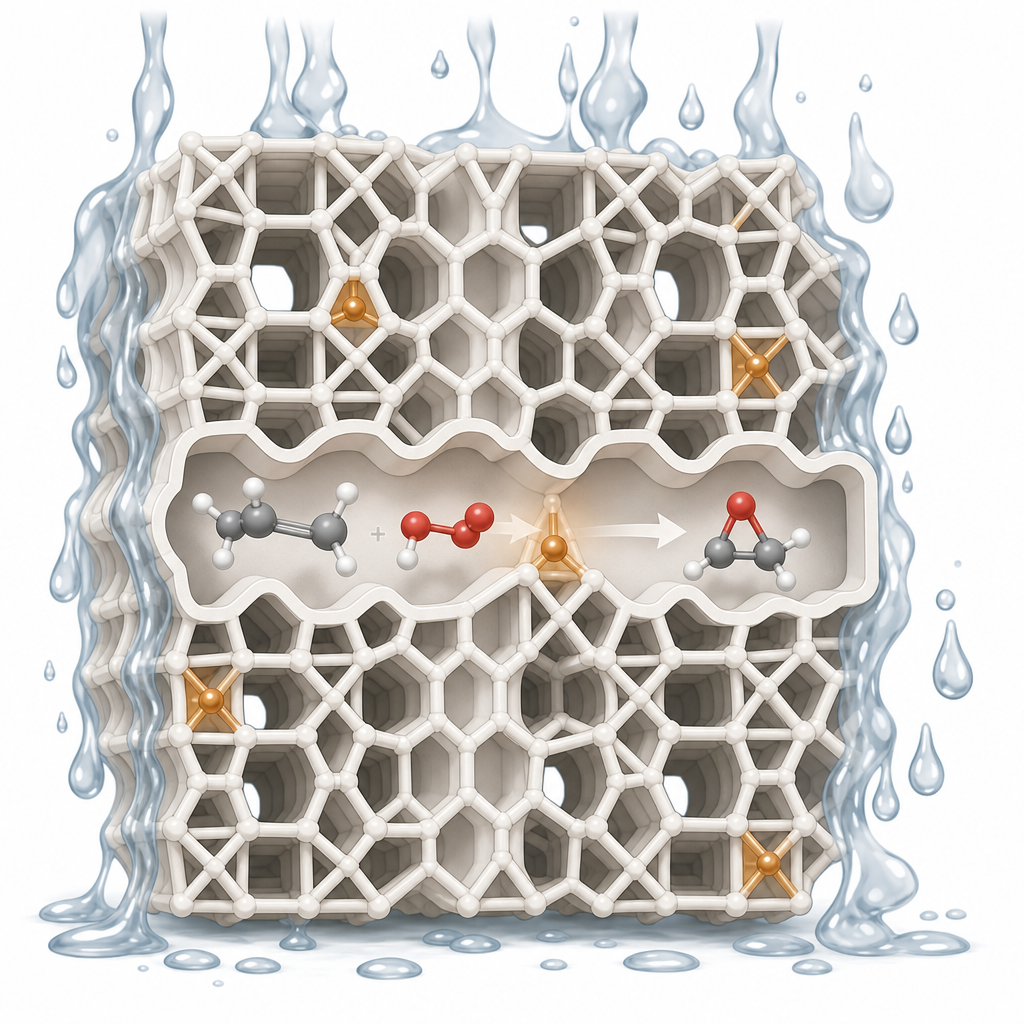
How ACS Material products were used
- Titanium Silicalite-1 (TS-1) (Molecular Sieves) — “The catalyst, titanium silicalite (TS-1), was provided by ACS material type B.”
Product Performance in this Study
The TS-1 catalyst from ACS Material (type B, 450 m²/g surface area, 6.6 nm average pore size, 0.42 cm³/g pore volume) showed excellent stability for over 150 h time-on-stream with no measurable deactivation, and delivered propylene conversions up to ~80% with very high propylene oxide selectivity under optimized conditions.
Related product categories
Frequently asked questions
What is TS-1 zeolite used for in propylene epoxidation research?
Titanium Silicalite-1 (TS-1) is the benchmark heterogeneous catalyst for the HPPO process, which converts propylene and hydrogen peroxide into propylene oxide with high selectivity. Its framework titanium sites activate H2O2 to form a Ti-OOH species that delivers oxygen to propylene. Researchers use TS-1 to study reaction kinetics, side-product formation, catalyst stability, and reactor design, particularly in continuous fixed- and trickle-bed configurations.
How stable is commercial TS-1 catalyst under continuous trickle-bed operation?
In this Åbo Akademi study, commercial TS-1 (type B) operated for more than 150 hours of time-on-stream in a trickle-bed reactor at 40 °C and 4.5 bar without any detectable change in propylene conversion or product selectivity. Two 24-hour stability tests bracketing 37 parameter-variation experiments confirmed reproducibility, demonstrating that commercial TS-1 is robust enough for long-duration kinetic studies and pilot-scale evaluation.
Why does water content affect propylene oxide selectivity over TS-1?
Water plays a dual role on TS-1. It competes with reactants for adsorption sites, reducing conversion above approximately 30 wt %, and it acts as a ring-opening agent that converts propylene oxide to propylene glycol. However, higher water also suppresses the methanol-driven ring-opening to 1-methoxy-2-propanol. Net result: increasing water shifts the byproduct distribution and keeps propylene oxide as the dominant product, but at the cost of overall activity.