-
Voltage-Activated rGO NO2 Sensor — UW-Milwaukee, 2014
Jun 18, 2026 | ACS MATERIAL LLCCui, S. et al. (2014). Ultrasensitive chemical sensing through facile tuning defects and functional groups in reduced graphene oxide. *Analytical Chemistry*. https://doi.org/10.1021/ac501274z
University of Wisconsin-Milwaukee · Analytical Chemistry · 2014
University of Wisconsin-Milwaukee researchers used ACS Material graphene oxide to build voltage-activated rGO sensors detecting NO2 down to 50 ppb.
About this research
Researchers at the University of Wisconsin-Milwaukee used ACS Material single-layer graphene oxide (GO) water dispersion as the precursor for an ultrasensitive NO2 gas sensor that detects concentrations as low as 50 ppb after a simple voltage-activation step. Published in Analytical Chemistry in 2014 by Cui, Pu, and co-workers in Junhong Chen's group, the paper demonstrates that applying a short DC voltage across drop-cast reduced graphene oxide (rGO) intentionally introduces defects and oxygen functionalities, raising sensitivity by 500% over the as-prepared rGO. The work establishes a low-cost route to engineer rGO sensing layers without complex post-processing.
Why this research matters: detecting toxic gases such as nitrogen dioxide at sub-ppm levels is essential for environmental monitoring, industrial safety, and defense applications. Conventional metal-oxide sensors require elevated temperatures and consume significant power, while pristine graphene devices, although low-noise and low-power, often lack the chemical activity needed to capture analytes at very low concentrations. Defect-engineered and oxygen-functionalized graphene materials have emerged as promising candidates because pits, edges, and epoxide or ether groups provide preferred adsorption sites for polar analytes. However, deliberately tuning these features in a controlled, scalable manner remained an open challenge. The reported voltage-activation strategy directly addresses this gap and aligns with broader efforts in 2D-material gas sensing, wearable environmental sensors, and low-power IoT chemical detection.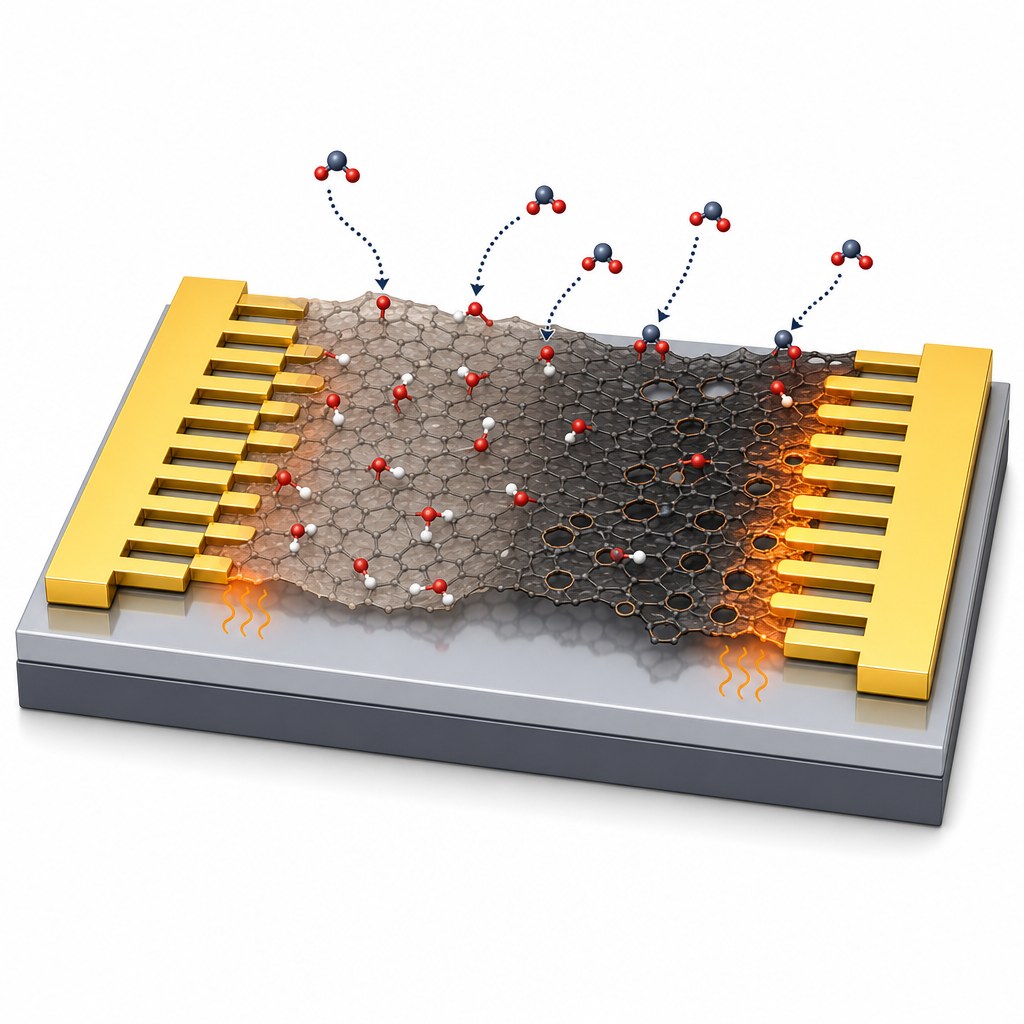
How the ACS Material product was used: the team began with a diluted commercial single-layer graphene oxide water dispersion supplied by ACS Material. As stated in the Experimental Section, "The rGO was obtained by chemically reducing a diluted commercial single layer GO water dispersion (ACS Material) using our previously reported method." The GO (1 mg in 25 mL) was chemically reduced with hydroxylamine hydrochloride at 80 °C for 30 hours, then filtered, rinsed, and redispersed in DMF by 2 h of sonication. A 1 μL droplet of the resulting 0.05 mg/mL rGO dispersion was drop cast onto interdigitated gold electrodes patterned on a SiO2/Si substrate by e-beam lithography. The device was annealed at 200 °C in argon to remove DMF residues. Voltage activation was then carried out by stepping a DC bias across the rGO film in room air in 5 V increments up to 40 V, with each step held for 1 minute, inducing controlled Joule heating, defect formation, and additional oxygen functionalization.
Key results: SEM images before and after activation revealed pronounced morphological changes, with breakdown regions and etch pits forming near the gold contacts and mid-gap. Resistance increased monotonically with applied voltage, climbing from 6.1 × 10^4 Ω in the original rGO to 1.4 × 10^7 Ω after activation at 90 V — three orders of magnitude higher — in stark contrast to thermally reduced GO under inert atmosphere, which shows decreased resistance. Temperature estimates indicated the rGO reached approximately 400 °C at 30 V and around 450 °C at 40 V. Synchrotron infrared microspectroscopy at the IRENI beamline showed that epoxide groups (C–O–C asymmetric/symmetric stretching at ~1200 cm⁻¹) and ether groups (~883 cm⁻¹) increased after voltage activation rather than being removed. For NO2 sensing, the voltage-activated rGO exhibited a sensitivity 500% higher than untreated rGO, and the lower detection limit reached 50 ppb — the lowest reported for any rGO-based NO2 sensor at the time of publication. Density functional theory (DFT) calculations attributed the enhanced response to efficient charge transfer from ether groups to adsorbed NO2 molecules, identifying ether functionalities as the dominant sensing motif.
Applications and outlook: the voltage-activation approach offers a route to high-performance, room-temperature graphene gas sensors for air-quality monitoring, automotive exhaust detection, industrial leak detection, and wearable environmental sensors. Because the technique relies on electrical pulses applied to as-fabricated devices, it is compatible with on-chip post-processing and can be combined with other rGO-based platforms such as biosensors and flexible electronics. The authors note that the same method could be used to dope additional elements into the graphene basal plane, broadening the chemistry available for selective detection of NH3, H2S, volatile organic compounds, and other analytes. Further work could explore selectivity engineering, humidity tolerance, and integration with CMOS readout circuits.
Why this matters for researchers: this paper highlights the importance of high-quality, single-layer graphene oxide as a reproducible starting material for sensor research. The single-layer GO dispersion from ACS Material's graphene series, along with related reduced graphene oxide and functionalized graphene products, is available to researchers working on chemiresistive sensors, defect engineering of 2D materials, and electrochemical platforms. Consistent flake size, layer count, and oxidation level make it easier to compare device performance across studies and to translate laboratory results toward scalable sensor manufacturing.How ACS Material products were used
- Single Layer Graphene Oxide Dispersion (Graphene Series) — “The rGO was obtained by chemically reducing a diluted commercial single layer GO water dispersion (ACS Material) using our previously reported method.”
Product Performance in this StudyThe ACS Material single-layer graphene oxide water dispersion served as the precursor for chemically reduced graphene oxide (rGO), which after voltage activation became the active sensing layer with 500% higher NO2 sensitivity and a 50 ppb detection limit.
Related product categories
Frequently asked questionsHow is single-layer graphene oxide used to build NO2 gas sensors?
Single-layer graphene oxide dispersions are chemically reduced to rGO, then drop cast across interdigitated electrodes to form a conductive sensing channel. NO2 molecules adsorb onto defects and oxygen functional groups, withdrawing electrons and changing the device resistance. Using single-layer GO ensures high surface-to-volume ratio and reproducible flake thickness, which directly improves baseline conductance and chemical response in the resulting reduced graphene oxide sensor.
Why do epoxide and ether groups improve rGO sensitivity to NO2?
Density functional theory calculations in this study show that ether groups on the rGO basal plane donate charge efficiently to adsorbed NO2 molecules, producing a strong resistance change. Epoxide groups create local polar sites and lattice strain that further stabilize NO2 adsorption. Together they act as preferred binding centers, which is why voltage activation that increases epoxide and ether content boosts sensitivity by 500%.
What detection limit can voltage-activated reduced graphene oxide reach for NO2?
The voltage-activated rGO sensor in this work detects NO2 at concentrations as low as 50 ppb, which at the time was the lowest detection limit reported for an rGO-based chemiresistive sensor. The improvement comes from defects and pits formed by Joule heating during voltage activation, combined with an increase in epoxide and ether functional groups that provide efficient charge-transfer adsorption sites for NO2 molecules.