-
ZSM-5 and MCM-41 for Wheat Straw Pyrolysis - Riga Technical University, 2015
Jun 17, 2026 | ACS MATERIAL LLCLazdovica, K., Liepina, L., & Kampars, V. (2015). Comparative wheat straw catalytic pyrolysis in the presence of zeolites, Pt/C, and Pd/C by using TGA-FTIR method. *Fuel Processing Technology*. https://doi.org/10.1016/j.fuproc.2015.07.005
Fuel Processing Technology · 2015
Researchers at Riga Technical University used ZSM-5 and MCM-41 from ACS Material to compare zeolite and noble-metal catalysts in wheat straw catalytic pyrolysis.
About this research
Researchers at Riga Technical University used ZSM-5 and MCM-41 catalysts purchased from ACS Material to compare zeolite and noble-metal pathways for upgrading wheat straw pyrolysis vapors, finding that all tested catalysts raised biomass conversion to 72.2–79.6% while only the noble metals strongly deoxygenated carbonyl, carboxyl, and hydroxyl species. The study, published in Fuel Processing Technology, applies a coupled thermogravimetric analyzer and Fourier-transform infrared spectrometer (TGA-FTIR) to track the evolution of volatiles in real time. It establishes a clear functional split: zeolites tune volatile composition through cracking, while Pt/C and Pd/C reshape both composition and the temperature profile of volatile release.
Bio-oil derived from biomass pyrolysis is a complex mixture of acids, ketones, aldehydes, phenols, hydrocarbons, and water. Its high oxygen content drives corrosiveness, instability, and poor heating value, so practical use as a transportation fuel requires deoxygenation. Catalytic pyrolysis, performed in-bed with acidic zeolites or supported metals, is the most studied route to lower the oxygen content of pyrolysis vapors before condensation. ZSM-5 has been the workhorse for converting cellulose- and hemicellulose-derived oxygenates into aromatics and light olefins, while mesoporous MCM-41 offers larger pores (20–300 Å) and higher surface area for bulkier lignin fragments. Noble-metal catalysts such as Pt/C and Pd/C are typically reserved for hydrotreating, but their role in non-hydrogen pyrolysis atmospheres is less well defined. This paper directly compares all four families on a single lignocellulosic feedstock.
The ACS Material ZSM-5 used here had a BET surface area of 321 m²/g, micropore surface area of 301 m²/g, total pore volume of 0.18 cm³/g, particle size around 2 μm, and a Si/Al ratio of 70. The ACS Material MCM-41 had a BET surface area of 856 m²/g, total pore volume of 0.49 cm³/g, micropore surface area of 707 m²/g, and particle sizes of 0.1–0.9 μm. Both catalysts were dried for 5 h at 105 °C and stored in a desiccator before use. For each TGA-FTIR run, 32 mg of milled, sieved wheat straw (0.15–1.0 mm particle size) was physically mixed with 32 mg of catalyst, then heated from 30 to 700 °C at 100 °C/min in a 20 ml/min nitrogen stream and held for 10 min at the final temperature. Pt/C and Pd/C, each at 5 wt% metal loading and sourced separately, were tested under identical conditions and were not pre-reduced in hydrogen, isolating the intrinsic catalytic effect under inert pyrolysis conditions.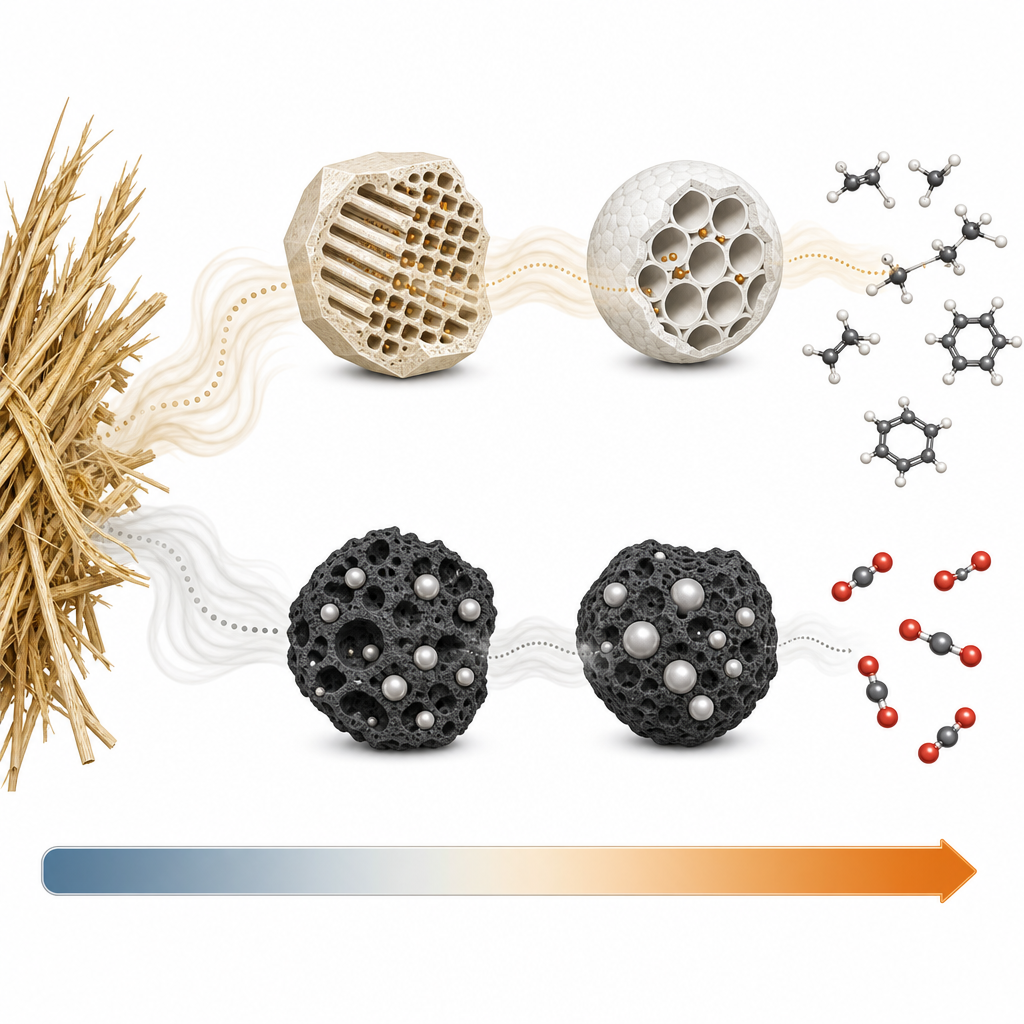
The non-catalytic baseline gave a wheat straw conversion typical of cellulose/hemicellulose/lignin co-pyrolysis. Adding catalyst increased conversion across the board to 72.2–79.6%. Beyond conversion, the FTIR-tracked composition of evolved volatiles diverged sharply between the two catalyst families. ZSM-5 and MCM-41 modified the composition of the gases — suppressing some oxygenates and promoting hydrocarbons via cracking and dehydration — but left the absorption versus temperature profile of each volatile largely intact. By contrast, Pt/C and Pd/C changed both the composition and the temperature window over which each volatile evolved, indicating that the metal sites alter reaction pathways rather than just selecting among existing ones. Quantitatively, the noble metals were more effective deoxygenation catalysts for compounds carrying carbonyl, carboxyl, and hydroxyl groups, consistent with decarbonylation and decarboxylation activity on Pt and Pd surfaces even without an added hydrogen atmosphere. The authors note that this is a useful finding because pretreatment with H2 has been a usual prerequisite in earlier noble-metal upgrading work. The mesoporous MCM-41 channels also accommodated bulkier lignin-derived intermediates that struggle to enter ZSM-5 micropores.
The practical message for bio-refinery design is that catalyst choice determines which oxygen-removal mechanism dominates: zeolites lean toward dehydration and cracking, generating aromatics and light olefins from cellulose and hemicellulose fragments; noble metals on carbon enable decarbonylation and decarboxylation, cleanly stripping CO and CO2 from carbonyl- and carboxyl-bearing intermediates. The findings inform catalyst selection for upgrading condensable pyrolysis vapors from agricultural residues such as wheat straw, corn stover, or rice husk into transport-fuel precursors and platform chemicals. Future work pointed to by the authors includes combining the two catalyst families in series or as bifunctional formulations, and exploring regeneration via supercritical CO2 extraction for the noble-metal catalysts and conventional calcination for the zeolites.
For researchers working on biomass catalytic pyrolysis, both ZSM-5 and MCM-41 used in this study are available from ACS Material with the textural parameters reported above, alongside related microporous and mesoporous frameworks such as SBA-15, beta zeolite, SAPO-34, and Al-MCM-41. The catalyst comparison approach demonstrated here — pairing TGA-FTIR with well-characterized commercial catalysts — gives a reproducible benchmark that other groups can adapt when screening cracking, deoxygenation, or hydrotreating catalysts on lignocellulosic feedstocks.How ACS Material products were used
- MCM-41 mesoporous silica (Molecular Sieves) — “MCM-41 (BET surface area, 856 m2/g; total pore volume, 0.49 cm3/g; micropore volume, 0.25 cm3/g; micropore surface area, 707 m2/g; particle size = 0,1-0,9 μm) catalysts used in this study were purchased from a commercial supplier ACS Material.”
- ZSM-5 Zeolite (Molecular Sieves) — “The zeolite ZSM-5 (BET surface area, 321 m2/g; total pore volume, 0.18 cm3/g; micropore volume, 0.11 cm3/g; micropore surface area, 301 m2/g; particle size, 2 μm; Si/Al:70) and MCM-41 ... catalysts used in this study were purchased from a commercial supplier ACS Material.”
Product Performance in this StudyZSM-5 increased wheat straw conversion and changed the composition of pyrolysis volatiles, although it did not alter absorption-spectra profiles over temperature like the noble-metal catalysts did.
Related product categories
Frequently asked questionsHow do ZSM-5 and MCM-41 affect wheat straw pyrolysis volatiles?
In this TGA-FTIR study, ZSM-5 and MCM-41 zeolites raised wheat straw conversion to 72.2–79.6% and changed the composition of evolved volatiles by promoting cracking and dehydration. However, both zeolites left the absorption-versus-temperature profile of each volatile largely unchanged, meaning they selected among existing reaction products rather than opening new pathways, in contrast to Pt/C and Pd/C which altered both composition and release temperature.
Why use MCM-41 instead of ZSM-5 for lignocellulose pyrolysis?
MCM-41 offers mesopores of 20–300 Å and a BET surface area near 856 m²/g, much higher than ZSM-5 micropores. Bulky lignin-derived intermediates that cannot enter ZSM-5 channels can diffuse into MCM-41 and access acidic cracking sites. In the wheat straw study, MCM-41 from ACS Material delivered conversion comparable to ZSM-5 while accommodating larger oxygenated fragments, complementing microporous zeolites in bio-oil upgrading.
Why is TGA-FTIR useful for biomass catalytic pyrolysis studies?
TGA-FTIR couples thermogravimetric mass loss with continuous infrared identification of evolved volatiles. This pairing tells researchers both how much biomass converted at each temperature and which functional groups appear in the gas phase. In the wheat straw work, TGA-FTIR revealed that noble-metal catalysts shifted release temperatures of carbonyl, carboxyl, and hydroxyl species, while zeolites only changed composition without shifting their evolution windows.