-
ZSM-5 & MCM-41 Catalytic Pyrolysis of Wheat Bran - Riga Technical University, 2016
Jun 02, 2026 | ACS MATERIAL LLCLazdovica, K., Liepina, L., & Kampars, V. (2016). Catalytic pyrolysis of wheat bran for hydrocarbons production in the presence of zeolites and noble-Metals by using TGA-FTIR method. *Bioresource Technology*. https://doi.org/10.1016/j.biortech.2016.01.117
Bioresource Technology · 2016
Riga Technical University used ACS Material ZSM-5 and MCM-41 zeolites to catalytically pyrolyze wheat bran, boosting aliphatic and olefin hydrocarbon yields.
About this research
Researchers at Riga Technical University (Institute of Applied Chemistry, Latvia) used ZSM-5 zeolite and MCM-41 mesoporous silica supplied by ACS Material, together with 5% Pt/C and 5% Pd/C, to catalytically pyrolyze wheat bran in a coupled TGA-FTIR system, demonstrating that zeolites promote aliphatic and olefin hydrocarbon formation while noble-metal catalysts favor aromatics and oxygen removal. The work, published in Bioresource Technology (2016) by Lazdovica, Liepina, and Kampars, quantifies the catalyst-specific shifts in volatile matter, solid residue, and the chemical families produced during biomass thermal conversion. The comparative design isolates the role of catalyst type on deoxygenation and deamination pathways relevant to producing higher-quality bio-oils from agricultural by-products.
Bio-oils derived from biomass pyrolysis are attractive renewable feedstocks but suffer from high oxygen content, corrosiveness, instability, and, in nitrogen-rich feedstocks such as wheat bran, significant N-containing impurities. Catalytic upgrading of pyrolysis vapors is the most direct way to address these issues without separate hydrotreating steps. ZSM-5 and HZSM-5 zeolites have long been recognized for deoxygenation and aromatics formation, while mesoporous silicas such as MCM-41 provide larger pores suitable for bulky lignin- and cellulose-derived intermediates. By benchmarking microporous (ZSM-5) and mesoporous (MCM-41) frameworks alongside carbon-supported precious metals, the authors map how pore architecture and acidity control which functional groups, carbonyl, carboxyl, hydroxyl, or amine, are preferentially removed. This is directly relevant to converting low-value agricultural residues into transportation fuels and value-added chemicals.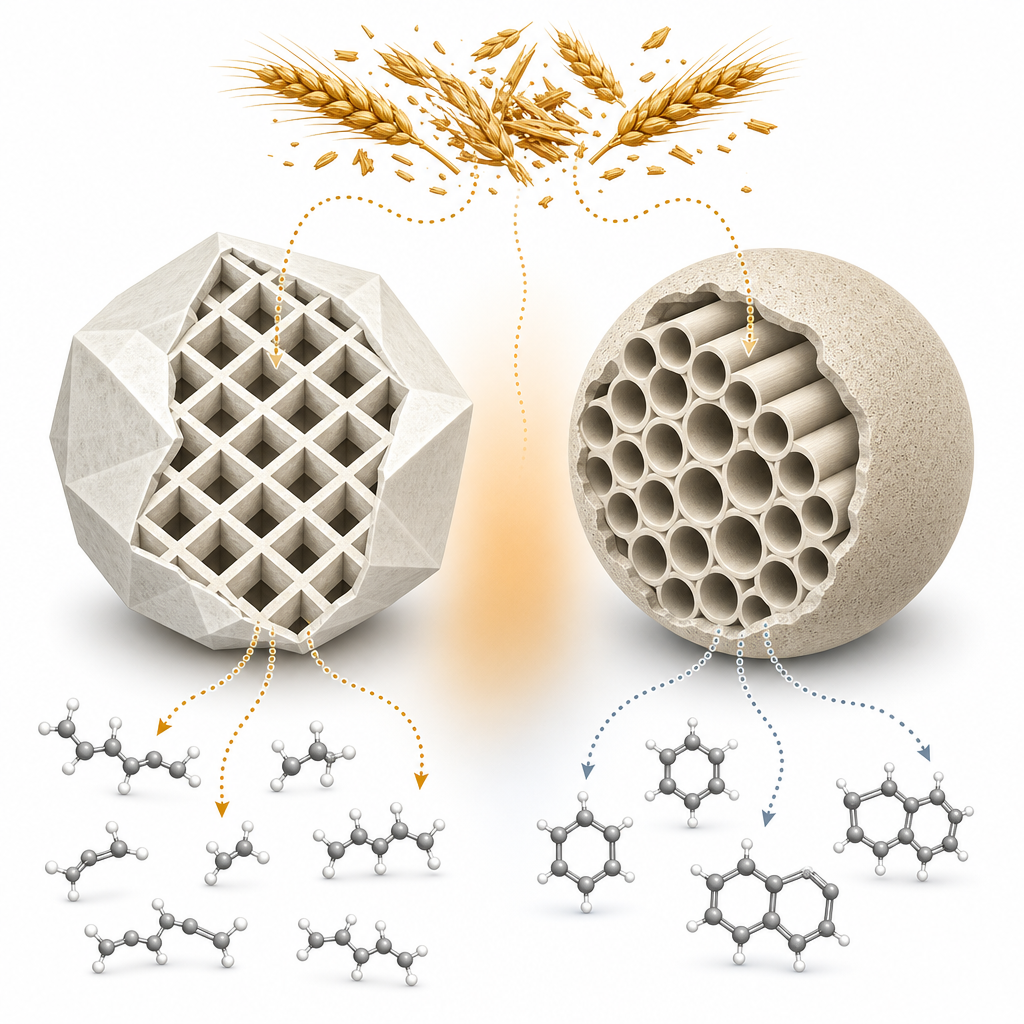
The ZSM-5 supplied by ACS Material had a BET surface area of 321 m²/g, total pore volume of 0.18 cm³/g, micropore volume of 0.11 cm³/g, particle size of about 2 μm, and Si/Al ratio of 70. The MCM-41 from ACS Material had a much higher BET surface area of 856 m²/g, total pore volume 0.49 cm³/g, and particle size between 0.1 and 0.9 μm. Both catalysts were dried at 105 °C for 5 h and stored in a desiccator before use. In each TGA-FTIR run, 32 mg of wheat bran was physically mixed with 32 mg of catalyst, then heated from 30 to 700 °C at 100 °C/min in a pure nitrogen flow of 20 mL/min and held for 10 min. A PerkinElmer STA 6000 thermogravimetric analyzer was coupled to a PerkinElmer Spectrum 100 FTIR through a heated TL8000 transfer line maintained at 230 °C to suppress condensation of semi-volatiles. FTIR spectra were collected every 9 s between 4000 and 650 cm⁻¹ at 4 cm⁻¹ resolution, allowing the evolution profiles of individual functional groups to be tracked against catalyst type. Quartz sand served as the inert reference matrix in non-catalytic experiments.
All four catalysts decreased the volatile-matter yield and increased the solid residue. Volatile matter dropped from the non-catalytic 76.3% to 75.9% with ZSM-5, 73.9% with 5% Pd/C, 73.5% with MCM-41, and 69.7% with 5% Pt/C, while solid residue rose from 18.0% to 18.4%, 20.4%, 20.8%, and 24.6%, respectively. Noble-metal catalysts displayed the strongest deoxygenation activity for compounds carrying carbonyl, carboxyl, and hydroxyl groups, evidenced by attenuation of the corresponding FTIR absorptions, and they promoted formation of aromatic hydrocarbons while changing the temperature profile of evolved species. ZSM-5 and MCM-41, in contrast, drove the product slate toward aliphatic and olefinic hydrocarbons and were more effective at degrading nitrogen-containing intermediates derived from wheat bran's protein content (the feedstock contained 2.78 wt% nitrogen and 39.75 wt% oxygen on a dry basis). The data confirm that pore geometry and Brønsted acidity in the zeolites favor cracking and oligomerization toward small olefins, whereas Pt and Pd sites accelerate hydrogenation and aromatization pathways.
The findings inform catalyst selection for upgrading pyrolysis vapors from nitrogen-rich agricultural residues such as wheat bran, straw, manure, and even microalgae, where deamination is as important as deoxygenation. Combining ZSM-5 or MCM-41 with a hydrogenation-active metal could yield bio-oils with both reduced oxygen content and tunable aromatic-to-aliphatic ratios, supporting downstream blending into transportation fuels or use as renewable chemical feedstocks. The TGA-FTIR protocol described here is also a cost-effective screening platform that other groups can adopt before committing to fixed-bed or Py-GC/MS studies, accelerating the development of catalytic fast pyrolysis processes for diverse lignocellulosic and protein-containing biomass.
For researchers working on biomass valorization, this paper documents quantitative, side-by-side performance data for two widely used porous solids that ACS Material supplies as standard catalogue items: ZSM-5 zeolite and MCM-41 mesoporous silica. Both materials are stocked in research quantities with the textural specifications reported here, making it straightforward to reproduce or extend this comparative pyrolysis study with other feedstocks, modified Si/Al ratios, or impregnated metal centers.How ACS Material products were used
- MCM-41 mesoporous silica (Molecular Sieves) — “MCM-41 (BET surface area, 856 m2/g; total pore volume, 0.49 cm3/g; micropore volume, 0.25 cm3/g; micropore surface area, 707 m2/g; particle size = 0.1–0.9 μm) catalysts used in this study were purchased from a commercial supplier ACS Material.”
- ZSM-5 zeolite (Si/Al = 70) (Molecular Sieves) — “The zeolite ZSM-5 (BET surface area, 321 m2/g; total pore volume, 0.18 cm3/g; micropore volume, 0.11 cm3/g; micropore surface area, 301 m2/g; particle size, 2 μm; Si/Al:70) and MCM-41 ... catalysts used in this study were purchased from a commercial supplier ACS Material.”
Product Performance in this Study
ZSM-5 reduced the volatile matter yield from 76.3% to 75.9% and increased solid residue to 18.4%, promoting formation of aliphatic and olefin hydrocarbons and aiding degradation of nitrogen-containing compounds during wheat bran pyrolysis.
Related product categories
Frequently asked questions
How does ZSM-5 affect biomass pyrolysis product distribution?
ZSM-5 zeolite shifts pyrolysis vapors toward aliphatic and olefinic hydrocarbons through its strong Brønsted acidity and shape-selective micropores. In wheat bran pyrolysis, ZSM-5 reduced volatile matter from 76.3% to 75.9% and raised solid residue to 18.4%. It also enhanced degradation of nitrogen-containing intermediates derived from protein, making it useful for upgrading bio-oils from nitrogen-rich agricultural feedstocks.
Why is MCM-41 used as a catalyst for biomass pyrolysis?
MCM-41 is a mesoporous silica with a BET surface area near 856 m²/g and pore sizes large enough to accommodate bulky cellulose- and lignin-derived intermediates that cannot enter ZSM-5 micropores. In the wheat bran study, MCM-41 lowered volatile matter to 73.5% and increased solid residue to 20.8%, while promoting aliphatic and olefin formation and assisting deoxygenation of polar functional groups.
What is TGA-FTIR and why is it used in catalytic pyrolysis studies?
TGA-FTIR couples a thermogravimetric analyzer with an infrared spectrometer through a heated transfer line, recording mass loss and the IR spectra of evolved gases simultaneously. This lets researchers correlate temperature, weight loss, and the functional groups in volatile products. In catalytic pyrolysis it is invaluable for screening catalyst effects on deoxygenation, aromatic formation, and nitrogen species evolution without running full Py-GC/MS campaigns.