FDM, SLA, and SLS are the three polymer 3D printing processes you will meet first — and they solve the same problem in three fundamentally different ways: melting a filament, curing a liquid resin with light, and fusing a bed of powder.1 Which one is right depends on what you value: detail, toughness, cost, or freedom from supports. This guide compares them head-to-head across surface quality, materials (including the flexible end of the spectrum), strength and anisotropy, workflow, and cost — and ends with an interactive comparator so you can weigh the trade-offs for your own part.
FDM vs SLA vs SLS at a glance
Swipe horizontally to compare all columns →
| FDM / FFF | SLA / DLP | SLS | |
|---|---|---|---|
| How it builds | Melts and extrudes thermoplastic filament | Cures liquid photopolymer resin with light | Laser-fuses polymer powder, layer by layer |
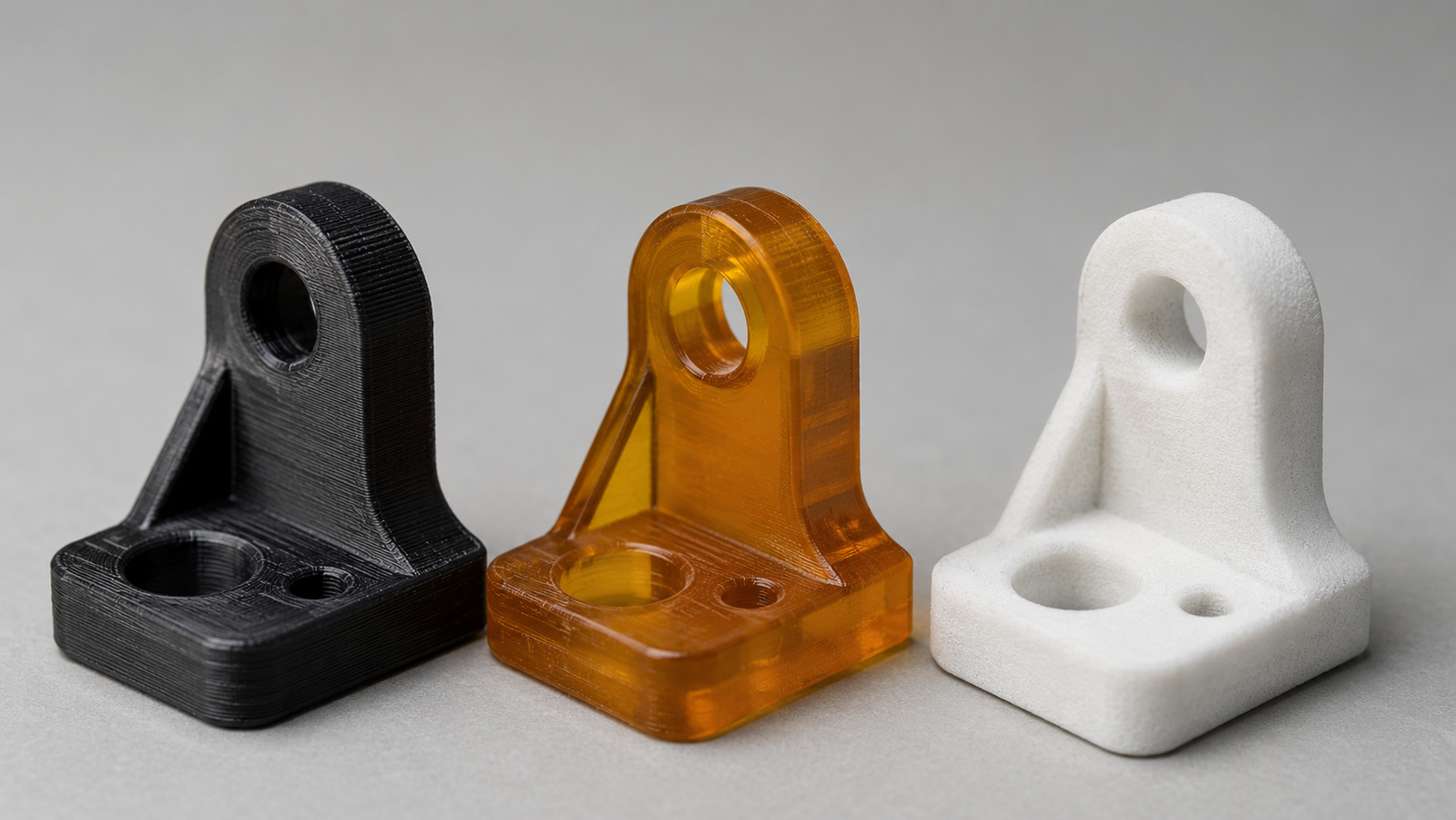
| Signature surface | Visible layer lines, matte | Smooth, near-injection-molded | Slightly grainy, uniform matte |
| Fine detail | Moderate | Excellent | Good |
| Strength character | Tough thermoplastics; weakest across layers | Detail-first; standard resins more brittle | Balanced, closer to isotropic behavior |
| Supports | Printed, removed after | Printed, removed after | Normally none — powder cradles the part |
| Flexible option | TPU filament | Elastomer resins (DLP) | TPU powder |
| Cost profile | Usually the lowest entry cost; often lowest for one-offs | Moderate; resin + post-cure workflow | Higher machine cost; efficient in nested batches |
| Best for | Fast, cheap, tough prototypes and fixtures | Fine-detail models, patterns, elastomer lattices | Durable end-use nylon parts, small batches |
Classification and terminology follow ISO/ASTM 52900.1 The remaining comparisons are synthesized from the fully cited sections below.
What each process actually is
FDM / FFF — fused deposition modeling
A thermoplastic filament is melted in a heated nozzle and drawn across the build plate as a fine bead that welds to the layer below — the process Scott Crump patented in 1992 and the one most people picture when they hear “3D printer.”2 In the ISO/ASTM taxonomy it is the filament branch of material extrusion.1 Because the feedstock is ordinary engineering thermoplastic, FDM parts behave like the plastics you already know — with one important caveat about layer bonding we cover below.
SLA / DLP — vat photopolymerization
A vat of liquid photopolymer is selectively cured by light: a scanning UV laser in stereolithography (SLA, Chuck Hull’s 1986 patent that founded the industry) or a full-layer projected image in DLP, with continuous-interface variants pushing speed further.3,11 Each layer is a chemical reaction rather than a weld, which is why resin parts offer some of the finest feature detail and smoothest as-printed surfaces in mainstream polymer AM — and why their mechanical character is set by resin chemistry rather than by a familiar thermoplastic datasheet.9,10
SLS — selective laser sintering
A thin layer of polymer powder — usually nylon PA12 — is spread across a heated bed, and a laser fuses each cross-section; the surrounding unfused powder supports the part as it grows, so SLS normally requires no separately printed support structures. Carl Deckard patented the principle in 1989.4,12 Powder chemistry and thermal history govern part quality, which is why SLS materials science is a discipline of its own.13,23 All three processes trace back to the same late-1980s founding wave of additive manufacturing.5
Detail and surface finish
If the part must look and feel refined straight off the machine, resin wins. Vat photopolymerization delivers among the finest features and smoothest as-printed surfaces available in mainstream polymer additive manufacturing — crisp text, thin walls, watertight curves — because light can be patterned far more finely than a molten bead can be drawn.9,10 SLS sits in the middle: no layer steps like FDM, but a characteristic fine-grained matte texture from the powder, which many engineers actually prefer for functional parts.12 FDM shows visible layer lines and stair-stepping on shallow slopes; sanding, vapor smoothing, or thoughtful orientation mitigate but never entirely erase them.7,17 Layer thickness tells part of the story — FDM commonly builds at 0.1–0.3 mm layers, SLA/DLP at 0.025–0.1 mm, SLS around 0.1 mm — but Z-resolution alone does not decide perceived quality: sidewall texture, minimum feature size, and how the process renders small holes and sharp edges matter as much. And none of these figures is a dimensional tolerance; what a part actually holds is a separate question of geometry, thermal history, and post-processing, with standardized test artifacts existing precisely to characterize it.17,22 One discipline applies to all three: resolution figures such as layer thickness or pixel pitch are not the same thing as dimensional tolerance — our precision guide unpacks that distinction properly.22
Materials — from rigid workhorses to the flexible end
FDM has the broadest and cheapest palette: PLA and PETG for easy printing, ABS and ASA for toughness and weather, nylon and polycarbonate for engineering duty, fiber-filled grades for stiffness, and high-performance polymers such as PEEK on heated-chamber machines.7,16 A practical shorthand: PLA for looks-fast-cheap, PETG when it must survive the parking lot, ABS/ASA for heat and outdoors, nylon or fiber-filled grades when a fixture earns its keep, PEEK-class polymers only when the duty genuinely demands them. SLA/DLP spans rigid, tough, castable, clear, high-temperature, and ceramic-filled resins — a chemistry-driven menu that keeps expanding.9,10 Read resin datasheets by their verbs: “standard” resins prioritize detail, “tough/durable” grades borrow thermoplastic-like ductility, “castable” burns out clean for investment casting, and high-temperature grades trade impact resistance for heat-deflection numbers. SLS is narrower but deep: PA12 dominates, with PA11 for ductility, filled grades for stiffness, and TPU for flexibility.12,13
The flexible end deserves its own sentence in every comparison, because all three processes reach it by different roads: FDM prints TPU filament (economical, coarser detail), SLS sinters TPU powder into durable flexible parts that normally need no separately printed supports, and DLP cures photopolymer elastomers — the route that produces fine rubber-like lattices with elongations of several hundred percent.19,20 That last branch is the process behind our elastomer 3D printing service; for rigid FDM/SLA/SLS work, treat this article as engineering education — the comparison logic is the same wherever you print.
Strength and anisotropy — the layer-bond question
The defining mechanical fact of FDM is anisotropy: parts are strongest along the deposited roads and weakest across the layer bond. In the classic characterization of FDM ABS, tensile strength across build directions ranged from roughly 65–72% of the injection-molded equivalent, with raster orientation the dominant variable — and orientation studies on PLA show the same story, with upright-printed specimens dramatically weaker than on-edge ones.15,16 Good FDM design is therefore load-path design: orient the layers to carry the stress.
SLS parts behave much closer to isotropic — powder fusion in a hot bed produces more uniform inter-layer bonding — which, together with genuine nylon toughness, is why SLS is commonly selected for functional nylon parts — particularly when nesting without separately printed supports, directional consistency, and batch production matter.12,17 Standard SLA resins trade toughness for detail and can embrittle with UV exposure, though tough, durable, and elastomeric formulations close much of the gap when selected deliberately.9,10,17 Two more axes deserve attention before you lock a process for anything load-bearing: temperature (unfilled thermoplastics and standard resins soften far below their printed appearance suggests) and fatigue (cyclically loaded printed parts fail at the weakest interface — the layer bond in FDM, the notch-sensitive skin in some resins — so design and test for the duty cycle, not just the static datasheet number).17 Whichever process you choose, published figures are supplier-reported typicals measured on standard coupons — not design allowables for your geometry.17
Supports, workflow, and design freedom
FDM and SLA both print sacrificial supports under overhangs and remove them afterward — a design constraint and a labor cost. SLS normally needs no separately printed supports because the surrounding powder cradles the geometry, which unlocks interlocking assemblies, internal channels, and dense nesting of many parts in one build.12 Workflow differs too: many FDM parts are usable at support removal — though sanding, vapor smoothing, annealing, inserts, sealing, or machining may still follow, depending on the application; SLA parts must be washed and post-cured before they reach final properties; SLS parts are excavated from the powder cake, depowdered, and typically bead-blasted.9,17 None of the three is “zero post-processing” — the steps are just different. The operating environments differ too, and it matters for who runs the machine: FDM is comparatively desktop-friendly in footprint and workflow — though enclosure, ventilation, material selection, and exposure control still matter; SLA involves liquid resin handling, gloves, and solvent washing; SLS is an industrial workflow with powder management, sieving, and controlled housekeeping — one reason SLS lives in service bureaus and production floors more than on desks.13,17
Throughput and cost
For a simple one-off part, FDM is usually the lowest-cost starting point — machines from hobby to industrial, inexpensive filament, minimal finishing.7,8 SLA sits in the middle: resin and post-processing add cost, but one machine covers everything from jewelry patterns to dental models. SLS economics work differently — the machine and powder management are the investment, and cost per part falls sharply when a build volume is efficiently nested with many parts, which is why SLS (and its powder-bed siblings) is the small-batch production workhorse.14,17 The honest answer to “which is cheapest” is therefore: cheapest at what quantity, size, and finish requirement — the same total-cost logic that governs all additive manufacturing.8 A useful intuition: at quantity one, the ranking is usually FDM < SLA < SLS. As quantity grows, powder-bed processes become more competitive because many parts nest throughout the build volume without separately printed supports — but the break-even point is project-specific, moving with part size, packing density, material, finishing, machine utilization, and provider pricing. And if the part is large but geometrically simple, FDM often stays cheapest at every quantity. Run the numbers at your real quantity before believing any general claim — including this one.
Beyond the big three: MJF, HSS, and material jetting
The polymer field is wider than its three famous names. Multi Jet Fusion (MJF) and High Speed Sintering (HSS) are agent-assisted powder-bed processes: instead of a scanning laser, inkjet heads print fusing agents across the bed and an infrared source consolidates each full layer — they often process PA12 and related thermoplastic powders — though the qualified material portfolio differs by platform — with different thermal histories and highly competitive part quality at batch throughput.6,14,24 Material jetting cures droplets of photopolymer in flight for outstanding accuracy and multi-material models, at model-shop rather than workhorse economics.18 Between SLS, MJF, and HSS specifically, the choice is application-specific: they share a powder-bed architecture, but can differ in material availability, thermal history, surface appearance, dimensional behavior, throughput, refresh strategy, and economics — comparative PA12 studies find dense, functional parts from both SLS and MJF, with property differences traceable to thermal history and feedstock conditioning.14,24 If you want the full map of all seven ISO/ASTM process families — polymers, metals, and ceramics together — start from our guide to everything you need to know about 3D printing.1
Which process should you use?
Work the decision in order: confirm the material family you need exists for the process; check the part fits the build volume and feature sizes; then weigh detail, strength direction, quantity, finish, and post-processing against budget. More than one of the three is often feasible — the right pick is the one that satisfies the whole requirement set at acceptable cost.7,8,17
- Cheap, fast, tough prototype or fixture → FDM.
- Fine detail, smooth finish, small precise features → SLA/DLP.
- Durable end-use nylon parts, normally no separately printed supports, efficient batch nesting → SLS (or MJF).
- Rubber-like or lattice part → elastomer DLP; TPU by SLS or FDM as alternatives.
- Load in one known direction on a budget → FDM, oriented for the load path.
- Visual model with premium surface → SLA/DLP (or material jetting).
The comparator below applies the same logic interactively — pick what you value most and see how the three processes stack up. Treat it as orientation, not a substitute for engineering review.
Where flexible parts fit in this comparison
Flexible parts stress every axis of this comparison at once: they need detail (lattice struts), durability (cyclic flexing), and material behavior no rigid datasheet describes. Photopolymer elastomers printed by industrial DLP have become the reference route for fine flexible lattices — midsole-style cushioning, compliant robotic structures, seals, and grips — with the soft-matter printing literature documenting how far the property window has moved.19,20,21 When a project lives at that end of the spectrum, the process conversation changes from “FDM vs SLA vs SLS” to hardness, lattice architecture, and rebound — which is exactly the conversation our elastomer 3D printing service is built around, from Shore 60A to 80A on builds up to 768 × 432 × 450 mm. One design habit transfers from the rigid world: material and architecture are chosen together — in lattices especially, unit-cell geometry and relative density move effective stiffness substantially, so a hardness number alone never specifies the part.20,21
FAQ
1. FDM vs SLA — which is better?
Neither, universally. FDM is better where cost, toughness, and speed to a working thermoplastic part matter; SLA is better where fine detail and surface finish matter. The crossover is your requirement list, not the technology.7,9
2. Is SLS stronger than FDM?
Not universally. SLS nylon is often more directionally consistent because it does not rely on discrete extruded roads the way FDM does — the classic FDM ABS data put cross-direction strength at roughly 65–72% of molded, far lower upright.12,15,16 But absolute strength depends on material grade, build orientation, geometry, process parameters, porosity, and the test in question: a well-designed engineering-filament part can outperform SLS in some loading conditions, while SLS is often the more consistent choice for complex, multi-directionally loaded components.
3. Which of the three is cheapest?
Per single part, usually FDM. As quantities grow, well-nested SLS or MJF builds become increasingly competitive — where the crossover lands is project-specific (size, packing, finishing, provider pricing). SLA sits between, paying for its finish with resin and post-cure workflow. Always compare at your real quantity and finish spec.8,14,17
4. Do SLS parts really need no supports?
Normally no separately printed supports — the unfused powder supports the geometry. Design limits still exist: powder must escape enclosed volumes, fragile features need care during depowdering, and nesting spacing matters.12
5. Can FDM, SLA, or SLS print flexible parts?
All three can, by different roads: TPU filament on FDM, TPU powder on SLS, and photopolymer elastomers on SLA/DLP — with DLP among the strongest routes for fine, smooth flexible lattices. Hardness, geometry, and duty cycle decide which road fits — our flexible materials guide goes deeper, and the elastomer service page covers what industrial DLP handles.19,20
References
This article is provided by ACS Material LLC for educational purposes. Process characteristics and mechanical figures discussed are typical of each process in general; published values are supplier-reported typicals measured on standard specimens, not design allowables, and the capabilities achievable for any specific part depend on geometry, material grade, machine, and post-processing. ACS Material operates an elastomer DLP printing service; coverage of FDM, SLA, and SLS here is educational. The interactive comparator is a schematic teaching tool reflecting the qualitative comparisons in this article. Sample images are representative.