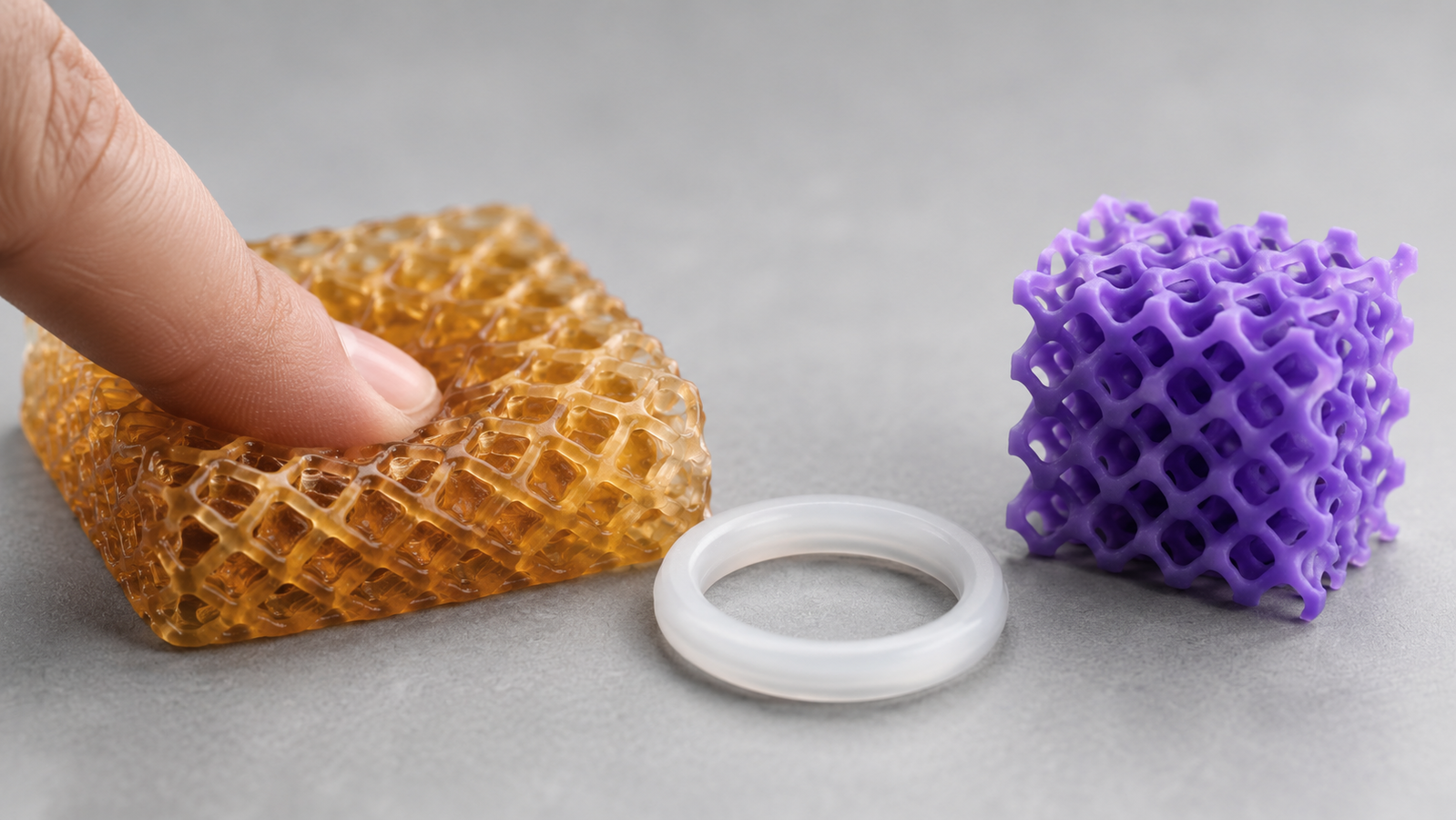
Flexible 3D printing materials span everything from a gummy-soft gel to a skateboard wheel — and choosing among them starts with two questions most datasheets answer badly: how soft, and soft in what way. This guide explains the Shore hardness scales properly, walks through the three material families that dominate flexible printing — TPU, silicones, and photopolymer elastomers — and shows how hardness, elasticity, and process each shape what a printed flexible part can do.1,2
Shore hardness, properly explained
“Shore hardness” is not one scale — the governing standard, ASTM D2240, defines multiple durometer types (twelve in its current editions), and for most flexible-printing discussions the three encountered most often are: Shore 00 for gels and very soft foams, Shore A for rubbers and elastomers, and Shore D for hard rubbers and semi-rigid plastics. Each is an empirical indentation test — a standardized point pressed into the material under a specified force — intended primarily for specification and quality control.3
Three facts prevent most specification mistakes. First, the scales overlap: a material near the upper end of one scale can also produce a usable reading near the lower end of the next, so the same material can carry two different-looking numbers — and these overlap regions are approximate, not universal conversions. Second, readings from different durometer types are not interchangeable: Shore scales have no exact universal conversion, because indenter geometry, spring force, viscoelasticity, specimen thickness, and test conditions all differ. Third, and most important for engineers: hardness is not stiffness. A durometer reading correlates loosely with elastic modulus for similar chemistries, but two materials with identical Shore A values can behave very differently in tension, tear, and rebound — hardness tells you how the surface resists a point indenter, not how the part carries load.3,4 On a drawing, a competent flexible-part callout therefore reads like “65 ± 5 Shore A per ASTM D2240” — value, tolerance, scale, and method — because durometer readings drift with specimen thickness, dwell time, and temperature, and the standard itself describes the test as empirical and intended for control purposes. For orientation on the softest scale: a gel insole sits around 30–50 on Shore 00, a gummy candy near the bottom of it, and by the time a material reads usefully on Shore A it has left the gel world entirely.3
Beyond hardness: the four axes that actually matter
Flexible parts fail and succeed on properties a durometer never sees.4 Elongation at break sets how far the material stretches before failing — printed elastomers commonly span from under 100% to several hundred percent depending on family and grade. Tear strength governs survival at notches, thin webs, and lattice nodes, where flexible parts actually die. Compression set measures how much a squeezed part fails to spring back after sustained load — the make-or-break number for seals and gaskets. And resilience versus damping (rebound and hysteresis) decides whether a lattice feels springy like a running-shoe midsole or dead like a vibration mount — both are legitimate design targets, in opposite directions. Temperature sits under all four: elastomers stiffen dramatically near their glass transition and relax when hot, so a “65A” part is only 65A near room temperature. Anchors help: a rubber band stretches several hundred percent (elongation), a notch in a balloon is fatal while a tire shrugs off gravel (tear strength), an old mattress that stays dented has failed in compression set, and the difference between a bouncy ball and a lump of clay is resilience versus damping. Every flexible application weights these four differently — write the weighting down before touching a material list.
Family 1: TPU — the flexible workhorse
Thermoplastic polyurethane is the most widely printed flexible material because it rides two mature processes. As FDM filament, many widely used TPU grades fall around Shore 85A–95A — substantially softer filament grades exist but are generally harder to feed, constrain, and print consistently — and TPU prints economically on ordinary hardware; if you are still weighing the printing routes themselves, our FDM vs SLA vs SLS comparison covers them head-to-head — coarser detail and slower speeds than rigid filaments, but honest abrasion resistance and toughness.5 As SLS powder, TPU produces flexible parts with relatively balanced directional behavior — normally with no separately printed support structures — whose quality traces to powder characteristics and thermal history — the materials-science literature on TPU sintering (flow, melt rheology, shrinkage, particle shape) is unusually direct about what makes a grade printable.6,7,8,9 The same powder-bed family extends to MJF, which also processes selected TPU grades; comparative PA12 studies explain the shared powder-bed architecture and its thermal logic, but TPU-specific material and process data — not PA12 results — are the evidence that counts for elastomer performance.10,11 TPU’s character: durable, abrasion-resistant, moderately damped — the pragmatic choice for grips, protective housings, belts, and flexible hinges. Two practicalities save TPU projects: filament is hygroscopic, so dry it before printing or watch surface quality and elongation degrade; and because many accessible grades cluster around 85A and up, a part that must feel softer than the material usually gets there through geometry — thinner walls, ribs, or lattice infill — rather than through an exotic soft grade.
Family 2: Silicones — the temperature and chemistry specialists
True silicones (polysiloxanes) bring what organic elastomers struggle to match: service across a wide temperature window, excellent chemical and UV stability, low compression set — and certain medical-grade silicone systems carry long histories in biocompatible applications, though any printable formulation must still be qualified independently for composition, cure chemistry, extractables, sterilization, and the intended regulatory use. Printing them is the hard part — silicones are thermosets, so they cannot be melted like TPU or photocured like acrylate resins in the same way; additive routes center on extrusion / direct ink writing of viscous silicone pastes with thermal or UV-assisted curing, plus specialized jetting and vat approaches, an area the review literature maps thoroughly.12 Printed silicone is a leading candidate when the part must seal hot, stay rubbery cold, or sit against skin in research prototypes — subject to the qualification above — with the caveat that fine lattice detail and throughput generally trail photopolymer routes.12 Within silicone printing, the chemistry does the heavy lifting: most systems use addition-cure (platinum-catalyzed) formulations, cured thermally or UV-assisted, and very soft geometries are often printed into a support bath or with co-printed support material to hold shape until cure — details that decide whether a design is printable long before hardness enters the conversation.12
Family 3: Photopolymer elastomers — the fine-detail route
Photopolymer elastomers are rubber-like resins cured layer by layer in vat photopolymerization — and they are why flexible printing stopped meaning “squishy prototypes.” Modern formulations reach elongations of several hundred percent while printing the fine, smooth features DLP is known for; the landmark chemistry work demonstrated highly stretchable UV-curable elastomers precisely for DLP-class printers.13,14 Continuous-interface printing extended the same family toward higher throughput, making it one commercially important route for fine elastomer lattices, including footwear midsoles and compliant structures.15 This is the family that made lattice-first design practical in elastomers: unit cells small enough to tune feel zone by zone, skins smooth enough to touch, and the soft-robotics literature runs on exactly this capability.16 It is also the family our own elastomer 3D printing service runs, on industrial DLP from Shore 60A to 80A up to 768 × 432 × 450 mm. Post-processing discipline matters: washing and post-cure set final properties, and standard photopolymer caveats about aging apply unless grades are formulated otherwise.14 The design payoff is zone tuning: one build, one resin, and a midsole-class part whose heel reads soft, arch reads supportive, and forefoot reads springy — purely by grading the lattice, regional response that a homogeneous molded part can only approximate with inserts, multi-density assemblies, or added tooling.
The three families, side by side
Swipe horizontally to compare all columns →
| TPU (FDM / SLS) | Silicone (extrusion/DIW) | Photopolymer elastomer (DLP) | |
|---|---|---|---|
| Typical hardness window | ~80A–95A common; softer grades exist | Very soft to ~70A, incl. sub-A gels | Formulation-dependent; ACS service range 60A–80A |
| Fine lattice detail | Limited (FDM) to moderate (SLS) | Moderate; strand-based geometry | Excellent — the lattice-first route |
| Elastic character | Tough, abrasion-resistant, damped | Very elastic, low compression set | Tunable; resilient lattice behavior |
| Temperature window | Moderate | Widest of the three | Moderate; grade-dependent |
| Supports | FDM: printed supports; SLS: normally no separately printed supports | Often printed or bath-supported | Printed, removed after cure |
| Signature strengths | Durability per dollar | Chemistry, heat, qualified skin-contact formulations | Detail, smooth skins, zone-tuned lattices |
| Watch out for | Detail limits; moisture-sensitive filament | Throughput, fine detail, equipment rarity | Post-cure discipline; grade-dependent aging |
Terminology follows ISO/ASTM 52900; entries are qualitative synthesis of the family sections and references in this article, with material jetting’s rubber-like digital materials widely used for visual, ergonomic, and functional prototypes — including multi-material, variable-durometer models — while long-term durability remains highly grade-dependent; the full seven-family process map lives in our 3D printing overview guide.17,18
Choosing by application
Seals and gaskets reward low compression set — silicone often leads, TPU suits abrasive duty, and elastomer DLP is a strong candidate when the seal is also a complex geometry. Grips, handles, bumpers are a common TPU fit: durable, economical, hardness in the 80–95A comfort zone. Cushioning and midsole-class lattices favor photopolymer elastomers, where unit-cell design does what foam density used to do.16 Soft robotics splits by function: pneumatic bodies and skins lean silicone; fine compliant mechanisms and structured lattices lean elastomer DLP.2,16 Wearables and skin-adjacent research prototypes often start from a qualified silicone formulation or dedicated skin-safe grades, subject to the required biological and regulatory evaluation — and any real product takes its material through the application’s own qualification, not a blog’s. Two more rows worth naming: vibration isolation and dampers favor damped TPU grades or tuned lattices over bouncy resins; footwear and padding is a signature elastomer-DLP application — lattice midsoles graded zone by zone — with TPU lattices by SLS as the durable batch alternative.16
Explore the Shore scales interactively
The explorer below puts everyday objects on the three scales at once — pick an object, see where it sits on Shore 00, A, and D, and which printable families reach that feel. It is a teaching tool for the scales themselves; grade-level selection belongs in an engineering conversation.
Design notes for flexible parts
Flexible design is co-design: material and geometry choose each other.19 Wall thickness moves perceived stiffness faster than a Shore grade swap; below process minimums, thin flexible walls tear at handling rather than in service. Lattices multiply the design space — the same 70A resin can feel like three different materials at three relative densities — and holding that behavior batch to batch depends on process discipline, from powder condition in SLS to wash-and-cure consistency in DLP.20 Dimensional expectations differ from rigid parts too: soft parts deform under their own measurement, so tolerance conversations reference function and fit rather than caliper heroics.21 Housekeeping rules of thumb: every enclosed lattice needs drainage/escape openings (resin or powder must leave), sharp internal corners are tear starters (radius them), and the softer the grade, the more support removal itself becomes a design constraint. How lattice topology and relative density control effective stiffness is a story of its own.
FAQ
1. What is the softest material you can 3D print?
Printed gels and specialty silicones reach the Shore 00 range — softer than a gel insole — while many mainstream flexible-AM service grades fall within roughly Shore 60A–95A — substantially softer and firmer specialty systems exist on both sides. Below ~50A, handling, support removal, and tear resistance become the real constraints, not printability alone.3,12
2. TPU vs silicone — which should I choose?
TPU for durability per dollar, abrasion, and easy sourcing across FDM/SLS; silicone when temperature range, chemical stability, low compression set, or access to a suitably qualified skin-contact formulation leads the requirement list. For very fine visible lattice detail, photopolymer elastomers by DLP can offer the advantage.6,12,13
3. What is the difference between Shore A and Shore D?
Different durometer types for different stiffness regimes: A for rubbers and elastomers, D for hard rubbers and semi-rigid plastics, with an approximate overlap region between the top of A and the bottom of D. They use different indenter geometries and forces, so values do not convert exactly — always state the scale.3
4. Can FDM printers really print rubber?
They print rubber-like TPU — a thermoplastic elastomer — very serviceably, especially at 85A and up. True vulcanized rubber and thermoset silicones need different routes (silicone extrusion/DIW, or molding). For most flexible prototypes, TPU on FDM is the honest budget answer.5
5. Which flexible material is cheapest?
TPU filament on FDM for one-offs; TPU on SLS becomes efficient in nested batches; photopolymer elastomers price like premium resin parts and pay it back in geometry that can be difficult or uneconomical for many other flexible-printing routes; silicone printing remains the specialist option priced accordingly. As always, compare at your real quantity and geometry.22
References
This article is provided by ACS Material LLC for educational purposes. Hardness windows, property ranges, and family characterizations are typical of each material class in general; published values are supplier-reported typicals, not design allowables, and skin-contact, medical, or food applications require qualification under the applicable regulatory framework regardless of material pedigree. ACS Material operates an elastomer DLP printing service (Shore 60A–80A); coverage of TPU and silicone routes here is educational. The interactive explorer is a schematic teaching tool for the Shore scales, using approximate everyday anchors. Sample images are representative.